
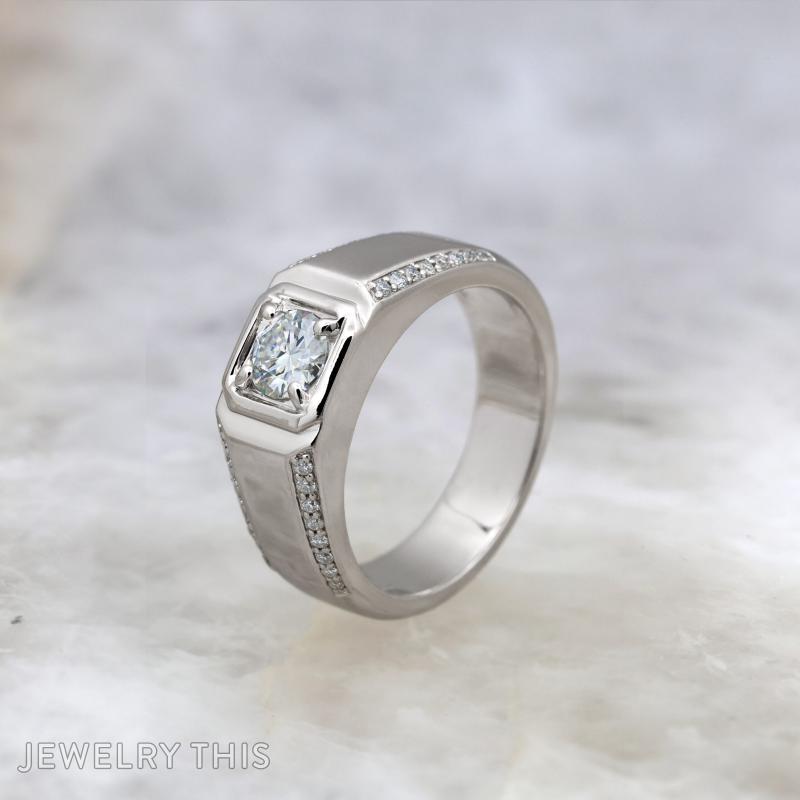


Men's White Gold Engagement Ring — Soft-Square Pave Sides
$$
14k white gold, moissanite, diamonds
A client set out to design an engagement ring for a partner who wanted something masculine but not oversized — flashy without the bulk common in many men's rings. Working through several rounds of feedback on the top size, stone arrangement, and band shape, the two of them landed on a soft-square silhouette with a bezel-set center stone and pave accents down the band. When it was finally delivered, the client wrote: 'It looks amazing! Absolutely perfect!' — and later added that their partner was in love with it.
'It looks amazing! Absolutely perfect! Thank you so much! I'm so excited to give it to my partner.' — on delivery
Quick specs
Design type
Primary Metal
Shape / Cut
Primary Stone
Accent Stones
Style
Design Complexity
Intent: Certainty
Size
Ring size 5.25 US (15.9mm).
How they made it distinctive
-
01
Bezel setting chosen for the center stone to keep the profile secure and low-key rather than flashy prongs
-
02
Soft-square top shape specifically requested — not a sharp, boxy square — for a more wearable masculine look
-
03
Pave diamonds run partway down both sides of the band rather than wrapping fully around, balancing detail with a cleaner look
-
04
Band profile changed from concave to flat-sided mid-design after client feedback, giving the ring a more substantial feel
-
05
Moissanite chosen for the center stone to maximize brilliance and durability within the budget
How you'd make it yours
Stone: this piece uses a moissanite center stone; a new commission could use a lab diamond or natural diamond for a different look and price point
Metal: this piece is 14k white gold; the same soft-square design language works in yellow gold or platinum
Top size: this piece uses a small-to-medium top profile; a new commission could go larger or smaller depending on hand size
Pave coverage: this piece has pave stones partway down the band; a new piece could extend coverage fully around or reduce it to a single row
Engraving: the inside of the band can carry a date, initials, or short phrase on a new piece
One of a kind: this exact ring was designed for one client's partner and is not reproduced — a new commission is an original piece inspired by this one, not a copy
Design changes made
The band profile was changed from concave to flat-sided after the client reviewed the first render and said they weren't a fan of the concave look. The overall top shape and stone arrangement matched the client's brief from the start.
Who this is for
This piece is for someone designing a ring for a partner who wants a bold, masculine look without an oversized top or heavy hands-on-the-table presence. It's especially right if you're working within a defined budget and want a design that reads as substantial and flashy while still fitting comfortably on a smaller hand.
How it's made
Once the design was approved, a 3D-printed resin model was produced first — the physical preview of the ring before any metal was involved. That model was affixed to a wax tree, invested in plaster, and fired in a kiln to burn out the wax and leave a hollow mold. Molten 14k white gold was then cast into the mold under pressure, cooled, and extracted as the raw ring form.
After casting, the ring was cleaned and polished to bring out the white gold's finish across the flat band sides. The bezel around the center stone was finished to sit flush and secure, and the pave diamonds were set by hand in rows along both sides of the band, following the soft-square top's contour. The center stone was set last, once the bezel and pave work were complete.
Key note
The band's flat-sided profile was a mid-design correction — the piece was originally modeled with a concave profile before being reworked to flat sides at the client's request.
Pricing guidance
A men's-style engagement ring with a bezel-set center stone and pave band accents in 14k white gold sits in the mid range for custom engagement work of this complexity. Most of the cost comes from the labor of hand-setting pave stones along the band and finishing the bezel, rather than the metal itself. Stone choice and the amount of pave coverage are what move the price most from there.
Moves price up ↑
- ↑ Upgrading the center stone from moissanite to natural diamond
- ↑ Extending the pave setting fully around the band instead of partial coverage
- ↑ Increasing the size of the center stone
- ↑ Adding a two-tone metal combination for contrast
- ↑ Upgrading to platinum instead of white gold
Moves price down ↓
- ↓ Reducing the pave stone count or coverage along the band
- ↓ Choosing a smaller top profile with less bezel surface to finish
- ↓ Using a single row of accent stones instead of a wider pave band
- ↓ Selecting a simpler band shape without the soft-square geometry
- ↓ Choosing all lab diamonds at a lower total carat weight than the current design
Questions people ask
Yes, moissanite has more brilliance and fire than a natural diamond due to its higher refractive index, so it often reads as flashier under light. It's also significantly harder than most gemstones, ranking 9.25 on the Mohs scale versus a diamond's 10, making it very durable for daily wear. For a bezel-set center stone like this one, moissanite holds up well against everyday knocks since the bezel itself protects the stone's edges. It's a common choice for clients who want a bold look without the cost of a natural diamond.
A bezel setting surrounds the stone with a continuous rim of metal, holding it in place without prongs sticking up above the stone's surface. This makes it more resistant to snagging and better suited to an active lifestyle or a more understated masculine look. A prong setting exposes more of the stone but has thin metal claws that can catch on clothing or gloves over time. For a ring designed to feel solid and low-profile, a bezel setting is generally the more durable and practical choice.
A ring like this — a bezel-set center stone with pave diamonds running down both sides of a soft-square band in 14k white gold — typically falls in the mid range for custom engagement work. The main cost driver is the labor involved in setting many small stones by hand along the band, not just the metal or center stone. Total cost varies significantly based on whether the center stone and accents are lab-grown, moissanite, or natural, and how much of the band is covered in pave stones.
The full process from approved design to finished ring typically takes about five to six weeks. The first week covers the sketch, 3D model, and rendered design for approval, including any adjustments the client wants to make. Once the design is approved and paid, production — casting, polishing, and stone setting — takes roughly three to four weeks. Shipping adds a few more days depending on the destination.
Most rings with a flat-sided band and pave stones only partway down the sides can be resized within a modest range, typically one size up or down, without disturbing the stone setting. Because the pave accents on this design stop partway down the band rather than wrapping all the way around, a jeweler has room to work with on the plain portion of the shank. Larger resizes may require more significant rework and should be discussed with a jeweler beforehand. It's best to confirm the ring size carefully before production to avoid needing a resize at all.
White gold is an alloy that includes rhodium plating to achieve its bright white finish, which will need periodic re-plating over the years as it wears, especially on high-contact areas. Platinum is naturally white, more durable, and doesn't require replating, but it's noticeably heavier and typically a higher-cost option. For a ring with a bold, chunky top like this one, platinum's added weight can actually enhance the substantial feel some clients want in a men's design. White gold remains the more common choice for balancing look, weight, and cost.
In most bezel-set designs, the center stone can be swapped by a jeweler, though the process requires opening and re-closing the bezel, which is more involved than adjusting a prong setting. It's generally best to have this kind of stone swap done by the original jeweler or someone experienced with bezel work to avoid damaging the setting. If a natural diamond upgrade is planned for the future, it helps to confirm the exact stone dimensions in advance so the bezel can accommodate it. This kind of upgrade is a common request as budgets or preferences change over time.
Explore Similar Creations
Every masterpiece starts with a spark. Explore how our clients raw ideas - sketches, heirlooms, inspirations - were transformed into bespoke works of arts.
This Yellow gold wedding set is a loving recreation of a cherished original piece that ...

Celebrate your love story with this captivating pair of 14karat Rose gold rings. The engagement ...

This elegant white gold engagement ring features a stunning princess cut moissanite center stone. The ...

This engagement ring centers a 7x5mm oval amethyst in a four-prong setting, flanked on each ...
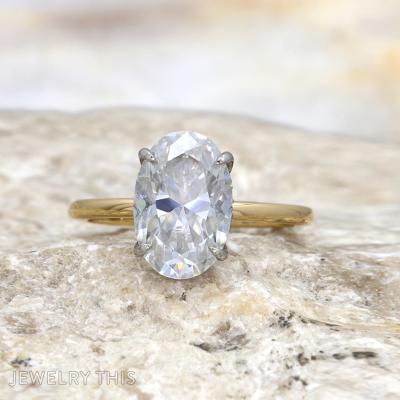
This engagement ring centers a large oval moissanite, chosen for its brilliance and elongated shape, ...
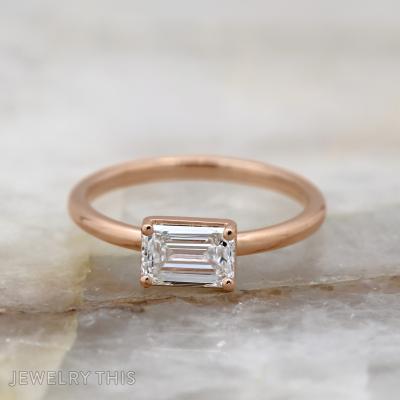
This Rose gold solitaire ring is a timeless symbol of elegance and grace. This ring ...

This custom wedding band is a sentimental recreation of the original ring, bringing back cherished ...

Elegance and sophistication converge in this platinum ring where a magnificent large Aquamarine takes center ...

This Rose gold ring is a captivating expression of sophistication. Adorning the top portion of ...
This meaningful yellow gold engagement ring showcases a beautiful combination of heirloom stones, thoughtfully incorporated ...
This engagement ring pairs a bold elongated oval center diamond with a softly split yellow ...

This engagement ring pairs a 1.05-carat oval lab-grown diamond with two symmetrical clusters of accent ...