
Recreated Gold Eagle Pendant — Family Heirloom Restored
$$$
10k yellow gold
K. came to us after a gold eagle pendant that had been a family heirloom was stolen, with only photographs left to work from. He worked with the design team through several sketch rounds to get the details right, down to a small ring held in one talon that had to be preserved from the original. When it was finished, he wrote that he couldn't wait to see it in person.
Quick specs
Design type
Primary Metal
Primary Stone
Accent Stones
Design Complexity
Intent: Certainty
Size
Pendant approximately 2in total length. Hollow-back construction.
How they made it distinctive
-
01
Recreated entirely from photographs after the original family heirloom was stolen, with no physical piece to reference
-
02
Small ring held in the right talon preserved specifically because it was part of the original pendant
-
03
Dense, dimensional feather texture across both wings and body rather than a flat silhouette
-
04
Hollow-back construction keeps the piece wearable despite the full wingspan design
-
05
Pose refined through multiple sketch rounds so the eagle appears to actively grip the ring rather than simply wear it
How you'd make it yours
Bird subject: this piece depicts an eagle; a new commission could recreate a different bird or animal from reference photos
Metal: this piece is 10k yellow gold; the same sculptural design language works in 14k gold, white gold, or sterling silver
Size: this piece is sized close to a quarter at the body with an extended wingspan; a new piece can be scaled up or down
Held element: the small ring in the talon was specific to this client's original piece; a new commission could include a different held object or omit it
One of a kind: this exact pendant was designed for one client from their own reference photos and is not reproduced — a new commission is an original piece inspired by this one, not a copy
Design changes made
The client asked for a small ring around the back foot to be added after the first sketch, since it had been part of the original pendant. The final version was refined further to show the eagle actively holding the ring in its talon rather than just wearing it as a loop.
Who this is for
This piece is for someone who lost something that mattered and wants it back, even without the physical original to work from. It's especially right if you have old photos of a piece and are willing to go through a few rounds of review to get small details exactly right.
How it's made
Once the design was approved, a wax model of the eagle pendant was 3D printed and attached to a wax tree inside a flask. The flask was placed in a kiln, where the wax was burned out to leave a hollow mold in its place. Molten 10k yellow gold was then poured into that mold, cooled, and extracted as the raw casting.
After casting, the piece was cleaned and polished to bring out the dimensional feather texture across the wings and body without losing the fine detail lines. The bail and the ring held in the talon were cleaned up by hand to keep those smaller connected elements crisp, and the back of the pendant was finished hollow to keep the overall weight manageable given the size of the wingspan.
Key note
The pendant is cast hollow-backed specifically to keep its weight reasonable, since the full wingspan design would otherwise carry significantly more metal than a flat or solid-backed pendant of the same size.
Pricing guidance
A dimensional gold eagle pendant with this level of feather texture and a hollow-back construction sits toward the higher end of pendant pricing for 10k gold. Most of the cost comes from the labor of hand-finishing the wing and feather detail and from the gold content itself, since the wingspan extends the piece well beyond a simple round pendant. Metal karat and the extent of surface detail are what move the price most from there.
Moves price up ↑
- ↑ Upgrading from 10k to 14k or 18k gold, which increases material cost substantially
- ↑ Adding stone-set eyes or accents to the design
- ↑ Increasing the overall size or wingspan beyond what was made here
- ↑ Requesting a solid (non-hollow) back, which adds significant gold weight
Moves price down ↓
- ↓ Reducing the level of feather texture detail to a smoother, more simplified silhouette
- ↓ Choosing a smaller overall pendant size
- ↓ Using gold-plated silver instead of solid 10k gold
- ↓ Omitting secondary details like the held ring element
Questions people ask
Yes, a piece can be recreated from photographs alone, though the process typically starts with a sketch to confirm proportions and details before moving to a 3D model. Additional angles or reference photos help capture small details like texture and specific poses. The final result is a faithful interpretation based on what's visible in the images, refined through review rounds with the client. Minor differences from the original piece are normal since the recreation is built from photo reference rather than the physical item.
A hollow-back pendant is still solid gold on the front and sides, with only the interior cavity left open to reduce weight. This construction is common for larger dimensional pieces like animal or figural pendants, where a fully solid back would make the piece uncomfortably heavy. As long as the walls are cast to standard thickness, hollow-back pendants hold up well to normal daily wear. They are just slightly more delicate to deep structural damage than a fully solid piece, though this is rarely an issue in practice.
A dimensional, textured pendant like an eagle with full wingspan in 10k gold falls toward the higher end of pendant pricing because of the labor involved in hand-finishing detailed surface texture and the gold content required for a piece this size. Karat choice has a significant effect on price, since gold cost scales with both weight and purity. Simpler or smaller designs in the same style would cost less, while upgrading metal or adding stones would increase it further.
The design phase, including sketch review and a 3D render for approval, typically takes about a week, though more detailed pieces can take slightly longer. Once the design is approved and production begins, casting and finishing generally take three to four weeks. The full timeline from deposit to shipping is usually five to six weeks total, though it can vary if a client needs extra time between design and production stages.
10k gold is a durable, practical choice for a pendant with this much surface detail, since its higher alloy content makes it harder and more resistant to wear than higher-karat gold. It has a slightly less saturated yellow color than 14k or 18k gold but holds up well to daily wear and handling. It's a common choice for pieces that prioritize durability and detail retention over a deeper gold tone. 10k is also less expensive by weight than higher karats, which matters on a larger dimensional piece like this one.
Yes, the pendant itself is designed and priced separately from any chain. Many clients already own a chain they'd like to reuse, so the pendant is typically built with a bail sized to accommodate a standard chain width. If a new chain is wanted, it can be added as a separate item at an additional cost. It's worth confirming the bail opening size in advance if you plan to use a specific existing chain.
Yes, small added elements like an object held in a claw or talon are a common way to preserve a specific detail from an original piece or add personal meaning. These details are typically worked out during the sketch phase, where the design team can show a few variations of how the element could be incorporated. They do add a small amount of additional hand-finishing work, but they don't significantly change the overall production timeline. It's best to flag any small details like this early, since they're easier to build into the 3D model from the start.
Yes, the same sculptural approach to feather texture and wing detail can be applied to other birds or animals, and the piece can be cast in other metals like 14k gold, white gold, or sterling silver. Changing the animal would require a new sketch and design phase, since the proportions and pose are specific to the reference used. Metal choice mainly affects cost and color rather than the production process itself.
Explore Similar Creations
Every masterpiece starts with a spark. Explore how our clients raw ideas - sketches, heirlooms, inspirations - were transformed into bespoke works of arts.
This pendant centers a round lab-grown emerald inside a cushion-shaped double halo of small round ...
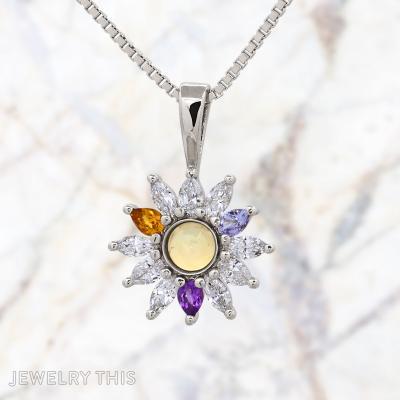
This exquisite white gold pendant is a wearable sunburst, centered by a luminous round opal ...

Inspired by the essence of enduring love and shared milestones. This pendant was designed and ...

Embrace the beauty of personalized elegance with this custom pendant—a tribute to cherished moments and ...

This custom pendant is an elegant intertwining of the parent’s initials, “VS”. At its heart ...

This unique and special 14k yellow gold pendant features the adoption symbol on a round ...

Embrace the whimsical charm of this custom bird pendant. Meticulously crafted from 18k yellow gold, ...

14k yellow gold rectangular pendant featuring the mantra “Just Grace” Pendant: 1.5 inches long
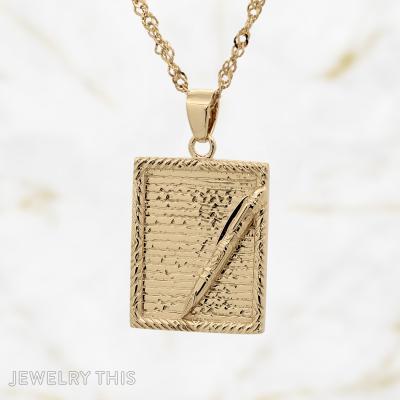
This pendant takes the shape of a written page — a rectangular cut-out frame bordered ...
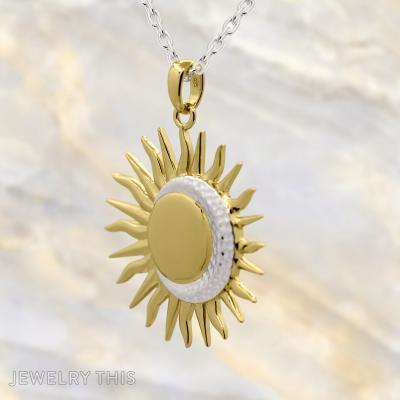
Celebrate celestial beauty with this 1.25-inch necklace, harmonizing a hammered silver moon and a radiant ...

This gold pendant is of regal elegance as it represents nobility of the Onitsha kingdom. ...
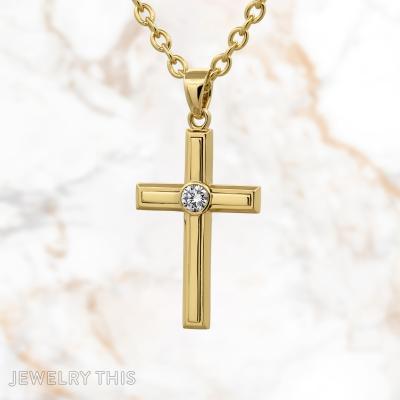
This cross pendant was built around a single bezel-set lab diamond centered at the crossbar, ...