


Dragon Claw Pendant Recreation — Blue Topaz Orb
$$$
14k white gold, black rhodium plating, sky blue topaz
L. had a dragon-claw pendant with a blue glass orb that came loose from its setting and shattered on the floor. Wanting to recreate it without the skin irritation she gets from sterling silver, she worked through months of stone sourcing to match the exact shade of blue she remembered, eventually landing on a custom-cut sky blue topaz sized specifically so the claws would hold it securely. When she picked it up, she wrote: "The pendant is beautiful! Thank you!"
'I was able to pick up the package. The pendant is beautiful! Thank you!' — on delivery
Quick specs
Design type
Primary Metal
Shape / Cut
Primary Stone
Accent Stones
Design Complexity
Intent: Certainty
Size
Pendant approximately 1 inch (not including bail); 12mm orb bead.
How they made it distinctive
-
01
Claws sized specifically around the scanned dimensions of the custom-cut stone, directly addressing why the original pendant's orb had fallen out
-
02
Two-tone black rhodium and polished white gold finish designed to mimic the oxidized look of the original sterling silver piece without triggering a metal sensitivity
-
03
Webbing added between the talons after the client flagged it was missing from the first render, matching a detail from the original pendant
-
04
Custom-cut sky blue topaz selected after an extended search for the closest match to the original glass orb's color
-
05
Teardrop bail chosen over the original bail style after the client preferred it in an early sketch
How you'd make it yours
Stone: this piece uses a custom-cut sky blue topaz — a new commission could use a different natural stone or a lab-created alternative in another shade of blue or green
Metal: this piece is 14k white gold with black rhodium accents — the same claw design works in yellow gold, rose gold, platinum, or sterling silver with an oxidized finish
Finish: the two-tone black rhodium and polish treatment can be adjusted to a fully polished or fully matte look on a new piece
Bail style: this piece uses a teardrop bail — a new commission could use a different bail shape to suit a different chain
One of a kind: this exact pendant was designed and cast for one client and is not reproduced — a new commission is an original piece inspired by this one, not a copy
Design changes made
The bail was changed from the original design to a teardrop shape the client preferred after seeing it in an early sketch, and webbing was added between the claws after the first render omitted a detail visible in photos of the original piece. The orb was also sized larger than the original specifically so the claws could grip it securely.
Who this is for
This is for someone who had a piece they loved get damaged and wants it brought back — not as an exact copy, but as a sturdier, better-built version that won't fail the same way again. It's especially right if you have a metal sensitivity and need a design solution that still captures the look of an antiqued or oxidized finish.
How it's made
Once the design was approved, a wax model was 3D printed and affixed to a tree for casting. The tree was invested in plaster and fired in a kiln to burn out the wax, leaving a hollow mold, and molten 14k white gold was poured into the mold under pressure to form the raw pendant. The custom-cut topaz bead was ordered and scanned ahead of the final model so the claws could be built to its exact dimensions.
After casting, the piece was cleaned and polished on all raised, smooth surfaces to bring out the white gold finish. Black rhodium plating was then applied over the entire piece and polished away from the smooth outer areas, left intact only in the recessed lines, webbing, and textured details to create a two-tone antiqued effect. The topaz orb was set last, held securely inside the resized claws without need for glue or a pin.
Key note
The gemstone was scanned into the 3D model before the claws were finalized, so the claw dimensions were built around the stone's exact size rather than the stone being fitted to a pre-set claw.
Pricing guidance
A sculptural claw-form pendant with a custom-cut center stone and two-tone metal finishing sits in the mid range for pendants of this complexity. Most of the cost comes from the hand-finishing needed to achieve a two-tone plated-and-polished look and the sourcing of a non-standard custom-cut stone. Metal choice is the next biggest lever on price.
Moves price up ↑
- ↑ Upgrading from 14k white gold to platinum or 18k gold
- ↑ Sourcing a natural stone in an unusual custom cut or size versus a standard cut
- ↑ Adding more intricate surface texture or additional claw/talon elements
- ↑ Choosing a larger overall pendant size, which increases metal weight and finishing time
Moves price down ↓
- ↓ Using a standard, readily available stone size and cut instead of a custom order
- ↓ Choosing sterling silver instead of gold or platinum
- ↓ Simplifying the two-tone finish to a single polish or plating treatment
- ↓ Reducing the sculptural detail (fewer claws, less webbing texture)
Questions people ask
Yes, this is a common request — the original pendant's stone had come loose from its claw setting and shattered, so the recreation started from photos and a careful rebuild of the setting itself. The claws were resized around the new stone to prevent the same problem from happening again. The process typically starts with a sketch, moves to a 3D render for approval, and then into production. Minor differences from the original are normal since the piece is rebuilt from reference images rather than the physical item.
The most reliable method is sizing the stone correctly for the claws in the first place — claws that are too loose around an undersized stone are a common cause of stones falling out over time. Building the claws around the stone's exact scanned dimensions, rather than guessing at a size, ensures a secure grip. Additional options like a dab of adhesive or a small drilled pin can add extra security if requested, though they usually aren't necessary with a properly fitted claw. Damage to the claws themselves, such as bending from an impact, is the most likely way a properly sized stone could come loose.
Natural topaz and lab-created quartz can look very similar in color, but they differ in origin and sometimes in clarity characteristics — lab-created stones are typically grown without the natural inclusions found in mined stones. Both are reasonably durable for pendant wear, though hardness and durability should always be confirmed for the specific stone and cut being considered. Color availability also differs: a specific custom shade may only be achievable in one material or the other. The choice often comes down to personal preference for natural origin versus a specific, more consistent color match.
Black rhodium is a dark plating applied over white gold or silver to create contrast or an antiqued appearance. In a two-tone application, the plating is applied over the entire piece and then polished away from the raised, smooth surfaces, leaving the black finish only in recessed lines, texture, and detail work. This creates a deliberate light-and-dark contrast rather than an all-black finish. Like any plating, it will wear gradually with handling and can be reapplied by a jeweler if it fades over time.
A pendant with this level of sculptural detail, a custom-cut center stone, and two-tone metal finishing sits in the mid range for pieces of this complexity. The biggest cost drivers are the hand-finishing required for a two-tone look and the sourcing or custom-cutting of a non-standard stone. Metal choice — sterling silver versus gold versus platinum — is the next largest factor in the final price.
Sourcing or custom-cutting a stone in a non-standard size typically adds several weeks to the timeline beyond a standard design-and-production schedule, since the stone must be ordered, cut, and shipped before the final model can be built around its exact dimensions. Once the stone is in hand, the design and casting process generally follows a standard timeline of about one week for design and three to four weeks for production. Delays in stone sourcing or shipping are the most common reason a project like this runs longer than a standard piece. Total turnaround for a project with a custom stone is best treated as extended rather than standard.
White gold cannot be chemically oxidized the way sterling silver can, since that antique look comes from the silver's copper content reacting over time. However, a similar visual effect can be achieved by plating the white gold with black rhodium and then polishing it away from the raised surfaces, leaving the dark finish only in the recessed detail. This two-tone technique mimics the look of an oxidized piece without the metal actually tarnishing. It also avoids the skin sensitivity some people experience with sterling silver.
Both hold up well to daily wear but behave differently over time. White gold is harder and holds a high polish shine longer, while platinum is denser and more durable against chipping but develops a soft patina with wear that some people like and others prefer to have re-polished. Platinum is also heavier — often 50% or more heavier than gold — which matters for comfort on a pendant worn often. Either metal can be re-polished by a jeweler if its finish changes over time.
Explore Similar Creations
Every masterpiece starts with a spark. Explore how our clients raw ideas - sketches, heirlooms, inspirations - were transformed into bespoke works of arts.
Sterling silver pendant featuring design 10X. Bail customized to be in shape of a money ...

This custom pendant is a striking rectangle in shape. Crafted from radiant 10k yellow gold, ...

This sterling silver pendant was created to celebrate the pride and spirit of their university. ...

This custom pendant, a miniature mathematical compass, is a tribute to a cherished poem that ...

This captivating 14karat White gold pendant is a blend of nature and balance. This pendant ...

This custom cross pendant is exquisitely crafted from 14k white gold. At its heart, the ...

This logo pendant is a true testament to the one who wears it- the “world’s ...
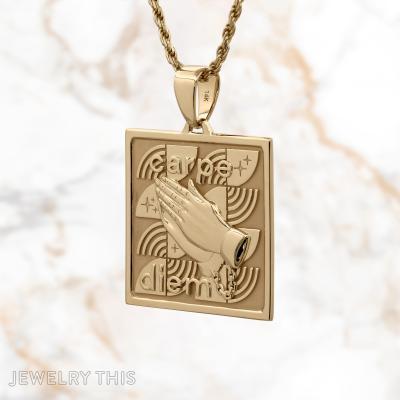
This bold pendant was brought to life from a client’s original design—an inspiring expression of ...

This custom pendant is a beautifully crafted sterling silver key design, making it a symbol ...

This pendant centers a heart-shaped amethyst — a February birthstone — inside a double-outlined heart ...

This 14karat white gold pendant features a small and uniquely shaped rocket ship. The rocket ...

This pendant holds deep personal meaning as a tribute to heritage and family legacy. Known ...



