




3D Molar Tooth Pendant in Solid 14k Yellow Gold
$$$
14k yellow gold
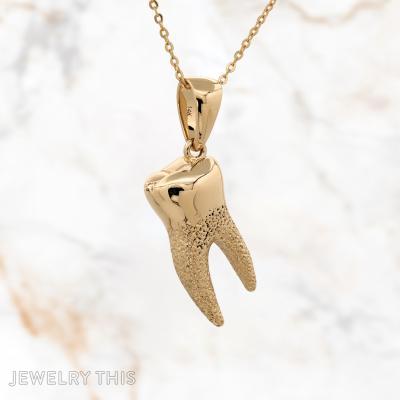
T. came to us wanting a gold molar pendant after loving a smaller version he'd bought elsewhere but wishing it had more size and presence. Through the design process he refined small details himself — moving the bail off-center so the tooth hangs at a slant, smoothing out a groove on the crown, and asking for a rougher, more textured finish on the roots to read as more true-to-life. When it arrived, he wrote: 'Wow!!!! That looks amazing!!! Thank you so much for all your work. I'm super excited!' He later shared that he's a dentist, and his own staff loved seeing it in person.
'This looks awesome! I'm ready to move forward with this design' — on design approval
'Wow!!!! That looks amazing!!! Thank you so much for all your work. I'm super excited!' — on delivery
Quick specs
Design type
Primary Metal
Primary Stone
Accent Stones
Style
Design Complexity
Intent: Certainty
Size
Pendant approximately 25mm (1 inch) length. Bail placed off-center on the edge of the crown. Roots textured/abrasive from a marked line downward; crown polished smooth.
How they made it distinctive
-
01
Fully 3D sculptural form rather than a flat or relief pendant, giving it real weight and dimension in hand
-
02
Bail moved off-center to the edge of the crown specifically so the tooth hangs at a natural slant rather than straight down
-
03
Two contrasting finishes on one casting — polished crown, textured root — to mimic the real visual difference between enamel and root
-
04
Scaled up to about an inch long after the client found a smaller version he'd previously owned too small to make an impact
-
05
Textured root finish made more pronounced than the original reference photo at the client's request, for a more true-to-life look
How you'd make it yours
Metal: this piece is 14k yellow gold; the same design works in 18k yellow gold or white gold for a different tone
Size: this piece is scaled to about one inch; a new commission can be sized larger or smaller
Texture: this piece contrasts a polished crown with a textured root; a new piece could use a single uniform finish or different texture zones
Bail placement: this piece has an off-center bail for a slanted hang; a new commission could use a centered bail for a straight hang
Chain: this piece pairs with a separately sourced chain; a new commission can specify chain style and length independently
One of a kind: this exact pendant was designed and cast for one client and is not reproduced — a new commission is an original piece inspired by this one, not a copy
Design changes made
The bail was moved from the center of the crown to its edge so the tooth hangs at a slight slant rather than straight down, a decorative groove on the crown was smoothed away, and the roots were given a rougher, more textured finish than the reference photo to read as more abrasive and true-to-life.
Who this is for
This piece is for someone drawn to anatomical or medical imagery who wants it rendered as real, substantial jewelry rather than a novelty charm. It's especially fitting for someone in a dental or medical field who wants a piece that nods to their work, or anyone who loved a smaller, mass-produced version of a design and wanted it remade with real weight, real gold, and finishing detail that actually holds up to a close look.
How it's made
Once the design was finalized from the approved 3D render, a wax model was 3D-printed and shared with the client for review before moving to casting. The wax was then attached to a tree inside a flask, invested in plaster, and fired in a kiln to burn out the wax and leave a hollow mold. Molten 14k yellow gold was then cast into that mold under heat and pressure to form the raw pendant.
After casting, the piece was cleaned and separated from the tree, then finished in two distinct zones to match the design: the crown was polished to a high shine, while the root section was given a textured, matte surface to mimic the rougher look of a real tooth root. The bail was positioned off-center along the crown's edge as requested, rather than centered, so the finished pendant hangs at a natural slant on its chain.
Key note
The crown and roots were intentionally finished in two different textures in the same casting — polished above, matte and textured below — to mimic the visual contrast of real tooth enamel versus root.
Pricing guidance
A fully three-dimensional sculptural pendant like this sits in the mid range for custom pendant work. Most of the cost comes from the 3D modeling and hand-finishing needed to render a recognizable anatomical shape convincingly in solid gold, plus the gold content itself at this scale. Metal karat and size are the two biggest levers on price from there.
Moves price up ↑
- ↑ Increasing the pendant size beyond roughly an inch in length, which adds significant gold weight
- ↑ Upgrading from 14k to 18k gold, which increases material cost per gram
- ↑ Adding gemstone accents or inlay work to the crown or roots
- ↑ Requesting a more intricate multi-texture finish across additional surface zones
Moves price down ↓
- ↓ Reducing the pendant to a smaller, more charm-like scale
- ↓ Choosing 10k gold instead of 14k or 18k
- ↓ Simplifying the design to a flatter, less dimensional relief rather than fully 3D
- ↓ Leaving the surface in a single uniform finish rather than two contrasting textures
Questions people ask
Yes, a fully three-dimensional pendant like a molar tooth can be cast in solid 14k or 18k gold using standard lost-wax casting. The process starts with a 3D-printed wax model built from an approved digital render, which is then invested and cast in molten gold. This produces a solid, dimensional piece rather than a flat or hollow stamped shape, giving it real weight and presence.
A length of about one inch, roughly the size of a quarter, is a common sweet spot for a pendant meant to read clearly as its subject rather than disappear as a small charm. At that scale the details — like root texture or surface contouring — remain visible to the eye rather than getting lost. Smaller versions under half an inch tend to read more like a subtle accessory than a statement piece.
14k gold is about 58% pure gold alloyed with other metals for strength and a lower cost per gram, while 18k is about 75% pure gold, which means more gold content and a noticeably higher price for the same design. Both are solid, daily-wear-durable options and neither is plated. The main practical differences are cost and a very slightly richer color in 18k — the structural durability for a pendant of this size is comparable in either karat.
This is done through selective finishing after casting — different sections of the same cast piece are treated with different surface techniques. A polishing wheel or buffing compound creates the high-shine areas, while a textured or matte finish is applied separately to the designated sections, in this case to mimic a tooth root. Because the piece is cast as one solid unit, the metal itself is continuous; only the surface treatment changes by zone.
A fully dimensional sculptural pendant of this size and complexity sits in the mid range for custom pendant work, with the main cost drivers being the 3D modeling and finishing labor plus the gold content at the chosen size and karat. Upgrading karat or increasing the pendant's size are the factors most likely to raise the price. Choosing a smaller size or a lower karat are the most direct ways to bring the cost down.
The design phase, including a sketch, a 3D render, and revisions based on client feedback, typically takes one to two weeks. Once the design is approved and production begins, casting and finishing usually takes another four to six weeks. In total, most custom pendants like this are completed within roughly five to seven weeks from the initial deposit to shipping.
Yes, bail placement can be adjusted during the design phase to change how a pendant hangs. Moving a bail off-center, for example to the edge of a shape rather than its middle, will cause the piece to hang at an angle or slant rather than straight down. This is a design decision made before casting, since the bail is cast as part of the piece rather than added afterward.
Yes, if you provide clear photos of your existing chain and clasp next to a ruler or coin for scale, the bail opening on a new pendant can be sized to fit that chain properly. This avoids the common problem of a bail that is too small for a thicker existing chain or too loose for a delicate one. It's also possible to order a new chain at the same time if you'd rather have one made to match the pendant.
Check what our clients say about us

Tim Sebreros
2 years ago
I love the pendant! I’m a dentist so I was able show my staff and they loved it as well! Thanks so much!
Explore Similar Creations
Every masterpiece starts with a spark. Explore how our clients raw ideas - sketches, heirlooms, inspirations - were transformed into bespoke works of arts.
This flavorful custom jewelry necklace is a unique piece that was created as a gift ...

A 14k yellow gold cat pendant with dimensional details and a sand blasted background. There ...

This custom pendant pays homage to Artemis, the revered goddess of the hunt. It was ...

This yellow gold pendant features a unique combination of religious and spiritual symbols. A cross ...

Crafted with meticulous attention to detail, this custom pendant is a true testament to elegance ...

This round sterling silver pendant combines Celtic knotwork with a nod to Chicago through its ...

This custom pendant is a beautiful and sentimental tribute to a beloved daughter. Measuring 1 ...

This 5 heart pendant is a heartfelt tribute to family bonds, meticulously crafted with love ...

This exquisite pendant is a masterful blend of Nordic heritage and contemporary craftsmanship, meticulously crafted ...

This custom pendant is a heartfelt tribute to an adoption agency. Crafted in lustrous 14k ...
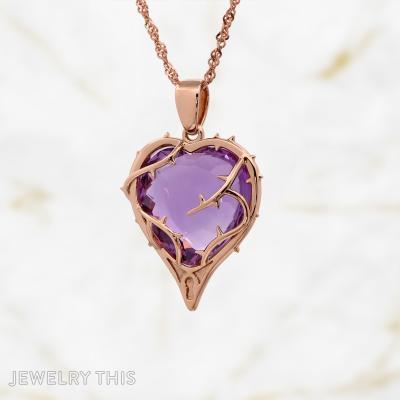
This exquisite heart-shaped pendant captures a unique blend of romantic elegance and gothic allure. Crafted ...

This pendant centers on a round 14k yellow gold disc with two crossed anchors cast ...



