


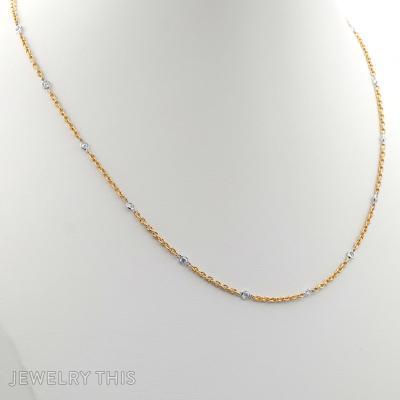

Diamond Station Necklace — Upgraded From Costume Chain
$$$
14k yellow gold, 14k white gold bezels, lab-created diamonds
A client wanted to upgrade a custom piece she already wore and loved — a thin yellow gold-tone chain lined with small silver beads — into something made to last. She asked for the beads to become lab-created diamonds set low and close to the chain, keeping the same delicate feel. When it arrived, she wrote: 'It is beautiful!'
'It is beautiful!' — on delivery
Quick specs
Design type
Primary Metal
Secondary Metal
Shape / Cut
Primary Stone
Accent Stones
Design Complexity
Intent: Certainty
Size
Chain length 18in fixed; diamond stations spaced 1in apart; diamonds 2.5mm each.
How they made it distinctive
-
01
Diamonds set in low-profile white gold bezels to achieve a floating look rather than a raised, prong-set appearance
-
02
Station spacing set at a full inch, wider than the original costume piece's bead spacing, for a more delicate and minimal look
-
03
Diamonds placed continuously around the entire chain rather than only at the front, so the sparkle carries all the way around
-
04
Diamond size increased slightly to 2.5mm during production for better visual proportion against the chain
-
05
Upgrades an existing costume design the client already loved into fine-jewelry materials rather than starting from a new design
How you'd make it yours
Stone: this piece uses lab-created diamonds; a new commission could use natural diamonds or cubic zirconia for a different cost profile
Spacing: this piece uses 1-inch station spacing; a new piece could use tighter or wider spacing for a denser or more minimal look
Metal: this piece is 14k yellow gold with white gold bezels; the same station language works in all-white gold or rose gold
Chain style: this piece uses a cable chain; a new commission could use a different chain style as the base
Clasp: an adjustable length clasp can be built in from the start on a new commission if flexible sizing matters
One of a kind: this exact necklace was designed for one client from her own costume piece and is not reproduced — a new commission is an original piece inspired by this one, not a copy
Design changes made
The diamond size was increased slightly from 2mm to 2.5mm at the jeweler's suggestion after the design was already approved, to improve how the stones would read against the chain.
Who this is for
This piece is for someone who already owns and loves a delicate everyday necklace but wants it to last — the kind of person who wears the same simple piece constantly and is ready to invest in a version that won't tarnish or break down over years of wear. It suits someone who prefers subtle, low-profile sparkle over a bold statement piece.
How it's made
The chain and bezel settings were produced separately before assembly. The 14k yellow gold cable chain was sourced to the confirmed length, while the white gold bezels were cast to hold each round lab-created diamond individually. Lab-created diamonds were sourced and confirmed for fit before the setting process began, ensuring each stone sat correctly within its bezel before being joined to the chain.
Each bezel was polished and finished separately from the chain to keep the settings low-profile and unobtrusive, supporting the floating look the design called for. The diamonds were set into their bezels first, then each finished station was linked into the chain at even intervals around the full circumference, rather than being added only to the front-facing portion.
Key note
Bezel settings for station necklaces are finished before assembly, not after, because polishing individual small settings once they're already linked to a moving chain risks scratching the adjacent links.
Pricing guidance
A station necklace with diamonds set continuously around a gold chain sits in the mid range for necklaces of this type, since each station is cast and finished as an individual unit before assembly. The main cost driver is the number of stations and the labor of setting each stone individually rather than the chain itself. Diamond size and the choice between lab-created and natural stones move the price meaningfully from there.
Moves price up ↑
- ↑ Increasing the number of diamond stations around the chain
- ↑ Upgrading from lab-created to natural diamonds of the same size
- ↑ Increasing individual diamond size beyond 2.5mm
- ↑ Adding a matching bracelet or earrings as a set
- ↑ Using 18k gold instead of 14k for the chain and bezels
Moves price down ↓
- ↓ Reducing the number of stations by widening the spacing further
- ↓ Using a thinner, lighter gauge chain
- ↓ Choosing cubic zirconia in place of lab-created diamonds
- ↓ Sourcing smaller diamonds under 2mm
- ↓ Using sterling silver with gold plating instead of solid 14k gold
Questions people ask
Yes, this is a common request — a client brings in a costume piece they love the design of, and the studio recreates it in precious metal and real stones. In this case, a fake gold chain with small silver beads was rebuilt as a solid 14k gold chain with lab-created diamonds set in white gold bezels. The overall design language stays the same, but the materials are upgraded to something that will hold up over decades rather than tarnish or wear through plating. This approach works well anytime a client has an existing piece they're emotionally attached to but want made properly.
A bezel setting is a continuous rim of metal that wraps around a stone's edge, holding it in place without prongs. On a station necklace, bezels keep each diamond sitting low and close to the chain rather than raised up on prongs, which gives a cleaner, more streamlined look as the stones move around the neck. Bezels are also more secure for stones on a moving chain, since there are no prongs to catch or bend over time. The trade-off is that a bezel does show a small rim of metal around the stone, which affects how visible the stone appears from certain angles.
Lab-created diamonds are chemically and optically identical to natural diamonds — same hardness, same brilliance, same durability for daily wear. For small stones spaced around a necklace, most people cannot tell the difference between lab and natural diamonds without specialized equipment. The main advantage of choosing lab-created stones is cost, since they typically run significantly less than natural diamonds of the same size and clarity. For a piece using multiple small stones like this one, that cost difference can be substantial.
A custom station necklace typically takes about one week for the design phase, including a sketch and a photorealistic render for approval, followed by roughly four to five weeks for production once the design is approved and paid for. Production includes sourcing the stones and chain, casting the individual bezel settings, setting each diamond, and assembling all the stations onto the finished chain. Complex requests, jeweler-recommended adjustments, or high demand can extend this timeline beyond the standard estimate. It's worth asking upfront about current production timelines if you have a firm deadline.
Yes, but the adjustable clasp mechanism typically needs to sit at the very end of the chain rather than woven into the middle, because adding it near the midpoint can disrupt the even spacing of the stations and create an uneven look. If an adjustable length is important to you, raise it clearly at the very start of the design conversation so it can be built into the chain from the beginning rather than added afterward. Retrofitting an adjustable clasp onto an already-finished station chain is possible but is best planned for at the design stage.
On a moving chain, individual bezel-set stations can rotate slightly as the necklace shifts against the neck, which means the back of a bezel can become visible at certain angles rather than always showing the stone face-on. This is a natural characteristic of chains with stones set at intervals rather than fixed to a rigid backing. Choosing a slightly heavier chain gauge or a wider bezel profile can reduce how easily the stations rotate, though some movement is normal for this style. It's a worthwhile question to ask about before production if a consistently forward-facing stone is important to you.
A station necklace has stones spaced out at intervals along the chain, with visible chain links in between each stone, while a tennis necklace has stones set continuously along the entire length with little to no visible chain. A station design is generally lighter, less expensive, and has a more delicate look since less of the piece is stone-covered metal. A tennis necklace requires significantly more stones and setting labor, since every link along the necklace's length holds a stone rather than just periodic points. Both styles can use the same stone types and metals, so the choice comes down to how much visual weight you want the piece to carry.
Yes, station spacing is one of the most flexible parts of this design — it can be tightened for a denser, more sparkling look or widened for a more minimal, delicate appearance. Spacing of around one inch, as used in this piece, gives a subtle, evenly distributed sparkle without the piece feeling stone-heavy. Wider spacing generally means fewer total stones needed, which affects both the look and the cost. This is a detail worth deciding early, since it affects how many stones need to be sourced and set.
Explore Similar Creations
Every masterpiece starts with a spark. Explore how our clients raw ideas - sketches, heirlooms, inspirations - were transformed into bespoke works of arts.
This three-piece set was built to echo a design from an old family photograph: a ...

This ‘Y’ style drop necklace is a timeless and elegant piece. Made from sterling silver, ...

Presenting a heartfelt custom jewelry pendant, a sterling silver necklace that beautifully captures the essence ...

This custom necklace is a beautiful celebration of motherhood and dedication. Crafted in radiant yellow ...

This stunning 14k yellow gold necklace features three lustrous pearls, each graduating in size from ...
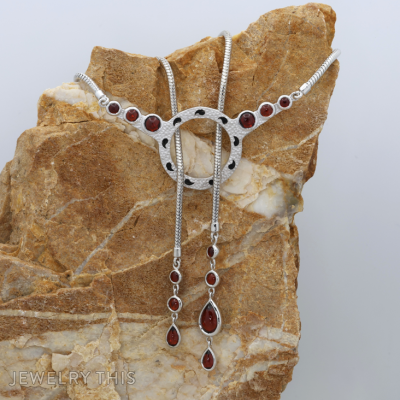
This lariat necklace was built around a circular pierced hoop in sterling silver, textured to ...
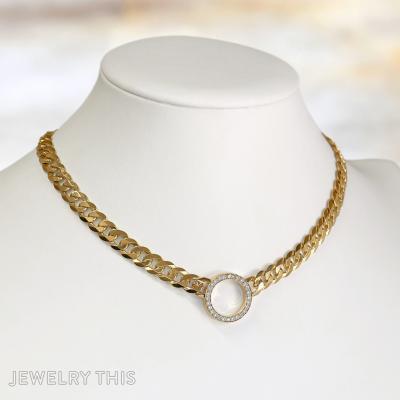
This choker takes the familiar Cuban-link nameplate necklace and simplifies it down to a single ...

This sentimental gold pendant beautifully captures the essence of family through its trio of vibrant ...

This exquisite 14k yellow gold lariat necklace is the perfect gift to show your love ...

This yellow gold necklace is a harmonious blend of spirituality and sophistication. The necklace consists ...

This stunning necklace is a true testament to elegance and sophistication. The strand is composed ...

This 14karat yellow gold necklace embraces both celestial love and the bond between a mother ...



