

Wings & Gavel Ring — Open Wrap Band in White Gold
$
10k white gold
D. wanted a ring that combined two specific symbols — wings and a courtroom gavel — into one open, wrap-style band modeled loosely after a nail-ring silhouette. He was precise about scale from the start, asking that the wings stay confined to about one finger's width so they wouldn't crowd the fingers next to them. When the finished piece arrived, he wrote: 'Thank you so much it looks great! It was nice working with you.'
'It looks perfect thank you!' — on seeing the photorealistic render
'Thank you so much it looks great! It was nice working with you I appreciate your help in the process I can't wait to see it!' — on delivery
Quick specs
Design type
Primary Metal
Primary Stone
Accent Stones
Design Complexity
Intent: Certainty
Size
Ring size 5.5 US (16.31mm referenced at intake).
How they made it distinctive
-
01
Open double-wrap construction modeled after a nail-ring silhouette rather than a traditional closed band
-
02
Wing width deliberately constrained to roughly one finger's span so the sculptural element doesn't crowd adjacent fingers
-
03
Two unrelated personal symbols — wings and a courtroom gavel — combined into a single cohesive layout, wings at top and gavel at bottom
-
04
No plating or color added — the entire piece left in a single polished white-gold tone for a cohesive monochrome look
-
05
Feather texture hand-finished on the wings to give dimensional detail without any stone accents
How you'd make it yours
Metal: this piece is 10k white gold — a new commission could use 14k, 18k white gold, or platinum for a brighter or heavier feel
Wrap structure: this piece uses two loops — a new piece could use a single loop or three loops for a different silhouette
Color detailing: this piece has no added color — a new commission could add black rhodium or enamel to the wings or gavel
Symbol choice: the wings-and-gavel pairing is specific to this client — a new piece could pair any two meaningful symbols in the same top-and-bottom layout
Wing scale: this piece confines the wings to one finger's width — a new commission could widen or narrow that proportion
One of a kind: this exact ring was designed for one client and is not reproduced — a new commission is an original piece inspired by this one, not a copy
Design changes made
The client adjusted the ring size from 5.75 to 5.5 after reviewing the initial model, and the team confirmed a two-loop wrap structure instead of a three-loop option before moving to the photorealistic render.
Who this is for
This piece is for someone who wants a personal or professional symbol worn as a compact, wearable detail rather than a large statement piece. It suits someone who thinks in specific, precise terms about scale and proportion, and who wants sculptural metalwork — not stones — to carry the entire design.
How it's made
Once the two-loop wrap design was finalized and approved from the photorealistic render, the piece moved to wax 3D printing. The printed wax model was attached to a wax tree and set into a flask, which was placed in a kiln to burn out the wax and leave a hollow mold in its place. Molten 10k white gold was then cast into that mold under pressure, producing the raw ring once cooled and removed.
After casting, the ring was cleaned to remove investment residue and prepared for finishing. The feathered wing detail was hand-finished to bring out the individual plume texture, while the gavel's stepped cylindrical profile was polished to a crisp, defined edge. The entire piece — band, wings, and gavel — was then polished to a uniform bright white metal finish, with no plating or secondary color applied, keeping the design monochrome as requested.
Key note
The ring's open, non-connecting wrap structure means the two loops were modeled and cast as a single continuous piece rather than two separate bands joined after the fact.
Pricing guidance
A sculptural wrap-style ring with two dimensional metal elements — wings and a gavel — sits toward the lower end of custom work of this complexity. Most of the cost comes from the technical drawing and 3D modeling time needed to translate two distinct sculptural motifs into a wearable open band, rather than from materials, since no stones are involved. Metal choice is the biggest lever on price from there.
Moves price up ↑
- ↑ Upgrading from 10k to 14k or 18k white gold, or to platinum
- ↑ Adding a third wrap loop instead of two
- ↑ Adding black rhodium or enamel color detailing to the wings and gavel
- ↑ Increasing the wing width beyond a single finger's span, requiring more metal and modeling time
- ↑ Adding stone accents to the gavel or wing details
Moves price down ↓
- ↓ Reducing the design to a single sculptural element instead of two (wings only, or gavel only)
- ↓ Using a single-wrap band instead of a double-wrap
- ↓ Simplifying the feather texture on the wings to a smoother, less detailed finish
- ↓ Choosing sterling silver instead of white gold
Questions people ask
Yes, open wrap-style rings — modeled after styles like the Cartier nail ring — are a common custom request. The band is designed with a deliberate gap so it doesn't form a closed circle, and in a multi-loop version like this one, the loops are modeled and cast as a single continuous piece rather than assembled afterward. This gives a relaxed fit that sits slightly differently than a traditional closed band. The open design also makes minor fit adjustments easier since there's some flexibility in how it sits on the finger.
10k white gold contains the lowest percentage of pure gold allowed to be called gold in the US — about 41.7% — with the rest made up of alloy metals for strength. It's more durable and scratch-resistant than higher karats because of that higher alloy content, and it's typically the most affordable gold option. 14k and 18k contain progressively more pure gold, which means a warmer tone before rhodium plating and a higher cost, but slightly less resistance to scratching. All three can be rhodium-plated to maintain a bright white finish over time.
White gold is typically rhodium-plated to achieve its bright white color, and that plating can wear thin with daily contact, especially at points where the ring rubs against other surfaces. This piece was left in its natural white gold tone without additional rhodium plating specified, so any color shift over time would come from the base alloy itself rather than plating wear. Either way, a jeweler can re-polish or re-plate a white gold piece as needed to refresh its appearance. How often that's needed depends on how frequently the ring is worn.
Yes, scale is one of the most important things to specify when commissioning a sculptural ring like this. In this design, the wing width was intentionally kept to about the width of a single finger so the detail wouldn't extend over neighboring fingers or overwhelm the hand. Providing a specific measurement or a comparison point, like finger width, helps the design team size dimensional elements accurately in the 3D model stage before anything is cast. This is typically confirmed during the sketch and render review stages, before production begins.
A two-element sculptural ring without stones, like a wings-and-gavel design, falls toward the lower end of custom pricing because the primary cost driver is design and modeling time rather than material or stone cost. Metal choice has the largest effect on final price — a ring like this costs meaningfully more in platinum or 18k white gold than in 10k white gold. Adding more sculptural elements, more wrap loops, or color detailing would also increase the price from there.
The design phase for a detailed sculptural ring — sketches, an initial 3D model, and a photorealistic render — typically takes about a week once a deposit is paid, though it can take longer with revisions. Production after the design is approved usually takes three to four weeks, covering wax printing, casting, cleanup, and finishing. In total, a piece like this usually takes around a month to a month and a half from deposit to delivery, though complexity and revision rounds can extend that.
A simple band can usually be resized within a size or two without much difficulty, but an open wrap-style ring with sculptural elements on it is more complex to resize because the loops and attached details change the metal distribution around the band. It's best to confirm your ring size as precisely as possible before casting rather than relying on a post-production resize. In this project, the size was adjusted from the initial plan before the final model was cast, which is the ideal time to make that kind of change. If a resize is needed after delivery, a jeweler should evaluate whether the wrap structure allows it without distorting the wing or gavel details.
Yes, combining multiple personal or symbolic elements into a single piece is a common custom request, and the key is working out how they'll be positioned relative to each other on the band. In this case, the wings were placed at the top of the band and the gavel at the bottom, so each element reads clearly without competing with the other for visual space. A technical sketch stage is typically used first to work out the layout before any 3D modeling begins. This lets the client confirm positioning and proportion before committing to production.
Explore Similar Creations
Every masterpiece starts with a spark. Explore how our clients raw ideas - sketches, heirlooms, inspirations - were transformed into bespoke works of arts.
This three-stone ring centers a cabochon-cut moonstone in a scalloped, milgrain-beaded bezel, flanked by two ...
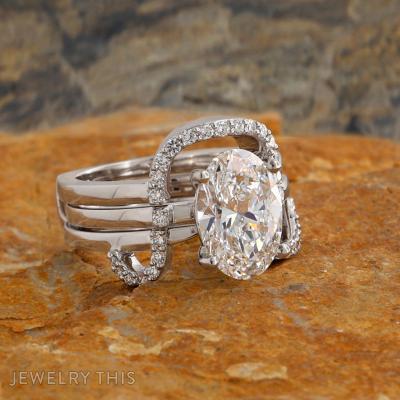
This engagement ring set is built from three interlocking bands in 14k white gold, designed ...


This gold ring was custom made as a heartfelt recreation of the wearer’s grandfather’s lost ...

This ring centers a pear-shaped labradorite in a pointed chevron setting, framed by a small ...

Introducing our elegant Gold-Plated Silver Oval Engagement Ring, adorned with a stunning 7x5mm oval lab-grown ...

This white gold signet-style ring exudes a powerful and regal presence. The ring’s flat oval ...
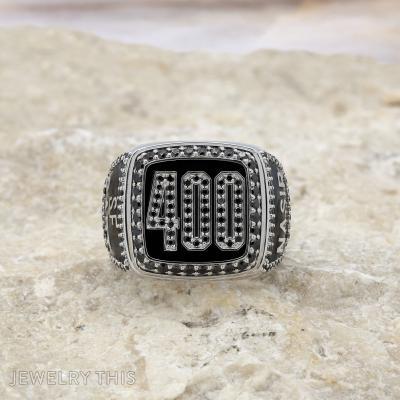
This signet-style ring centers on the number 400 set against a black enamel background and ...

This ring pairs two distinct blue gemstones — an emerald-cut aquamarine in a light, watery ...

Celebrate timeless love with our meticulously recreated diamond band. This exquisite piece features a milgrain ...

This exquisite white gold ring captures the timeless elegance of a three-stone design with a ...
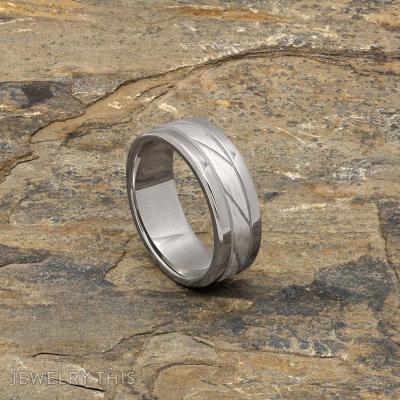
This custom wedding band is a thoughtfully recreated piece, transformed from an alternative metal design ...



