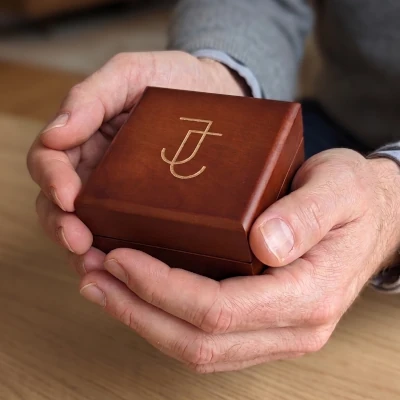


Sunburst Halo Ring — Recreated Heirloom for a Daughter
$$
14k yellow gold, lab-grown diamond, lab-grown diamonds
A client wanted to recreate a ring her aunt had given her years before she passed, so she could pass it on to her own daughter with her finger no longer bare. Working only from photos and her memory, since no paperwork existed, she and the design team refined the sunburst detailing until it matched what she remembered. When it arrived in time for her daughter's visit, she wrote: "Thank you guys so much! It's absolutely stunning!"
'It's perfect except for one change definitely.' — on seeing the first render
'Thank you guys so much! It's absolutely stunning!' — on delivery
Quick specs
Design type
Primary Metal
Shape / Cut
Primary Stone
Accent Stones
Design Complexity
Intent: Certainty
Size
Ring size 7 US (17.32mm).
How they made it distinctive
-
01
Marquise center stone bezel-set within a radiating sunburst frame, rather than a plain prong setting, echoing the original heirloom's detailing
-
02
Sunburst spokes specifically rendered in yellow gold rather than white metal, after the client caught the mismatch against her memory of the original ring
-
03
Scalloped diamond halo built from individually pave-set round stones rather than a single continuous band of pave
-
04
Recreated entirely from photographs and memory with no appraisal or paperwork to work from
-
05
Design saved to the client's account so a second matching piece can be produced later using the same model
How you'd make it yours
Center stone: this piece uses a marquise lab diamond; a new commission could use a sapphire or emerald center for color, as the client herself considered
Halo stones: this piece uses round pave diamonds; a new commission could mix in colored stones along the perimeter
Metal: this piece is 14k yellow gold; the same sunburst-and-halo design works in 18k yellow, white, or rose gold
Center stone origin: this piece uses a lab-grown diamond; a natural diamond could be used in the same cut and setting
One of a kind: this exact ring was designed to recreate one client's heirloom and is not reproduced — a new commission is an original piece inspired by this one, not a copy
Design changes made
After the first render, the client asked for the sunburst 'spokes' inside the center frame to be changed from silver-tone to gold, matching her memory of the original ring more closely. She also requested side-by-side comparisons with sapphire and emerald centers before ultimately confirming the original diamond design.
Who this is for
This piece is for someone who has a ring that matters tied up only in photographs and memory, with no paperwork or physical piece left to work from. It's especially right if you're planning to pass a family piece on to the next generation and want it rebuilt faithfully rather than reinvented from scratch.
How it's made
Once the design was approved, a 3D-printed resin model was produced as the initial physical version of the ring, refined around the center opening before being cast. The resin was attached to a wax tree, invested in plaster, and fired in a kiln to burn out the pattern, leaving a hollow mold. Molten 14k yellow gold was then cast into the mold under pressure and cooled before the raw ring was extracted for finishing.
After casting, the piece was cleaned and polished to bring out the sunburst texture radiating from the center opening, with the surrounding halo area finished to complement the surrounding diamonds. The marquise-cut lab diamond was bezel-set at the center, chosen to echo the framing of the original ring, while the round diamonds forming the scalloped halo were pave-set individually around the perimeter.
Key note
The radiating sunburst texture at the ring's center required a design revision mid-process — it was originally rendered in a white-toned metal but rebuilt in yellow gold to match the client's memory of the original piece.
Pricing guidance
A vintage-style oval cluster ring with a diamond halo and dimensional center detailing sits in the mid range for custom recreation work. Most of the cost comes from the hand-finishing required to bring out the sunburst texture and the labor of individually setting the perimeter diamonds. Stone choice and metal karat are the next biggest factors in where the price lands.
Moves price up ↑
- ↑ Switching from lab-grown to natural diamonds throughout the halo and center
- ↑ Upgrading from 14k to 18k gold
- ↑ Increasing the number or size of the halo diamonds for a fuller look
- ↑ Adding colored gemstones like sapphire or emerald in place of some diamonds
- ↑ Choosing a larger center stone than the original marquise size
Moves price down ↓
- ↓ Reducing the number of stones in the perimeter halo
- ↓ Using a smaller center stone
- ↓ Choosing sterling silver or gold-plated silver instead of solid 14k gold
- ↓ Simplifying the sunburst texture to a smooth polished center
- ↓ Selecting a single stone type throughout rather than mixing diamond placements
Questions people ask
Yes, this is a common request and this ring is a good example of it. The process starts with gathering every photo available and any measurements that can be estimated, like finger size, and building a 3D model from those references. Because there's no physical piece or paperwork to work from, small variations from the original are normal and expected. Most clients find the recreation captures the spirit and detail of the original closely, even without exact original specifications.
Lab-grown and natural diamonds are chemically, physically, and optically identical, so there's no visible difference in appearance or durability. The distinction is entirely about origin: natural diamonds are mined from the earth, while lab-grown diamonds are created in a controlled environment. Lab-grown diamonds typically cost significantly less than natural diamonds of equivalent size and quality, which is why they're a popular choice for pieces with multiple stones like a halo design. Both are rated the same on the hardness scale, so long-term wear performance is the same.
Yes, colored stones can be incorporated in a few different ways on a design like this. One option is keeping the small perimeter stones as diamonds while changing the center stone to a color, or the reverse, keeping a diamond center and using colored stones around the halo. Sapphires and emeralds both work well in a cluster design like this, though their color and luster in a photorealistic render won't be a perfect match to the stone in hand. It's worth reviewing a render of each option before deciding, since the visual effect changes significantly depending on which stones go where.
The design phase, from initial sketch to an approved 3D render, typically takes about one week. Once the design is approved and production begins, casting and finishing generally takes around four weeks, though pieces with detailed texture work or an intricate halo can occasionally run closer to the high end of that range. Total turnaround from deposit to shipping is usually five to six weeks. Rush timelines are sometimes possible but should be discussed upfront if there's a specific deadline.
A ring with this level of detail, a dimensional sunburst center and a full diamond halo, sits in the mid range for custom recreation work. The biggest cost driver is labor: hand-finishing the textured center and individually setting each halo stone takes considerably more time than a simple solitaire. Metal karat and whether the stones are lab-grown or natural are the next largest factors. Choosing lab-grown diamonds over natural ones is one of the more effective ways to manage cost without changing the visual design.
A ring with a plain polished band like this one can typically be resized within a standard range without disturbing the design, since the decorative element is isolated to the top of the ring. Larger resizes may require additional work around the point where the band meets the cluster setting. It's best to have any resizing done by the original jeweler when possible, since the bezel and pave settings around the center require careful handling. Getting an accurate finger measurement before production, as was done here, is the best way to avoid needing a resize at all.
Yes, a bezel setting surrounds the stone's edge with a continuous rim of metal, which offers more protection against chips and snags than an open prong setting. This makes it a good choice for a center stone in a ring that will see daily wear. The tradeoff is that a bezel setting can slightly reduce the amount of light entering the stone from the sides compared to an open prong setting, though this is generally a minor visual difference. For a design like this, where the center stone is already framed by a textured metal surround, the bezel setting also reinforces the overall look.
Explore Similar Creations
Every masterpiece starts with a spark. Explore how our clients raw ideas - sketches, heirlooms, inspirations - were transformed into bespoke works of arts.
This beautiful pair of wedding bands is the perfect symbol of love and commitment. The ...
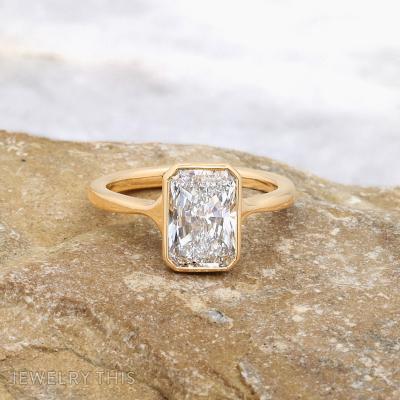
This stunning engagement ring features a 2.10-carat radiant cut lab-grown diamond of exceptional clarity (IF) ...
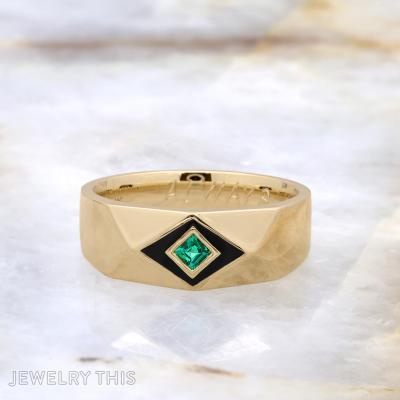
This striking yellow gold wedding band is a masterful blend of modern design and classic ...

This engagement ring centers a 1.56 carat oval-cut lab diamond, flanked by a matched pair ...
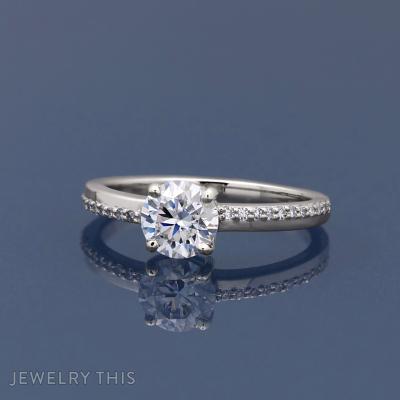
This timeless engagement ring features a brilliant round diamond at its center. The band offers ...

This engagement ring centers a 1.5 carat emerald-cut moissanite, flanked on each side by a ...

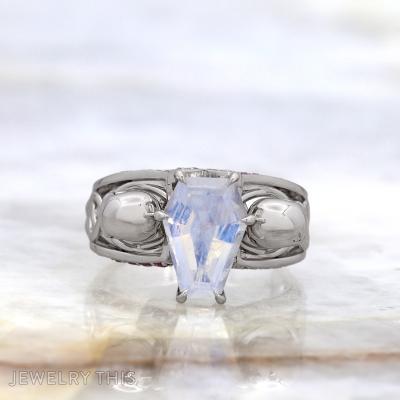
This hauntingly beautiful white gold ring is a masterpiece of dark romance and intricate symbolism. ...

This custom tiara-shaped ring is crafted in luxurious 14k white gold. The intricate design features ...
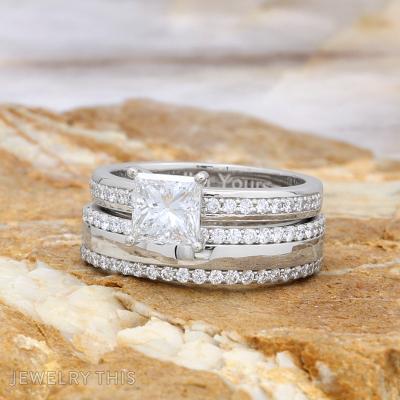
This cohesive white gold wedding set radiates contemporary elegance through its balanced geometry and brilliant ...

14k white gold ring featuring horizontal set lab grown emerald cut emerald which is set ...
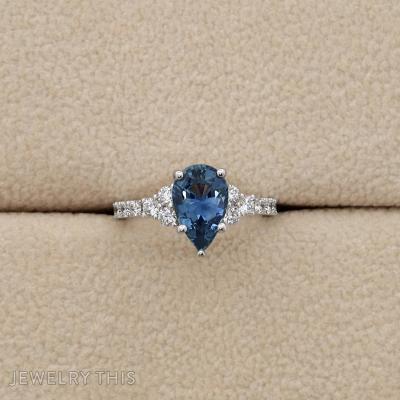
This engagement ring centers a 2.02 carat pear-shaped blue sapphire, chosen for its color over ...