Slimmed Heirloom Ring — Engraved Band, Moissanite Center
$
Sterling silver, moissanite
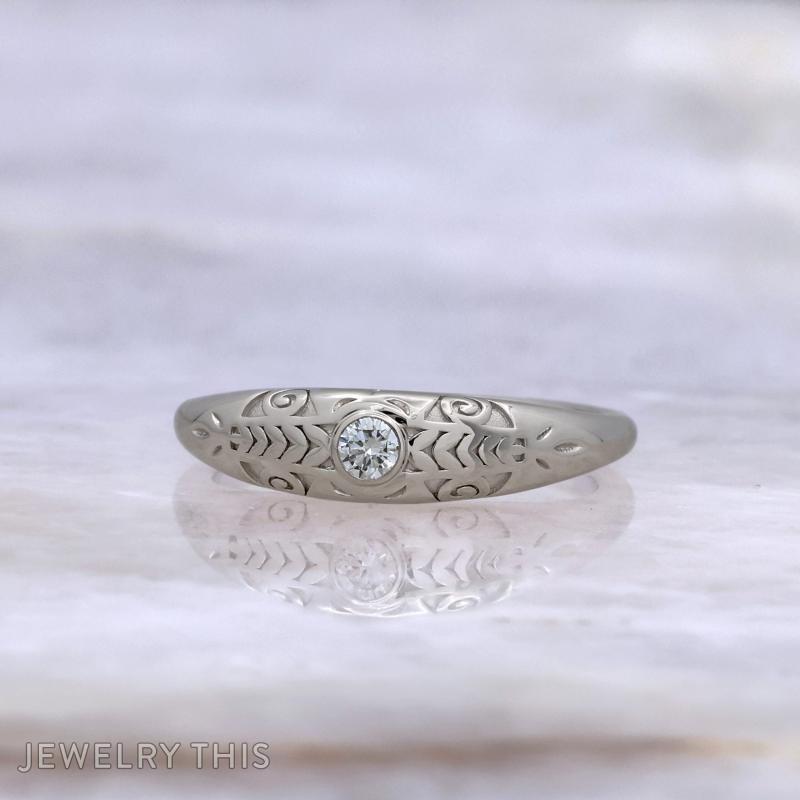
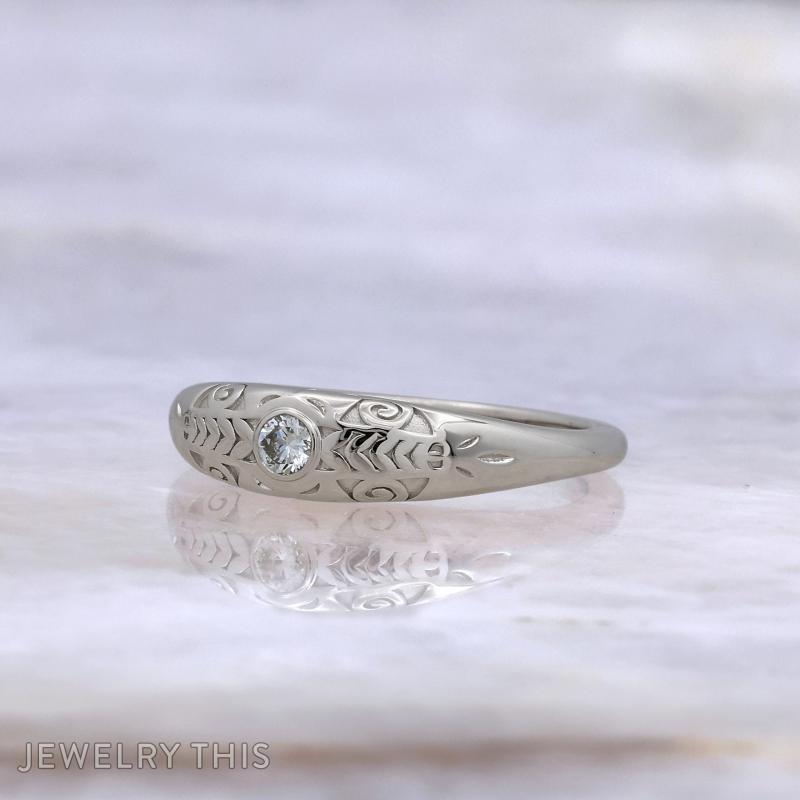
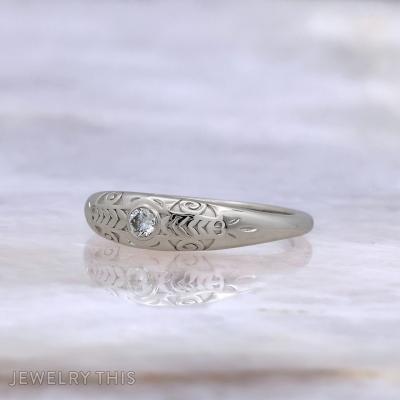
A client wanted to shrink down a thick heirloom ring she loved into something she'd actually wear every day, without making it look like a carbon copy. Over several rounds of sketches, the design moved from a five-stone flower layout to a single bezel-set moissanite, with the engraving simplified into angular leaves and spirals that echo the original at a fraction of the scale. She wanted people to look at it and say "I can see that" rather than "it's identical" — and that's exactly the effect the final band achieves.
Quick specs
Design type
Primary Metal
Shape / Cut
Primary Stone
Accent Stones
Design Complexity
Intent: Certainty
Size
Ring size 8 US (18.14mm).
How they made it distinctive
-
01
Stone count reduced from a full flower cluster to a single moissanite, chosen specifically to slim the profile without abandoning the center-stone focus of the original
-
02
Cut-out details converted to hand engraving because the narrower band lacked the material depth to support the original's open cut-outs
-
03
Leaf and spiral motifs adjusted mid-design to be more angular and larger at the client's request, moving the design closer to her memory of the original
-
04
Bezel setting chosen to keep the low profile consistent with the heirloom-inspired band rather than raising the stone with prongs
How you'd make it yours
Stone: this piece uses a moissanite; a new commission could use moss agate for color, or a natural diamond for a traditional heirloom look
Metal: this piece is sterling silver; the same engraved design language works in 14k yellow or white gold
Engraving pattern: the leaf, chevron, and spiral motifs can be adjusted to draw more or less directly from a specific original piece
Stone count: this piece uses a single center stone; a new commission could reintroduce a small cluster if a thicker band is used
One of a kind: this exact ring was designed to echo one client's heirloom and is not reproduced — a new commission is an original piece inspired by this one, not a copy
Design changes made
The stone count was reduced from a full flower cluster to a single center stone, and the original's cut-out details were converted to surface engraving since the thinner band didn't have enough material depth to support cut-outs. The client also asked for more angular leaves, a smaller centerline, and larger spirals during the sketch phase, though some fine details couldn't be replicated exactly due to the casting process versus the original's stamped-metal construction.
Who this is for
This piece is for someone who has a family ring they love but can't wear as-is — too heavy, too wide, or just not built for daily life. It's especially right if you want a piece that nods to something meaningful without being a literal copy, where people who know the story say "I can see that" rather than mistaking it for the original.
How it's made
Once the design was approved, a 3D-printed resin model was produced and shared with the client as a preview before casting. That model was invested in plaster and fired in a kiln to burn out the resin, leaving a hollow mold. Molten sterling silver was then cast into the mold under pressure and allowed to cool before the raw ring was extracted for finishing.
After casting, the band was cleaned up and polished to a bright finish, with the engraved leaf, chevron, and spiral details refined by hand to keep the pattern crisp at such a small scale. The moissanite was then bezel-set into the center, with the surrounding metal burnished down to hold the stone securely along the low-profile band.
Key note
The original heirloom ring's fine cut-out details were achieved by stamping metal into a mold, a process that allows finer separations than casting can reproduce at this smaller scale — which is why the recreation uses engraved lines instead of cut-outs.
Pricing guidance
A sterling silver band with hand-engraved detailing and a single bezel-set stone sits toward the lower end of custom work of this complexity. Most of the cost comes from the labor of refining fine engraving by hand at a small scale, plus the stone setting. Metal choice and stone type are what move the price most from there.
Moves price up ↑
- ↑ Upgrading from sterling silver to 14k gold, which raises both material cost and finishing labor
- ↑ Choosing a natural diamond over moissanite for the center stone
- ↑ Adding stones back into the design, such as returning to the original flower-cluster layout
- ↑ Requesting hand-carved wax modeling instead of a standard 3D-printed resin for finer engraving control
Moves price down ↓
- ↓ Simplifying the engraving pattern further to reduce hand-finishing time
- ↓ Choosing a smaller center stone
- ↓ Skipping the bezel setting for a simpler flush or prong setting
- ↓ Keeping the design to one metal without any two-tone elements
Questions people ask
Yes, this is a common request and it's very achievable, though some adjustments are usually necessary. Reducing a ring's size and thickness often means simplifying stone counts and converting fine cut-out details into engraved surface lines, since a thinner band doesn't have enough material depth to support cut-outs. The goal is typically to create a piece that clearly echoes the original in proportion and motif rather than reproducing it exactly. Most clients are happy with a result where the connection to the original is recognizable but not identical.
Moissanite is a lab-created stone with a hardness of 9.25 on the Mohs scale, just below diamond's 10, making it very durable for daily wear. It has a higher refractive index than diamond, so it can throw more rainbow-colored flashes of light rather than diamond's whiter sparkle. Visually the two are close enough that most people can't tell them apart in a bezel setting like this one. Moissanite typically costs significantly less than a natural diamond of comparable size.
Stamped or pressed metal pieces are formed by pressing metal into a die, which can create very fine, closely-spaced cut-outs because the metal is being displaced rather than poured. Cast pieces are made by pouring molten metal into a mold made from a wax or resin model, and very thin, closely-spaced open sections are structurally fragile in that process, especially at a reduced scale. This is why a recreation at a smaller size often converts cut-out details into engraved lines instead. The overall design language can still closely mirror the original even though the specific technique differs.
A ring with this level of hand-engraved detail and a single bezel-set stone in sterling silver falls toward the lower end of custom work of this complexity. The main cost driver is the labor involved in refining fine engraving by hand at a small scale, along with the stone-setting work. Choosing a more expensive metal or stone would move the price up from there, while simplifying the engraving pattern further would move it down.
The design phase typically takes about a week, during which sketches and a photorealistic render are shared for approval and adjusted based on feedback. Once the design is approved, production usually takes another three to four weeks, covering wax/resin modeling, casting, finishing, and stone setting. Rounds of design revision can extend the design phase somewhat if multiple adjustments are requested. In total, most projects like this are completed within four to six weeks from approval to delivery.
A bezel-set ring can generally be resized within a modest range, though the process requires more care than with a prong setting since the bezel wraps continuously around the stone. Larger resizes can be more challenging on a low-profile band because there's less extra material to work with. It's best to confirm your correct size before production, especially on a design like this where the band width was intentionally minimized. Most jewelers, including the original studio, can perform standard resizing services after delivery.
Sterling silver is a durable, workable metal for daily wear, though it is softer than gold or platinum and will show wear over time with polishing needed periodically to maintain shine. It doesn't require plating to stay white the way rhodium-plated white gold does, so there's less maintenance concern about plating wearing through. It can tarnish with exposure to air and certain chemicals, but regular wear and occasional cleaning generally keeps it looking good. For a ring with fine engraved detail like this one, sterling silver holds the design well while keeping the piece easy to care for.
Explore Similar Creations
Every masterpiece starts with a spark. Explore how our clients raw ideas - sketches, heirlooms, inspirations - were transformed into bespoke works of arts.
This rose gold engagement ring is a heartfelt recreation of a cherished original that was ...

Celebrate the union of past and present with this extraordinary custom engagement ring. At its ...

This symbolic wedding set celebrates the shared love for adventure. The men’s band features a ...

This set of white gold rings is a breathtaking display of unique gemstones and elegant ...

This ethereal engagement ring is a masterpiece of gothic-inspired botanical design, meticulously crafted from white ...

This stunning sterling silver ring showcases a unique hand-carved design of a majestic mermaid embracing ...

Embrace the exquisite charm of this custom wedding band designed to perfectly match a previously ...

This one-of-a-kind ring is crafted from sterling silver with black rhodium plating. This family ring ...
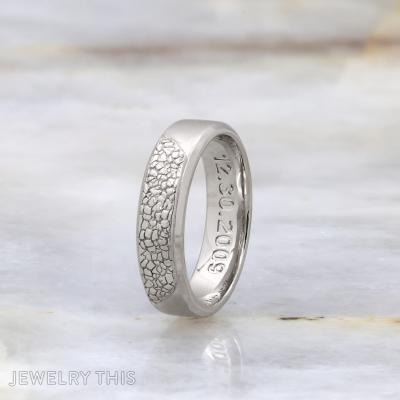
This custom wedding band for Taylor’s husband beautifully captures the unique nose prints of their ...

This ring pairs a row of five color-enhanced yellow diamonds with a colorless diamond halo ...
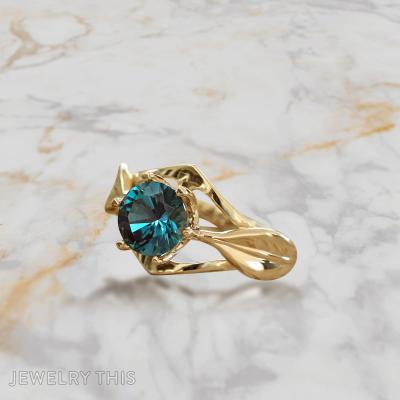
This meticulously recreated ring carries the emotional weight of a lost family heirloom, reborn in ...

The rose gold wedding set showcases a harmonious blend of shapes and colors. At the ...