


Three-Band Stacking Ring With Family Sapphires & Diamonds
$$$
14k yellow gold, natural sapphires, natural diamonds
A client came to us wanting to honor ten years spent caring for her mother, who had faced complications after brain surgery, and asked to build the design around her mother's own gemstones. Only the sapphires from a pair of earrings turned out to be usable, so the final ring was built entirely around those stones, set across three interlocking bands that can be worn together or separately. She wrote that she was 'super excited' when it shipped, and was already thinking about a second piece for her daughter using the gemstones that were left over.
'I am super excited about my ring, it's on its way.' — on shipping
Quick specs
Design type
Primary Metal
Shape / Cut
Primary Stone
Accent Stones
Design Complexity
Intent
Intent: Certainty
Size
Ring size 9 US (18.9mm), designed as a set of three interlocking bands worn together or separately.
How they made it distinctive
-
01
Three interlocking bands instead of one, designed to be worn stacked or split apart across fingers
-
02
Set with sapphires recovered from a family member's own earrings rather than newly sourced stones
-
03
A resin fitting stage was used specifically because the stacked width of three bands sizes differently than a single band
-
04
Marquise-cut sapphires paired with a row of pave diamonds along each band for texture and sparkle
-
05
Design adapted from an original ten-band concept down to three after gemstone assessment
How you'd make it yours
Stone: this piece uses sapphires recovered from the client's own jewelry; a new commission could use new natural or lab sapphires, or a different colored stone
Metal: this piece is 14k yellow gold; the same interlocking-band language works in 18k gold or rose gold
Band count: this piece uses three interlocking bands; a new commission could use two or more depending on the story being told
Diamonds: this piece uses a partial pave row on each band; a new piece could extend or reduce the diamond coverage
One of a kind: this exact three-band set was designed around one client's own gemstones and is not reproduced — a new commission is an original piece inspired by this one, not a copy
Design changes made
The original concept of ten bands representing ten years was adapted into three interlocking bands after gemstone assessment limited what could be used, and the client chose to keep the three rings separable rather than permanently joined so she could wear them together or apart.
Who this is for
This piece is for someone who wants a ring that carries real material history rather than stones chosen off a shelf, and who likes the idea of a design that adapts to how they feel like wearing it that day. It's especially right for someone marking a long stretch of time or effort with something built to be worn in pieces, not just as one fixed object.
How it's made
Once the three-band design was approved, a wax resin model was produced for each ring and sent to the client to test fit before any metal was committed — an unusual extra step taken because the interlocking bands sit wider on the finger than a single band would. After the correct size was confirmed, the models were invested in plaster and fired to burn out the wax, and molten 14k yellow gold was cast into the resulting molds to form the three raw bands.
After casting, each band was cleaned up and polished to a mirror finish. The marquise sapphires recovered from the client's earrings were set by hand into their prong settings across the bands, and the round diamonds were pave-set in a row alongside them. All three bands were finished separately since they were designed to also be worn apart.
Key note
The three bands were deliberately left separable rather than soldered into one unit, so a resin fitting stage was needed to size them as a stacked set rather than as a single ring.
Pricing guidance
A three-band interlocking ring set in 14k yellow gold with multiple sapphires and pave diamonds sits toward the higher end for custom ring work of this complexity. Building three separate bands that need to fit together precisely adds significantly more labor than a single band, and setting client-supplied stones adds an evaluation and fitting step. Metal choice and the number of stones used are the biggest remaining levers on cost.
Moves price up ↑
- ↑ Adding more bands to the interlocking set beyond three
- ↑ Using 18k gold instead of 14k for a richer color and higher metal content
- ↑ Adding more diamonds along each band rather than a partial row
- ↑ Custom-cutting replacement stones if client-supplied stones are not usable
- ↑ Requesting the bands be permanently soldered together with matched engraving on each
Moves price down ↓
- ↓ Reducing the set from three bands to two
- ↓ Using lab sapphires instead of natural stones if new stones are needed
- ↓ Leaving one or more bands plain without diamonds
- ↓ Choosing 10k gold instead of 14k
- ↓ Skipping the resin fitting stage on a more standard ring size
Questions people ask
Yes, this is a common request. The stones need to be shipped in and assessed by a jeweler first, since not everything in older jewelry is usable — sometimes the metal is plated rather than solid, or the stone quality is too low to reset safely. In this case, stones from a pair of earrings were usable while another ring's stones were not, so the design was adjusted around what could actually be reused. It's best to go into the process open to that possibility rather than assuming every stone will make the final piece.
A multi-band interlocking ring set with several stones and diamonds sits toward the higher end for custom ring work, mainly because of the labor involved in making three bands fit together precisely rather than one. Using client-supplied stones adds a bit more to the process since they need to be evaluated and fitted individually. Metal karat and how many stones are set are the biggest factors that move the cost up or down from there. Cost also depends heavily on whether the bands are simple or carry stones along most of their length.
Multi-band rings are trickier to size than a single band because the combined width sits differently on the finger than any one band alone. A resin (wax) model of the design is often printed and shipped to the client to try on before the metal is cast, since paper ring sizers don't always predict how a wide stacked set will feel. It's common to end up sizing slightly larger than a single-band ring would need, since the bands add width and can feel tighter than expected.
Yes, sapphires are one of the most durable gemstones available, ranking a 9 on the Mohs hardness scale, just below diamond. That makes them a strong choice for a ring that will be worn regularly, including in a stacked or interlocking design where the stones sit along multiple bands. They resist scratching well under normal daily wear. Cleaning is straightforward with warm water and a soft brush, and no special care routine is required beyond what you'd do for any fine jewelry.
Yes, in this design each of the three bands was intentionally made as its own complete ring rather than soldered together, so they can be worn all at once for a fuller look or split up and worn individually or on different fingers. This kind of separable multi-band design gives more flexibility than a fixed stacked ring, though it does mean each band needs its own accurate sizing. If permanent joining is preferred instead, that changes both the sizing approach and the finishing process.
Expect it to take longer than a standard custom ring, since the process includes time for the stones to ship in, be evaluated, and be scanned before design work can even begin. After that, a typical timeline includes about a week for the design and render stage, followed by four to six weeks for production, though a multi-band design or a sizing correction can extend that. In this case the process ran longer than standard because of the added resin fitting stage used to confirm sizing for the stacked bands.
The jeweler will let you know which stones passed inspection and which didn't, usually citing reasons like low-quality material or the piece being plated rather than solid precious metal. From there, you can choose to move forward with only the usable stones, add new stones to fill out the design, or rethink the piece around what's actually available. It's a common outcome, especially with older jewelry, and doesn't have to derail the project.
Yes, any gemstones that were not used in your original design are typically shipped back to you along with the finished piece, and they can be incorporated into a future project whenever you're ready. This is a common path for clients who send in a small collection of jewelry and want to spread the stones across more than one meaningful piece over time. Just keep track of what's left and reach out when you're ready to start designing the next piece.
Explore Similar Creations
Every masterpiece starts with a spark. Explore how our clients raw ideas - sketches, heirlooms, inspirations - were transformed into bespoke works of arts.
Crafted in 14k yellow gold, the custom vintage style ring showcases a stunning dark blue ...

This exquisite custom ring features a stunning 1.5 carat lab-created diamond center stone, beautifully complemented ...

This enchanting yellow gold band is adorned with a delicate design of twisting leaves and ...

This wedding band was crafted in sterling silver to and features some hidden details. The ...

Featured at the center of this sterling silver ring is a .50 carat lab-grown trillion ...
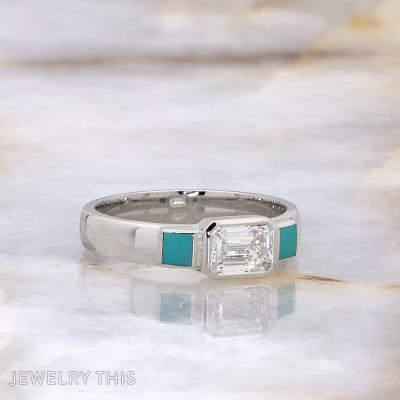
This elegant custom ring beautifully combines a .75 carat emerald cut lab diamond centerpiece with ...

This meaningful white gold ring was created as a celebration of family and new beginnings. ...

This yellow gold engagement ring is a mesmerizing blend of grace and sophistication. The focal ...

This striking ring is a faithful and elevated recreation of a beloved original, blending vintage ...


Replicated sterling silver ring from client into 10k white gold. Ring features repeated circular pattern ...

This unique wedding band, designed for an animal conservationist, celebrates a passion for wildlife with ...



