


Petite Black Star Sapphire Pinky Ring in Yellow Gold
$$
14k yellow gold, black star sapphire, lab-grown diamonds
A client wanted to recreate a pinky ring her spouse's father had worn for years — a ring that went to a sibling after he passed, leaving her spouse without one of his own. Working from old photographs, the design was scaled down from the original's larger proportions to fit a size 5 finger, with a black star sapphire kept as the one non-negotiable detail. When the render arrived, she wrote: 'You can't hear, but I'm squealing with how good it looks. You nailed it!'
'You can't hear, but I'm squealing with how good it looks. You nailed it! It's so good!' — on seeing the first render
'Omg! It's amazing!!! Thank you so much! You all are amazing. I love it!' — on delivery
Quick specs
Primary Metal
Shape / Cut
Primary Stone
Accent Stones
Design Complexity
Intent: Certainty
Size
Ring size 5 US. Top width approximately 0.5in.
How they made it distinctive
-
01
Black star sapphire kept as the one non-negotiable detail, tying the new ring directly back to the ring it was inspired by
-
02
Oval cabochon shape chosen over a rounder stone after a direct comparison showed it was closer to the original's proportions
-
03
Scaled down from a larger men's-style original to a petite size 5 pinky ring
-
04
Branch-like split-shoulder prong work gives the setting an organic, sculptural character rather than a plain framed mount
-
05
Lab-grown diamonds and sapphire chosen intentionally for a more accessible, ethically-sourced alternative
How you'd make it yours
Stone shape: this piece uses an oval cabochon — a new commission could use a rounder or custom 'roval' shape for a different silhouette
Stone type: this piece uses black star sapphire — a new commission could use a different colored cabochon stone with similar durability
Metal: this piece is 14k yellow gold — the same branch-style setting works well in rose gold or white gold
Accent stones: this piece uses 3 small diamonds — a new commission could use more, fewer, or colored accent stones
One of a kind: this exact ring was designed for one client's spouse and is not reproduced — a new commission is an original piece inspired by this one, not a copy
Design changes made
The client asked whether the sapphire could be round instead of oval; after seeing a side-by-side comparison showing the oval was closer to the original ring's proportions, she chose to keep the oval shape.
Who this is for
This piece is for someone who wants to give a ring that carries real meaning without recreating something exactly — a way to honor a person or a memory through a smaller, personal version of what they loved. It's especially right for anyone giving a ring on someone else's behalf, working only from old photos and a description, who wants the recipient to feel truly seen.
How it's made
Once the design was approved, a 3D-printed resin model was produced first, showing the exact form of the ring before any metal was involved. That model was used to create a mold, which was fired in a kiln to burn out the resin, leaving a hollow cavity. Molten 14k yellow gold was then cast into that cavity under heat and pressure, producing the raw ring, which was then extracted from the mold for finishing.
After casting, the ring was cleaned up and polished to bring out the shine of the branch-like prong work along the shoulders. The oval black star sapphire cabochon was set into its claw prongs at the center, and the three small lab-grown diamonds were set individually into the split shoulder design flanking the stone.
Key note
The center stone is a cabochon rather than a faceted cut, so it is held by claw-style prongs gripping its dome rather than the bezel or prong-on-facet settings used for cut gemstones.
Pricing guidance
A petite yellow gold pinky ring with an organic prong setting and a cabochon center stone sits toward the lower end of custom ring pricing. Most of the cost comes from the branch-style hand-finished prong work and the labor of setting both the center cabochon and the small accent stones. Stone choice and setting complexity are what move the price most from there.
Moves price up ↑
- ↑ Custom-cutting the center stone to a non-standard 'roval' shape instead of a standard oval
- ↑ Upgrading the diamonds from lab-grown to natural
- ↑ Increasing the ring's overall top size, which requires more metal and more prong work
- ↑ Adding more accent stones along the shoulders
- ↑ Using a higher karat gold such as 18k instead of 14k
Moves price down ↓
- ↓ Using a smaller, standard-sized cabochon instead of a custom oval shape
- ↓ Choosing a lab-grown stone rather than a natural black star sapphire
- ↓ Reducing the number of accent diamonds
- ↓ Using a simpler prong setting without the branch-like detailing
- ↓ Choosing a lower-karat gold or gold-plated silver
Questions people ask
A black star sapphire is a genuine corundum gemstone that displays asterism — a star-shaped light reflection caused by needle-like mineral inclusions inside the stone. Most black star sapphires available today are lab-grown, meaning they are chemically and optically identical to natural stones but grown in a controlled environment rather than mined. Lab-grown versions cost less than natural ones of comparable size and quality. Because the star effect depends on the stone being cut as a smooth dome rather than faceted, black star sapphires are always cut as cabochons, not brilliant cuts.
Lab-grown and natural stones of the same type share the same chemical composition, hardness, and optical properties — the only difference is where they were formed. Natural stones form in the earth over millions of years and are mined, while lab-grown stones are created in a controlled laboratory environment in a much shorter time. This means a lab-grown black star sapphire or diamond looks identical to its natural counterpart to the naked eye and under standard jewelry inspection. The main practical difference for a buyer is cost: lab-grown stones are typically significantly less expensive than natural stones of equivalent size and quality.
A petite yellow gold pinky ring with a cabochon center stone and a few small accent diamonds falls toward the lower end of custom ring pricing. The main cost driver is the labor involved in the branch-like prong work and hand-setting both the center stone and the accent stones, rather than the raw materials themselves. Choosing lab-grown stones instead of natural ones keeps the cost down significantly. Ring size and the amount of metal used in the setting also affect the final price.
The full process from approved design to finished ring typically takes about five to six weeks. The design phase — sketch, 3D model, and photorealistic render for approval — usually takes about a week. Once the design is approved and production begins, casting, stone setting, and finishing generally take another four to five weeks before the piece ships.
Yes, a cabochon-set stone like a black star sapphire can generally be removed and replaced by a jeweler since it is held in place by prongs rather than fused into the metal. Because black star sapphire is a fairly durable stone but softer than diamond, it can chip or scratch if knocked hard against a hard surface, so care should be taken during activities that put a lot of stress on the hands. If the stone is ever damaged, a jeweler can typically re-set a same-sized replacement stone into the existing prong setting.
Yes, a round center stone is technically possible, but it will noticeably change the overall look of the ring compared to an oval or elongated cabochon. An oval or slightly irregular stone shape tends to give the ring a more organic, elongated silhouette, while a round stone creates a more symmetrical, compact look. The choice mostly comes down to personal preference and whether you're trying to match a specific reference piece or simply want a distinctive ring shape.
Yes, 14k yellow gold is a common and durable choice for everyday rings because it balances gold content with added strength from other metal alloys, making it more resistant to scratching and bending than higher-karat gold like 18k or 24k. It's a good option for a pinky ring that will be worn regularly, since pinky rings can catch on things more than other fingers due to their position. Regular gold jewelry cleaning and occasional professional polishing will keep the ring looking bright over years of wear.
Yes, the number, placement, and type of accent stones can be adjusted on a design like this depending on preference and budget. This particular design uses small lab-grown diamonds set into the split shoulders flanking the center stone, but colored gemstones or a different stone count could be used instead. Adding more accent stones increases both material and labor cost, while removing them or using smaller stones brings the cost down.
Explore Similar Creations
Every masterpiece starts with a spark. Explore how our clients raw ideas - sketches, heirlooms, inspirations - were transformed into bespoke works of arts.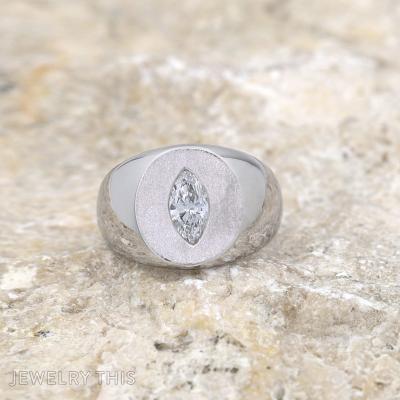
This is a men’s wedding band built around a signet-ring silhouette: an oval face with ...

14k white gold men’s wedding ring. Channel set through center with vertically set baguette moissanite ...

Personalized signet ring featuring enamel filled symbol inlayed into the top of the ring which ...

Sterling silver men’s ring featuring an emblem logo of a firefighter as well as motorcycle ...


This signet ring merges two professions into one design: pharmacy and information technology. A black ...
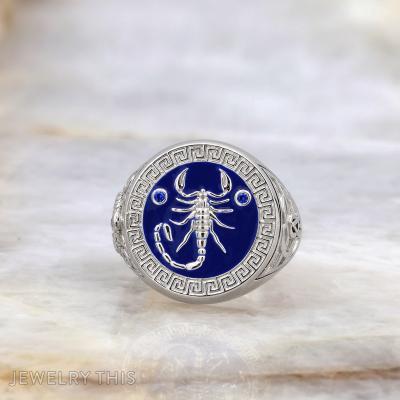
This men’s signet ring was designed to honor both a Greek heritage and an Irish ...

10k yellow gold signet-style ring with round top featuring pierced cross. Top of ring: 15mm
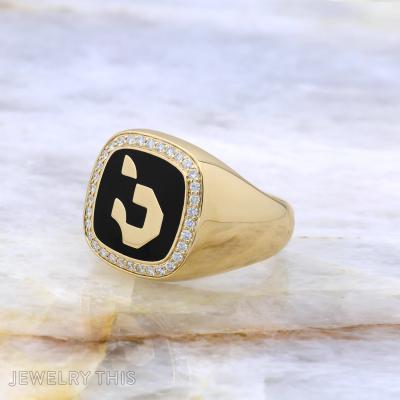
This signet-style ring was designed around a company’s logo, rendered in raised 14k yellow gold ...

This sterling silver signet ring was customized to perfection. The top surface of the ring ...




