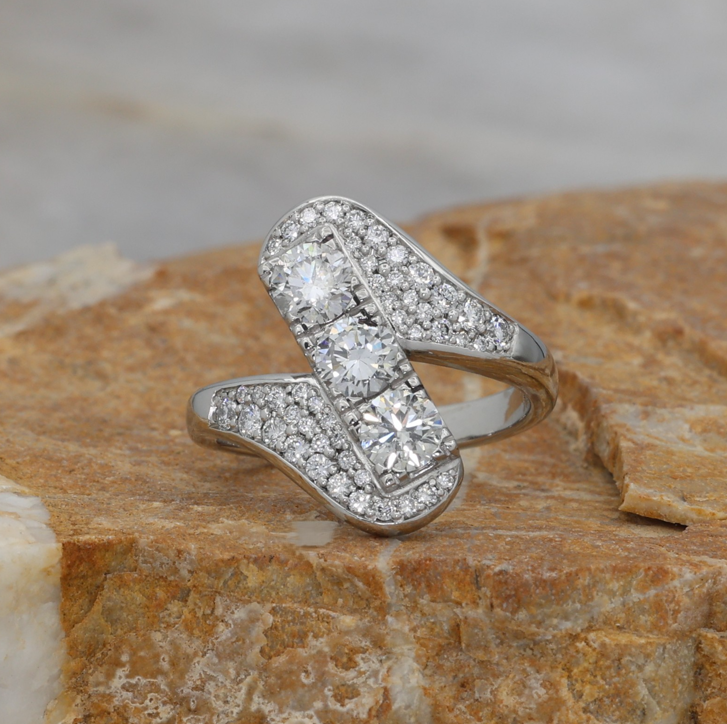
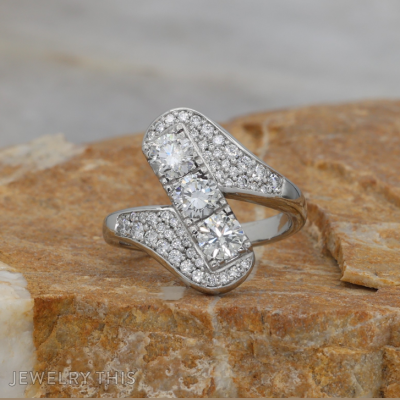
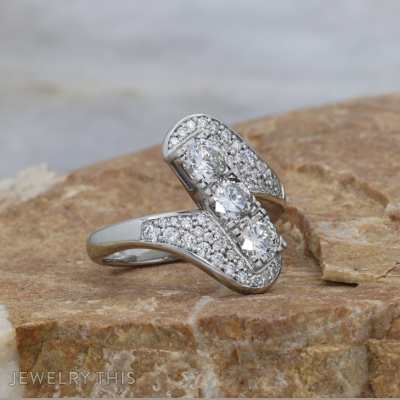
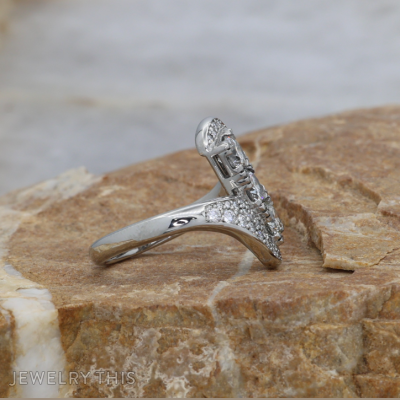
Recreated Vintage S-Curve Diamond Ring in Platinum
$$$$
Platinum, natural diamonds
A client came to us hoping to recreate a custom ring from the 1950s that had been stolen — a piece given to her by her mother-in-law and worn for years. Working only from photographs and her memory, she and the design team went back and forth over the exact placement of the diamonds and the solid, gap-free profile of the S curve until the render matched what she remembered. When it arrived, she wrote: 'You did a beautiful recreation. Thank you very much. I love it.'
'I have the ring and you did a beautiful recreation. Thank you very much. I love it.' — on delivery
Quick specs
Design type
Primary Metal
Shape / Cut
Primary Stone
Accent Stones
Style
Design Complexity
Intent: Certainty
Size
Ring size 6¼ US (16.71mm).
How they made it distinctive
-
01
Recreated entirely from photographs and memory of a stolen 1950s original, with no physical piece or paperwork to reference
-
02
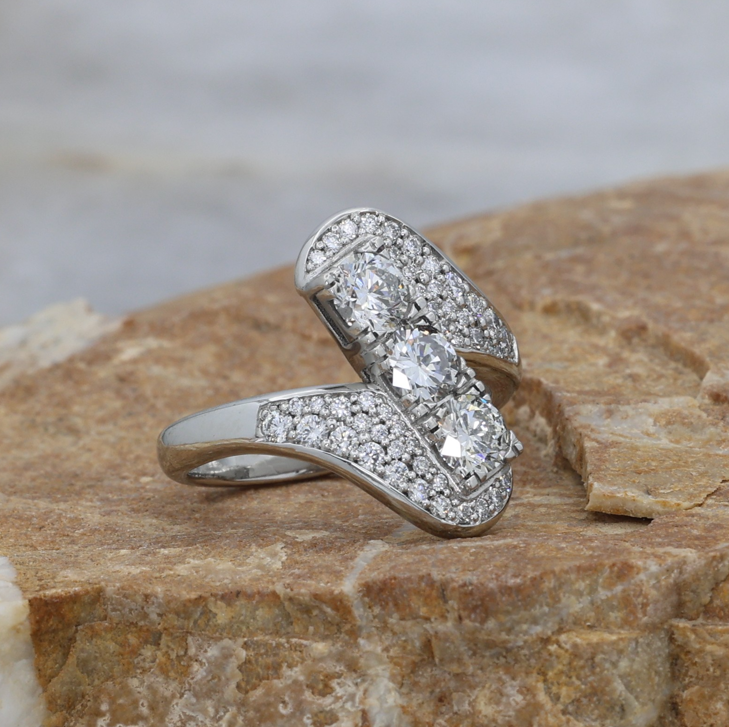
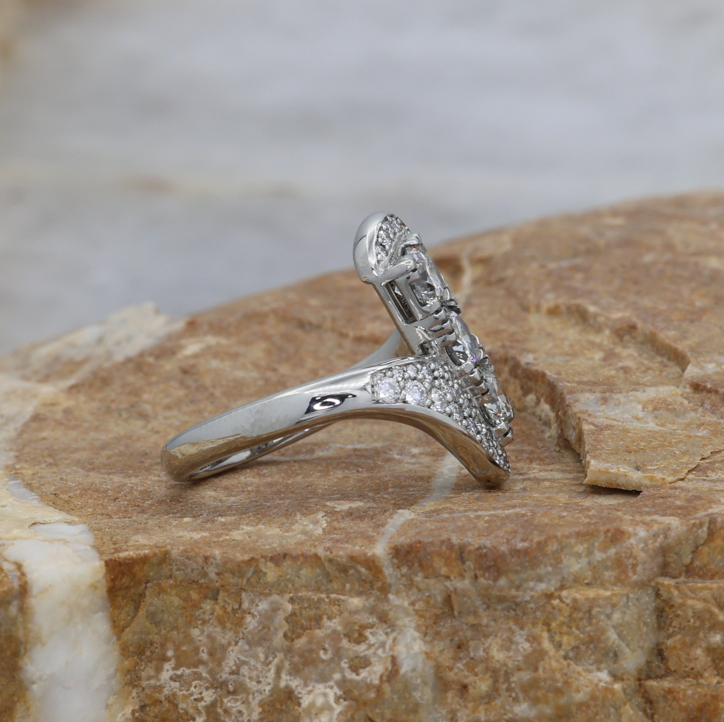
Three center diamonds set in a raised box frame flanked by continuous pave on both curves of the S, closing every gap to the skin as the client specified
-
03
Platinum chosen over white gold specifically for its durability and ability to stay white over decades without replating
-
04
Diamond sizing and pave coverage refined across two rendered versions until the layout matched the client's memory
-
05
Cast twice in platinum after the first casting did not pass quality control, ensuring a structurally sound final piece
How you'd make it yours
Center stones: this piece uses three round natural diamonds at roughly a third of a carat each; a new commission could use lab diamonds for the same look at lower cost, or a different stone shape
Metal: this piece is platinum; the same S-curve design works in 18k or 14k white gold with a different wear profile
Pave coverage: this piece has full pave along both curves; a new piece could leave some sections as polished metal for a lower-cost, more minimal look
Diamond grade: this piece uses SI clarity, G color stones; a new commission could specify higher or lower grades depending on priorities
One of a kind: this exact ring was recreated for one client from a specific vintage original and is not reproduced — a new commission is an original piece inspired by this design, not a copy
Design changes made
The layout was refined after the first sketch to close what looked like gaps between the center diamonds and the band, and the center stone size was adjusted down from an initial estimate to better match the client's memory of the original. The metal was also changed from the initially discussed white gold to platinum for durability once pricing was compared.
Who this is for
This piece is for someone who lost a piece of real personal history and wants it back as close to the original as possible, even when all that remains is a photograph and a memory. It's especially right for someone who values durability and wants a piece built to be worn every day and handed down, not just displayed.
How it's made
Once the sketch and 3D model were approved, the design was cast in platinum — a metal that requires more precise casting control than gold because it is harder to work with in molten form. After the raw casting was reviewed, quality control flagged irregularities typical of platinum casting, and the piece was recast to ensure a clean, solid structure before any finishing began.
After the second casting passed inspection, the band was cleaned up and given a high polish finish across the solid sections of the S curve. The three center diamonds were set into a raised box-style frame with individual prongs, while the smaller round diamonds were pave-set in a continuous line along both curves of the band, leaving no bare metal between the stones and the outer edge.
Key note
Platinum is significantly harder to cast cleanly than gold, which is why the first casting of this piece did not pass quality control and had to be remade before setting could begin.
Pricing guidance
A three-stone bypass ring in platinum with pave diamond accents sits toward the upper end of custom ring pricing. Platinum's higher labor and casting difficulty, combined with the diamond count required for continuous pave coverage, are the main cost drivers. Center stone size and metal choice are what move the price most from there.
Moves price up ↑
- ↑ Upgrading center stones above roughly a third of a carat each
- ↑ Using platinum instead of 14k or 18k white gold, which requires more careful casting and finishing
- ↑ Extending pave coverage further along the band
- ↑ Choosing higher clarity or color grades for the natural diamonds
- ↑ Adding a matching wedding band designed to nest against the S curve
Moves price down ↓
- ↓ Switching from platinum to 14k white gold
- ↓ Using lab-grown diamonds instead of natural diamonds for the center and accent stones
- ↓ Reducing the number or size of the pave accent diamonds
- ↓ Leaving some sections of the band as polished metal rather than fully pave-set
- ↓ Choosing a lower clarity grade for the center diamonds
Questions people ask
Yes. This ring was rebuilt entirely from photographs and the client's memory of the original 1950s piece, with no physical ring or paperwork to reference. The process starts with a hand sketch, moves to a 3D CAD model, and then a photorealistic render for approval, with adjustments made at each stage until the layout matches what the client remembers. Stone sizes and setting details are estimated from the images and refined through client feedback. The result is a close recreation, though it is a new piece built from the approved design rather than an exact duplicate of the original.
Platinum is a naturally white metal that stays white as it wears, while white gold is naturally a warmer, slightly yellow-toned metal that is plated with rhodium to appear bright white. Over years of wear, that rhodium plating gradually wears down and needs to be reapplied to keep white gold looking bright. Platinum is also denser and more durable, making it a common choice for pieces meant to be worn daily and passed down. The tradeoff is that platinum is more difficult to cast, since it has a much higher melting point and does not flow into fine detail as easily as gold.
In this design, the three center diamonds are approximately a third of a carat each, a size chosen to balance visual presence with the proportions of the S-shaped band. The exact size depends on the shape of the design and what looks right in the layout, which is usually confirmed once the 3D model is built. Additional pave-set diamonds line both curves of the band and are much smaller, typically under 2mm each. Center stone size is one of the biggest factors in the overall cost of a piece like this.
A three-stone bypass ring in platinum with pave diamond accents falls toward the higher end of custom ring pricing, largely because of platinum's labor-intensive casting process and the number of diamonds required for continuous pave coverage. Metal choice and center stone size are the two variables that move the price the most. A similar design in 14k white gold with lab-grown diamonds would come in meaningfully lower.
A standard custom ring typically takes around five to six weeks from approved design to delivery, though platinum pieces can take longer if a casting needs to be redone. Platinum is harder to cast without irregularities than gold, and quality control sometimes requires a recast to ensure the metal is structurally sound before stones are set. Once casting is finalized, finishing and stone setting typically take one to two weeks. Rush timelines are possible but depend on production capacity at the time.
Platinum can be resized, but it requires more heat and more skill than resizing gold because of its higher melting point and density. A jeweler experienced in working with platinum should always handle this rather than a jeweler who primarily works in gold. For a ring with pave-set stones along the band, like this one, resizing is more complex than it would be for a plain band, since the stone-set area limits how much the ring can be adjusted without disturbing the setting.
Pave setting is a technique where small diamonds are set closely together across a surface, held in place by tiny shared prongs or beads of metal, so the surface reads as continuously covered in stone with minimal visible metal. It is a durable setting method for daily wear as long as the prongs are properly maintained, though very small pave stones can occasionally loosen over years of wear and benefit from periodic inspection. Platinum holds pave prongs particularly well because of its strength and resistance to wear. Regular cleaning and an annual prong check are recommended to keep pave settings secure long-term.
Yes, diamond clarity and color can be selected to suit the intended style of a piece. This ring uses SI clarity and G color diamonds, a combination that offers strong brilliance and a near-colorless appearance without the premium cost of the highest grades. Vintage-inspired pieces often use similar mid-range grades since they were the norm in older jewelry, though the choice ultimately comes down to budget and personal preference. Clarity and color are two of the four factors, along with cut and carat weight, that determine a diamond's overall price and appearance.
Check what our clients say about us

Suzanne Baer
8 months ago
I am absolutely thrilled with this ring. It was purchased as a replica of my mother-in-law’s vintage ring, and the craftsmanship exceeded my expectations. The design is beautiful and remarkably close to the original—almost identical in detail, shape, and sparkle. It truly captures the elegance and character of the vintage piece.
I would also like to highlight the exceptional service provided by my jewelry representative, Carrie. She communicated with me every step of the process, kept me informed, and made sure every detail was handled with care. The quality feels substantial, the ring looks stunning when worn, and the entire experience was seamless. I couldn’t be happier with this purchase and would highly recommend both the ring and the team behind it
Explore Similar Creations
Every masterpiece starts with a spark. Explore how our clients raw ideas - sketches, heirlooms, inspirations - were transformed into bespoke works of arts.
This elegant 18karat gold engagement ring features a mesmerizing oval shaped 2.5carat Aquamarine at the ...

This enchanting rose gold engagement ring features a pear-shaped center diamond set at a graceful ...
This magnificent yellow gold engagement ring offers breathtaking sparkle and substantial presence. At its heart ...

This custom 14k white gold wedding band is a unique expression of love. With a ...

This custom 14k yellow gold engagement ring is a symbol of unique elegance and style. ...

This exquisite Platinum Moissanite And Sapphire Wedding Set. A harmonious blend of elegance and sophistication. ...

This White gold ring showcases a captivating round lab-grown Ruby at its heart. Held securely ...

Crafted to replace a cherished lost piece, this custom ring features an oval opal center ...
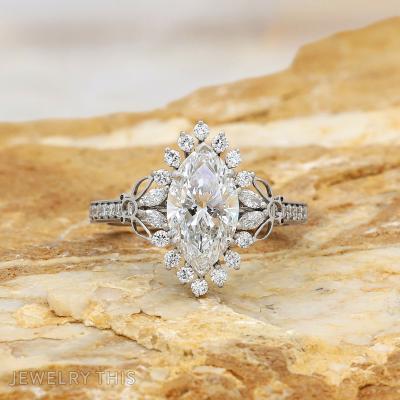
This engagement ring centers a marquise-cut lab diamond, colorless and just under two carats, surrounded ...
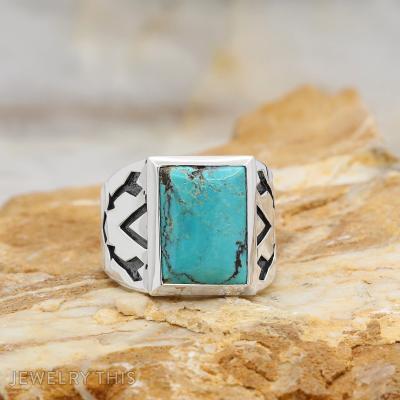
This sterling silver ring was custom-created to recreate a cherished lost piece. At its center ...

This platinum engagement ring centers a large oval lab-grown diamond in a raised cathedral setting, ...

This yellow gold ring is a stunning showcase of elegance and sophistication. At its heart ...