

Recreated Amethyst Ring — Rose Gold Lattice Band
$$
14k rose gold, natural amethyst
A husband wanted to bring back his wife's grandmother's ring after it was lost a few years ago — the only stone was a marquise amethyst, set between lattice-patterned shoulders. He asked for it rebuilt in rose gold instead of the original gold, working entirely from photographs. When it arrived, he wrote: "She loves it, thank you so much for your help making this happen!"
'This looks great!' — on seeing the first render
'She loves it, thank you so much for your help making this happen!' — on delivery
Quick specs
Design type
Primary Metal
Shape / Cut
Primary Stone
Accent Stones
Design Complexity
Intent: Certainty
Size
Ring size 9 US. Center stone approximately 10mm long (marquise).
How they made it distinctive
-
01
Marquise amethyst center stone rebuilt to match a lost grandmother's ring, sourced entirely from reference photos
-
02
Lattice-textured shoulders cast as an open diamond pattern rather than engraved, giving dimension on both sides of the stone
-
03
Rose gold chosen intentionally in place of the original's yellow gold, a deliberate departure from the source piece
-
04
Six-prong setting selected specifically to secure the marquise stone's pointed ends
-
05
Design approved without revision, closely matching the client's memory of the original on the first render
How you'd make it yours
Stone: this piece uses a natural amethyst; a new commission could use sapphire, natural or lab, for a similar deep color with more durability
Metal: this piece is 14k rose gold; the same lattice design works equally well in yellow or white gold
Stone cut: this piece uses a marquise shape; a new piece could use oval or pear for a similar elongated look
Lattice coverage: this piece has lattice on both shoulders; a new commission could extend or limit the pattern
Engraving: the inside of the band can carry a new inscription on a fresh commission
One of a kind: this exact ring was designed for one client's family piece and is not reproduced — a new commission is an original piece inspired by this one, not a copy
Design changes made
Design matched the initial brief without major changes.
Who this is for
This piece is for someone who wants to bring back a family ring that's no longer around, without needing an appraisal or exact measurements to start. It's especially right if the original had a distinct, structural design — texture, an unusual stone shape — that a plain replacement wouldn't capture.
How it's made
Once the design was approved, a wax model of the ring was produced using a 3D printer, then attached to a wax tree and set inside a flask. The flask was placed in a kiln to burn out the wax, leaving a hollow mold, and molten 14k rose gold was cast into that mold. After cooling, the piece was removed from the tree, cleaned, and prepared for finishing.
The lattice pattern on each shoulder was cleaned up and polished by hand to keep the diamond-shaped cutouts crisp and even on both sides of the band. The band itself was polished to a mirror finish, and the marquise amethyst was then set into a six-prong setting at the center, with the prongs adjusted to hold the stone's pointed ends securely.
Key note
The lattice shoulders are cast as an open pattern rather than a solid surface engraved afterward, which is why the diamond cutouts read all the way through the metal rather than sitting on top of it.
Pricing guidance
A rose gold ring with a lattice-textured setting and a marquise center stone sits in the mid range for custom work of this style. Most of the cost comes from the hand-finishing needed to keep an open lattice pattern crisp on both shoulders, plus the six-prong setting for a pointed marquise stone. Stone size and metal karat are what move the price most from there.
Moves price up ↑
- ↑ Upgrading from 14k to 18k rose gold
- ↑ Choosing a larger marquise amethyst, closer to 1.5–2 carats
- ↑ Extending the lattice pattern further around the band
- ↑ Adding milgrain or engraving detail to the lattice edges
- ↑ Switching the center stone to a sapphire or diamond
Moves price down ↓
- ↓ Reducing the lattice pattern to one shoulder only or a simpler texture
- ↓ Choosing a smaller center stone, under 1 carat
- ↓ Using a bezel setting instead of six-prong for the marquise stone
- ↓ Selecting a lower-karat rose gold, such as 10k
- ↓ Simplifying the shoulder shape to a plain tapered profile
Questions people ask
Amethyst rates 7 on the Mohs hardness scale, which makes it reasonably durable for daily wear but softer than sapphire or diamond. It can hold up well in a protective setting like six-prong or bezel, but it's more prone to scratching if knocked against hard surfaces repeatedly. Many people wear amethyst rings daily for years without issue as long as they're mindful during activities like heavy manual work or sports. Avoid ultrasonic cleaners and prolonged sun exposure, since amethyst can fade with excessive heat and light.
Yes, recreating a ring from photographs alone is a common request, especially for lost or inherited pieces with no measurements or appraisal available. The process starts with a detailed conversation about what's remembered or visible in the images, followed by a sketch and a 3D render for review before anything is cast. Stone size, shape, and setting details are estimated from the photos and refined based on client feedback. The result won't be a molecular-exact copy, but it can capture the design, proportions, and character closely.
Rose gold gets its color from a higher copper content mixed into the gold alloy, which gives it a warmer, pinkish tone compared to yellow gold's classic warm-yellow hue. Both are equally durable at the same karat weight, since the color difference comes from alloy composition, not purity. Rose gold also tends to show a lattice or textured pattern with slightly more contrast because of how light reflects off the copper-toned surface. The choice is mostly aesthetic preference rather than a durability trade-off.
A custom ring with a rose gold lattice-textured setting and a marquise center stone typically falls in the mid range for bespoke work of this style. The main cost driver is labor — an open lattice pattern requires more hand-finishing than a smooth band, and a marquise stone's pointed ends require a more careful prong setting than a round stone. Stone size and gold karat are the two biggest variables that shift the price up or down. Simpler textures or a smaller stone would bring the cost down; a larger stone or 18k gold would push it up.
The full process typically runs about four to six weeks from deposit to delivery on a standard timeline. The first week covers the sketch and 3D render, which the client reviews and approves before anything is cast. Once approved, production — casting, finishing, and stone setting — takes roughly three to four more weeks. Rush timelines are possible for date-driven gifts, like a holiday deadline, but should be discussed upfront since it affects scheduling.
Yes, a marquise-cut stone can be removed and reset into a new setting, though it requires a jeweler experienced with the shape since the pointed ends are more vulnerable during handling. A six-prong setting like this one is designed to protect those points, which also makes future resetting more straightforward if ever needed. The stone itself is not damaged by a routine reset as long as it's done carefully by a professional. This is a normal service most jewelers offer, separate from the original ring's construction.
Amethyst is a natural quartz variety colored by trace iron and other minerals, and it's not typically lab-created in the same way diamonds or sapphires are, since natural amethyst is widely available and inexpensive to mine. The deep purple color seen in finer amethyst comes from the specific mineral composition and heat exposure during formation. Because natural supply is abundant, there's little market demand for a synthetic version. Color can vary from pale lilac to deep violet, and deeper, more saturated purple is generally considered higher quality.
Yes, an open lattice or diamond-cutout texture like this can be adapted to other ring shapes and band widths, whether as full shoulders flanking a center stone or as a decorative band on its own. The pattern is cast as an openwork design rather than engraved afterward, so the cutouts read all the way through the metal for a more dimensional look. It works well in rose, yellow, or white gold, though the contrast and shine vary slightly by metal tone. The main design consideration is making sure the open sections remain structurally sound at the chosen metal gauge.
Explore Similar Creations
Every masterpiece starts with a spark. Explore how our clients raw ideas - sketches, heirlooms, inspirations - were transformed into bespoke works of arts.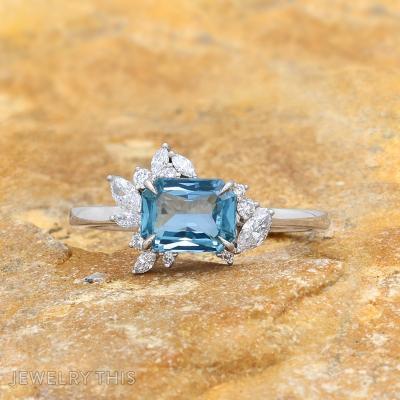
This captivating white gold engagement ring features a striking emerald-cut sapphire at its center, showcasing ...

This custom wedding set exudes romance and sophistication. The engagement ring, inspired by the classic ...

This chunky, rectangular-top ring was remade in solid 14k yellow gold from a plastic original ...

This beautiful and unique ring is a stunning representation of the client’s beloved home country, ...

This Yellow gold ring is a celebration of beauty and craftsmanship. At its heart lies ...

This ring rebuilds an original design whose bezel walls were cast too thin, allowing a ...
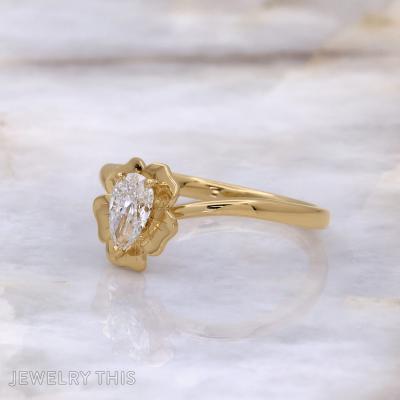
The Golden Bloom Ring Commissioned as a second chance to perfectly capture a client’s heartfelt ...

This pair of sterling silver wedding bands are a symbol of the unbreakable bond between ...

This sterling silver ring is a proud symbol of achievement for anglers who have conquered ...

This silver ring showcases a graceful swooping design that wraps beautifully along the top of ...

This custom wedding band, recreated from a beloved silver ring, now shines in radiant white ...

Crafted with honor and distinction, this Yellow gold men’s ring bears a circular flat top, ...