


Infinity Band Engagement Ring with Six Rainbow Gemstones
$$
14k yellow gold, moissanite, ruby, citrine, yellow sapphire, emerald, blue sapphire, amethyst
A. wanted to design an engagement ring himself — a golden infinity band with six colored gemstones representing a personal spectrum, plus a colorless center stone standing in for a traditional diamond. He sketched the layout by hand and worked with the team through several rounds of stone selection before settling on moissanite framed by ruby, citrine, yellow sapphire, emerald, blue sapphire, and amethyst. When it arrived, he wrote: "It's like you guys took my drawing and pulled it into reality. I'm absolutely over the moon."
'Oh wow, it's beautiful beyond words. I absolutely love it.' — on seeing the first render
'The ring came today, it is beautiful. It's like you guys took my drawing and pulled it into reality. I'm absolutely over the moon.' — on delivery
Quick specs
Design type
Primary Metal
Shape / Cut
Primary Stone
Accent Stones
Style
Design Complexity
Intent: Certainty
Size
Ring size 8 US. Center stone 5.5mm round; accent stones 2.5mm round.
How they made it distinctive
-
01
Six individually set colored accent stones, each placed within its own infinity loop rather than a shared channel
-
02
Design originated from the client's own hand-drawn sketch, giving the piece a personal layout rather than a stock design
-
03
Moissanite chosen over a diamond or white sapphire for its durability and long-term sparkle retention
-
04
Citrine specifically selected to balance three stones on each side of the center stone after the initial five-stone plan
-
05
Metal upgraded to 14k yellow gold at the client's request to suit his partner's preference
How you'd make it yours
Center stone: this piece uses moissanite; a new commission could use a lab or natural diamond, or white sapphire for a different look
Accent stones: this piece uses ruby, citrine, yellow sapphire, emerald, blue sapphire, and amethyst; a new piece could use fewer stones or different colors
Metal: this piece is 14k yellow gold; the same infinity design works in white or rose gold
Band width: this piece uses a wide band profile; a narrower or wider version changes how many stones fit per loop
Engraving: the inside of the band can carry a short inscription on a new piece
One of a kind: this exact ring was designed from one client's sketch and is not reproduced — a new commission is an original piece inspired by this one, not a copy
Design changes made
The orange accent stone was added after the initial estimate — a deep citrine was recommended and approved to balance three stones on one side of the center with three on the other. The metal was also upgraded from silver to 14k yellow gold at the client's request after the design was approved.
Who this is for
This piece is for someone who wants to design their own engagement ring rather than choose from a catalog, and who sees color as part of the story rather than an afterthought. It's especially right for a partner who wants a ring that still centers a clear, colorless focal stone while surrounding it with personal meaning.
How it's made
Once the design was approved, a 3D-printed wax model was created and shared with the client as a resin preview before any metal was committed. The model was attached to a wax tree, invested in plaster, and fired in a kiln to burn out the wax and leave a hollow mold. Molten 14k yellow gold was then cast into the mold under pressure, producing the raw ring for cleanup and finishing.
After casting, the band was cleaned, polished to a mirror finish, and the twisting infinity loops were refined by hand to keep the wave pattern even on both sides of the center stone. The moissanite center was set first using prongs, followed by the six round accent stones — ruby, citrine, yellow sapphire, emerald, blue sapphire, and amethyst — each set individually within its own loop, spaced equidistant around the band.
Key note
The six accent stones are set one loop at a time rather than as a single continuous row, since each stone sits in its own independent infinity loop rather than a shared channel.
Pricing guidance
A yellow gold engagement ring with a moissanite center and six individually set colored accent stones sits in the mid range for custom engagement rings of moderate complexity. Most of the cost comes from the number of individually set stones and the gold weight of the wider infinity band, rather than from the center stone itself. Upgrading metal karat or stone quality moves the price from there.
Moves price up ↑
- ↑ Upgrading from moissanite to a natural or lab diamond center stone
- ↑ Using natural colored gemstones instead of lab-grown for the ruby, sapphire, and emerald accents
- ↑ Increasing the band width or gold karat from 14k to 18k
- ↑ Adding more accent stones or enlarging the existing six beyond 2.5mm
- ↑ Choosing platinum instead of gold for the band
Moves price down ↓
- ↓ Using a smaller center stone diameter than 5.5mm
- ↓ Reducing the number of colored accent stones
- ↓ Choosing sterling silver instead of 14k gold for the band
- ↓ Selecting lab-grown stones across all six accent colors
- ↓ Simplifying the infinity wave pattern to a plainer band profile
Questions people ask
Yes, moissanite is a popular diamond alternative because it has similar brilliance and is significantly harder than most gemstones, rating 9.25 on the Mohs scale compared to a diamond's 10. It holds up very well to daily wear and resists scratching. Moissanite also tends to hold its sparkle and color better over time than white sapphire, which can look slightly duller by comparison. It is a durable, practical choice for an everyday engagement ring.
Yes, lab-grown versions of ruby, sapphire, and emerald are commonly used as accent stones in custom rings. They share the same chemical composition and hardness as their natural counterparts, so they perform identically in terms of durability and daily wear. The main difference is cost — lab-grown stones are typically more affordable than natural stones of the same size and color. Some clients mix lab-grown accents with one natural stone, depending on preference and budget.
An infinity or wave-pattern band can typically accommodate one stone per loop, spaced evenly around the ring. In this design, six small accent stones were set individually within six separate loops, three on each side of the center stone, at a 2.5mm size. The number of stones that will fit depends on the ring size and the width of the band — a larger ring size generally allows room for more loops and more stones.
A ring with a center stone and several individually set colored accents sits in the mid range for custom engagement work, since each stone requires its own setting rather than a shared channel. The number of stones, the stone sourcing (lab versus natural), and the gold karat are the biggest cost drivers. Moissanite or lab-grown accent stones keep the cost lower than an equivalent ring set with natural diamonds and natural colored gems.
The design phase typically takes about a week, during which a concept sketch and then a photorealistic 3D render are shared for approval. Once the design and metal choice are approved, production takes approximately three to four weeks, covering wax modeling, casting, finishing, and stone setting. A resin or wax preview is often shared partway through so the client can see the piece taking shape before it's cast in metal.
A band like this, with stones set within individual infinity loops rather than a continuous row, can generally be resized within a modest range without disturbing the stone settings, since the loops are spaced around the full circumference rather than concentrated at the bottom of the band. Larger resizing may require reworking the wave pattern more significantly. It's best to confirm the exact size before production, since resizing a stone-set band is more involved than resizing a plain one.
14k gold contains about 58% pure gold mixed with other metals for strength, while 18k gold contains about 75% pure gold, giving it a slightly richer color but making it a bit softer. For a ring with multiple stone settings, 14k gold is often preferred because the added metal alloy gives the prongs and settings more durability for daily wear. Both options are suitable for an engagement ring, and the choice mostly comes down to color preference and durability priorities.
Pairing a colorless center stone with colorful accents keeps the eye drawn to the center first, creating a clear focal point while the surrounding color provides personality and detail. It also follows the traditional engagement ring format of a dominant center stone, which some wearers and partners expect, while still allowing for a highly personalized design around it. This approach balances a classic engagement ring look with a non-traditional, individualized design.
Check what our clients say about us

Arno Basson
2 years ago
I gave them a drawing of a custom engagement ring I wanted and they literally brought it to life. They worked with me every step of the way and gave me plenty of option that fit my vision and my budget. They were kind, courteous, and always open to my input. Will definitely reach out to them again for more custom jewelry.
Explore Similar Creations
Every masterpiece starts with a spark. Explore how our clients raw ideas - sketches, heirlooms, inspirations - were transformed into bespoke works of arts.
This striking platinum engagement ring features a unique kite-shaped black diamond as its centerpiece. The ...
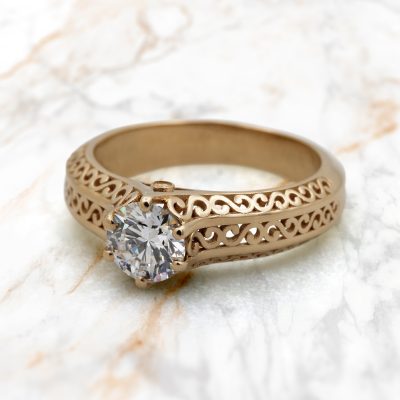
A 14k yellow gold engagement ring with filagree details set with a round lab created ...

This ring recreates a beloved family heirloom that was stolen, rebuilt from two photographs and ...
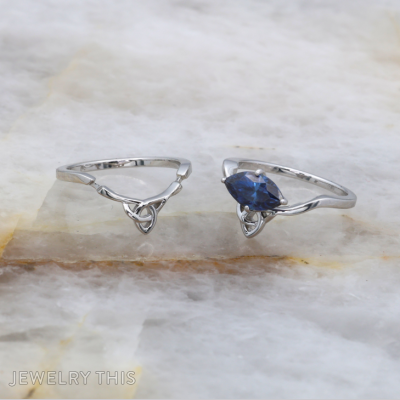
This captivating white gold wedding set features a harmonious design rich in meaning and artistry. ...

This ring rebuilds a 1970s engagement ring from a client’s memory, a handful of screenshots ...

Exquisite and timeless, this ring boasts a captivating design featuring two marquise-shaped stones set in ...
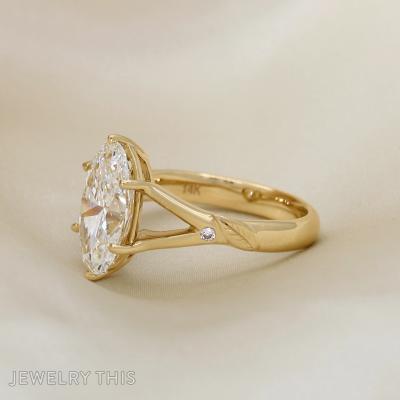
This engagement ring pairs a bold elongated oval center diamond with a softly split yellow ...

This striking 14K yellow gold engagement ring offers a beautiful blend of organic fluidity and ...

This engagement ring reimagines a familiar silhouette with the colors flipped: a colorless oval center ...

This engagement ring pairs a round moissanite solitaire with a 3mm white gold band engraved ...

This White gold engagement ring is a mesmerizing ode to love’s enchantement. Nestled at the ...

This engagement ring was designed as a close interpretation of a ring the client admired, ...



