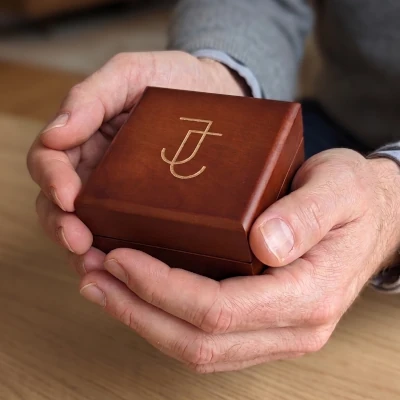


Yellow Marquise Diamond Engagement Ring in 14k Gold
$$$
14k yellow gold, yellow lab diamond
A client wanted to recreate an engagement ring design he had found elsewhere, swapping the center stone for a marquise-cut yellow lab diamond as a personal touch for his girlfriend. He held onto the finished ring for nearly a year before proposing, and when he finally did, he wrote back: 'She is obsessed with her ring and tells me everyday how much she loves it!'
'Wow looks great! Let's move onto the next step!' — on seeing the first render
'Wow it turned out great! She will love it thank you!' — on delivery
Quick specs
Design type
Primary Metal
Shape / Cut
Primary Stone
Accent Stones
Style
Design Complexity
Intent: Certainty
Size
Ring size 7 US (17.32mm).
How they made it distinctive
-
01
Marquise cut chosen specifically to match a design the client had already found and admired elsewhere
-
02
Yellow lab diamond substituted for the original stone as a personal customization
-
03
Bypass band with two polished arms meeting in a point, rather than a traditional shank and prong head
-
04
Partial bezel plus prong-tip setting chosen to protect the marquise's vulnerable points
-
05
14k yellow gold selected to complement the warm tone of the yellow diamond
How you'd make it yours
Stone: this piece uses a yellow lab diamond; a new commission could use a natural fancy yellow diamond, a different colored stone, or a colorless diamond
Metal: this piece is 14k yellow gold; the same bypass design works in 18k yellow gold, white gold, or rose gold
Setting: the partial bezel and prong-tip combination could shift to a full bezel for even more stone protection
Carat size: this piece uses approximately 1.23 carats; a new commission could scale the stone up or down within the bypass silhouette
One of a kind: this exact ring was designed for one client and is not reproduced — a new commission is an original piece inspired by this one, not a copy
Design changes made
Design matched the initial brief without major changes — the client's main request was substituting a yellow marquise lab diamond for the original ring's stone, which was carried through from the first render.
Who this is for
This piece is for someone who already has a clear picture of the ring they want — maybe from another jeweler's design — and wants it made their way, with their own stone choice and metal. It suits a partner who likes color in an engagement ring rather than a traditional colorless diamond, and who prefers a clean, sculptural band over added detail.
How it's made
Once the design was approved, a wax model was 3D printed and attached to a tree inside a flask before being invested in plaster and fired in a kiln to burn out the wax, leaving a hollow mold. Molten 14k yellow gold was then cast into the mold under pressure, producing the raw ring, which was extracted, cleaned, and prepared for finishing. A resin version was also printed and photographed before casting as a preview of the final form.
After casting, the bypass band was polished to a high mirror shine across both arms, with particular attention paid to smoothing the transition where the two arms meet at the point beneath the stone. The marquise diamond was then set using a combination of a partial bezel and fine prong tips at each pointed end of the stone, a setting style chosen to protect the vulnerable marquise points while keeping the profile low.
Key note
The marquise cut's two sharp points are its most vulnerable feature, which is why this setting combines a partial bezel with fine prong tips at each end rather than prongs alone.
Pricing guidance
A yellow gold solitaire engagement ring with a marquise lab diamond and a sculptural bypass band sits in the mid range for custom engagement rings of this style. Most of the cost is driven by the diamond's carat weight and color grade rather than the band itself, since the setting is a relatively simple two-arm design. Metal karat and any added detailing are the next biggest levers on price.
Moves price up ↑
- ↑ Choosing a larger marquise diamond, especially above 1.5 carats
- ↑ Selecting a more saturated or higher-graded fancy yellow color
- ↑ Upgrading from 14k to 18k gold
- ↑ Adding pave or halo diamonds around the center stone
- ↑ Choosing a natural fancy color diamond instead of lab grown
Moves price down ↓
- ↓ Choosing a smaller carat weight within the requested range
- ↓ Selecting a lower color saturation or more commercial-grade yellow
- ↓ Using a more standard prong-only setting instead of the partial bezel
- ↓ Choosing 10k gold instead of 14k
- ↓ Selecting a lab-grown diamond over a natural fancy color stone
Questions people ask
Yes, marquise-cut yellow lab diamonds are readily available and work well in a bypass or solitaire setting like this one. Lab-grown yellow diamonds have the same hardness and optical properties as natural fancy yellow diamonds, just grown in a controlled environment rather than mined. Because marquise cuts have two pointed ends that are prone to chipping, the setting typically combines prong tips at the points with a partial bezel along the sides for extra protection. This combination keeps the stone secure for daily wear without hiding its color or brilliance.
Diamonds rate a 10 on the Mohs hardness scale, so the material itself is extremely resistant to scratching. The main vulnerability with a marquise cut is its two sharp points, which can chip if struck directly against a hard surface. A setting with prong tips or a bezel at each point significantly reduces that risk. With a protective setting like this one, a marquise diamond holds up well for daily wear.
A yellow gold solitaire with a marquise lab diamond and a sculptural bypass band typically falls in the mid range for custom engagement rings. The center stone's carat weight and color grade are usually the biggest cost drivers, more so than the band design itself, since this setting uses a relatively simple two-arm structure. Metal karat, stone size, and any added stone detailing are the main variables that move the price up or down from there.
The process typically takes several weeks from design approval to completion. It starts with sourcing and confirming the center diamond, followed by a 3D model and photorealistic render for approval, then a 3D-printed wax model that is cast in metal, and finally hand-finishing and stone setting. Rings with a lab-grown stone that still needs to be sourced from a cutter can add roughly a week to the front end of the timeline.
Yes, a broken or snagged prong is a standard repair. The ring is sent back so a jeweler can rebuild or replace the affected prong and re-secure the stone before it's returned. If a prong has already broken, it's best to stop wearing the ring until it's repaired, since a stone with a compromised setting point is more likely to loosen or fall out. This is a routine fix and does not require remaking the entire ring.
Lab-grown and natural diamonds are chemically and optically identical, including fancy colors like yellow — the difference is entirely in origin. Lab-grown yellow diamonds are produced in a controlled lab environment in a matter of weeks, while natural fancy yellow diamonds form over millions of years and are mined. Lab-grown color diamonds are generally more accessible for a given carat weight and color saturation than their natural counterparts. Visually, side by side, there is no difference detectable to the eye or to standard jewelry equipment.
Yes, a coordinating wedding band can be designed to pair with an existing engagement ring like this one. The band is typically designed with the engagement ring's silhouette in mind — in this case, a bypass or V-shaped band — so the two sit together comfortably on the finger. Matching bands are usually made in the same metal as the engagement ring for a cohesive look, though mixing metals is also an option if requested.
Yes, settings can be adjusted for more day-to-day security, particularly around vulnerable points like the tips of a marquise stone. Options include a fuller bezel that wraps more of the stone's edge, or lower-profile prongs that sit closer to the band to reduce snagging on clothing, hair, or fabric. These adjustments are typically made at the design stage, before casting, based on the wearer's daily activities.
Explore Similar Creations
Every masterpiece starts with a spark. Explore how our clients raw ideas - sketches, heirlooms, inspirations - were transformed into bespoke works of arts.
This engagement ring replaces one that was lost, recreated as closely as possible to the ...
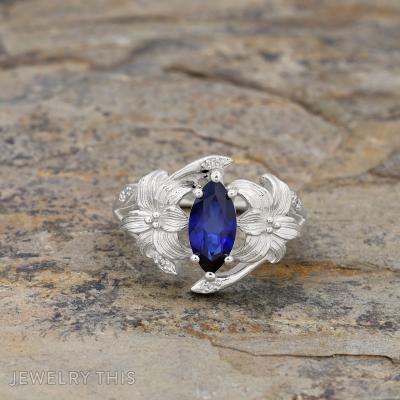
This exquisite engagement ring showcases a stunning marquise cut lab created blue sapphire as its ...

A 2.3carat oval diamond is set into a classic four prong solitaire mount. Adding to ...
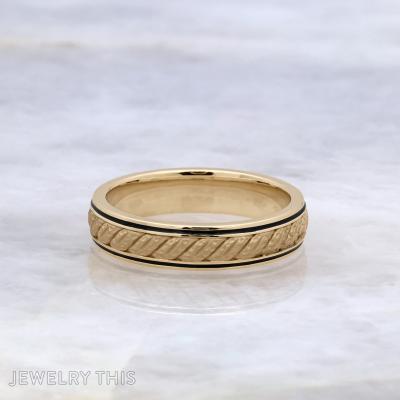
This unique gold ring was inspired by the delicate artistry of uni sushi, transforming a ...

This exquisite engagement ring showcases a striking teal-colored emerald-cut sapphire as its centerpiece. The vibrant ...

This yellow gold ring centers on a brilliant marquise diamond, elegantly framed by two smaller ...

This custom engagement ring features a stunning three-stone design that beautifully highlights the uniqueness of ...
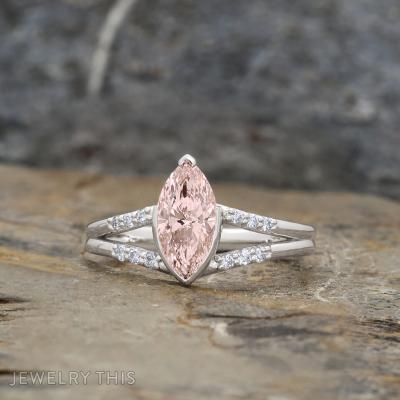
This elegant white gold engagement ring features a captivating pale pink marquise-shaped lab grown diamond ...

This stunning sapphire and diamond wedding band combines timeless elegance with a touch of color. ...
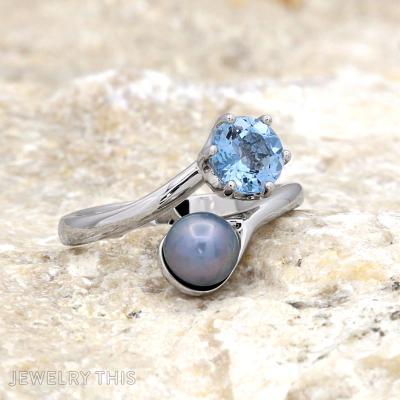
This 14k white gold engagement ring was designed as a self-purchase to mark a 50th ...

This enchanting white gold engagement ring is designed to capture a botanical-inspired motif. The centerpiece ...
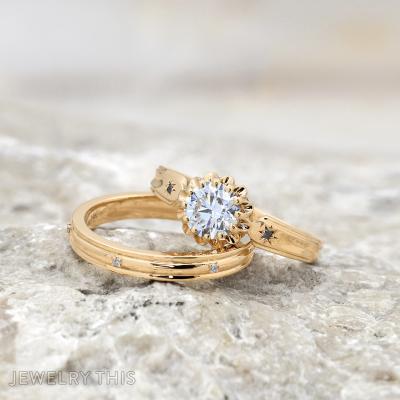
This 14k yellow gold engagement ring and wedding band set takes its cue from an ...