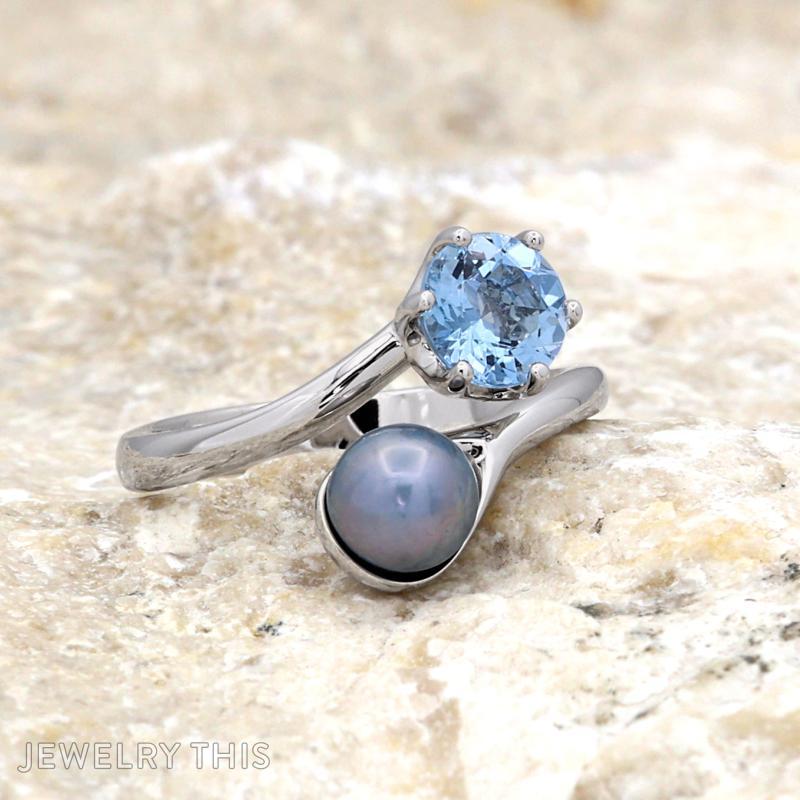
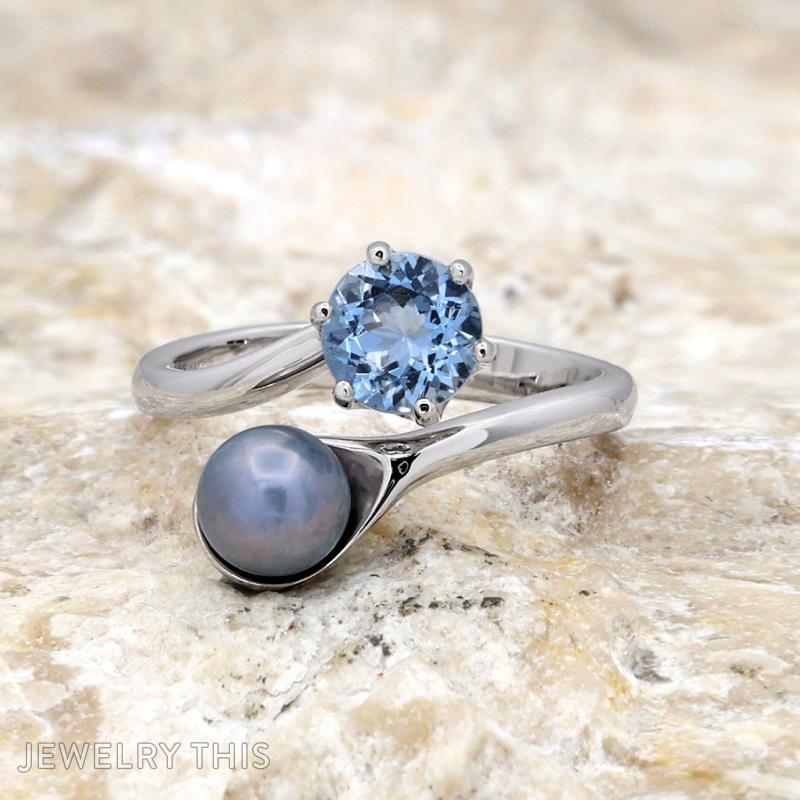
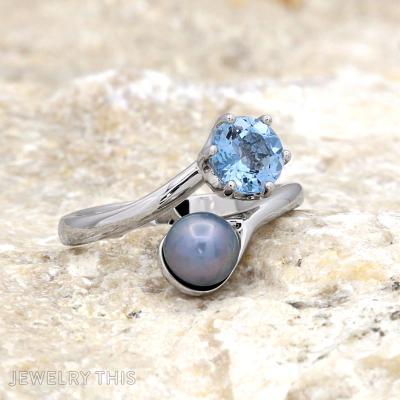
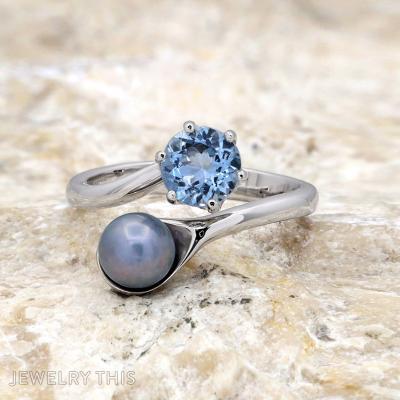
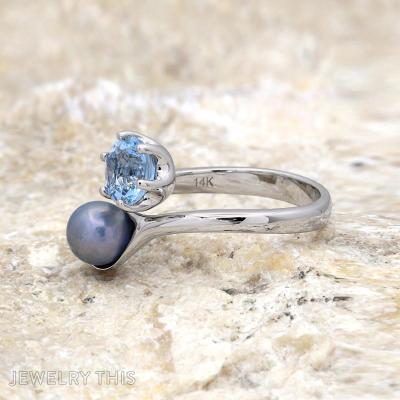
Aquamarine & Grey Pearl Self-Commitment Ring
$$$
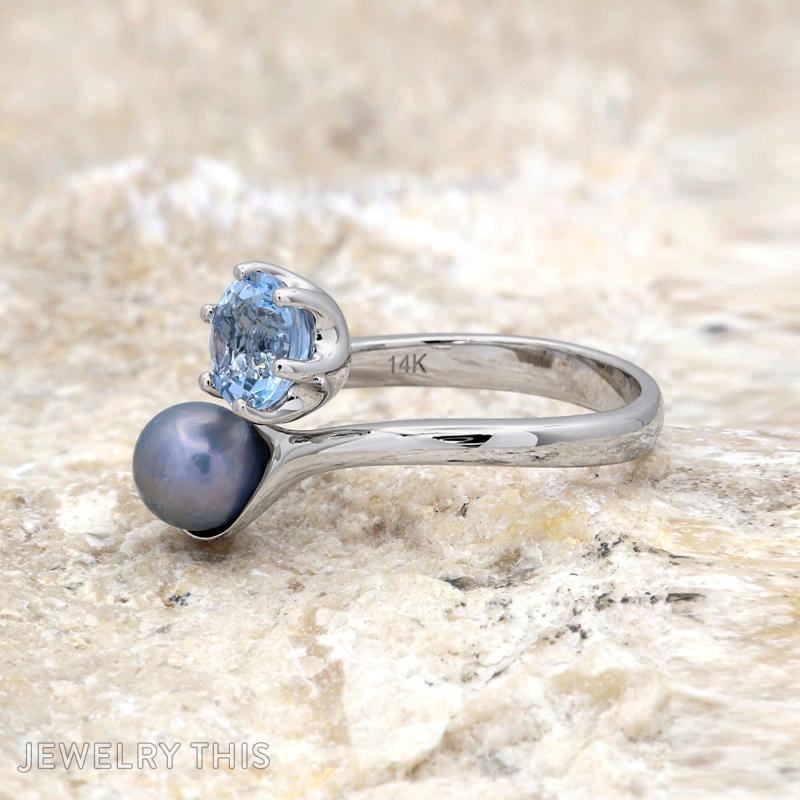
14k white gold, natural aquamarine, natural grey pearl
A. came to us wanting to design her own engagement ring as a gift to herself for her 50th birthday — a milestone she describes as a commitment to herself after everything it took to get there. The pearl honors her mother, who wore a pearl engagement ring instead of a diamond, and the aquamarine is her own birthstone. After a few rounds of fine-tuning how closely the metal wrapped around the pearl, she wrote: 'I am extremely happy. It is so beautiful and I've had so many compliments on it.'
'I love it.' — on seeing the first render
'I am extremely happy. It is so beautiful and I've had so many compliments on it.' — on delivery
Quick specs
Design type
Primary Metal
Shape / Cut
Primary Stone
Accent Stones
Style
Design Complexity
Intent: Certainty
Size
Ring size 7 US (17.32mm). Aquamarine 5.5mm round; pearl 6mm round.
How they made it distinctive
-
01
Bypass band deliberately asymmetrical — the pearl sits lower and set differently than the aquamarine, a look the client specifically requested over a symmetrical pairing
-
02
Pearl chosen in honor of her mother's own pearl engagement ring, rather than a traditional diamond
-
03
Aquamarine selected as the client's own birthstone, tying the ring to her directly
-
04
Pearl setting size fine-tuned twice to get the exact amount of metal coverage the client wanted
-
05
Grey pearl tone selected by comparing two stones side by side to avoid an unwanted purple undertone
How you'd make it yours
Stone type: this piece uses aquamarine; a new commission could use another colored gem such as sapphire or morganite for a similar bypass look
Pearl color: this piece uses a deep grey pearl; a new piece could use white, cream, or a lighter grey tone
Metal: this piece is 14k white gold; the same bypass design works in yellow or rose gold
Setting coverage: the amount of metal wrapping the pearl can be adjusted for more or less coverage on a new piece
One of a kind: this exact ring was designed for one client's 50th birthday and is not reproduced — a new commission is an original piece inspired by this one, not a copy
Design changes made
The pearl setting was adjusted twice after the client felt it needed to be 'hugged' more by the metal, then pulled back slightly when a second revision wrapped it too fully — the team returned to a setting close to the original with a slightly enlarged base. The pearl color was also finalized after comparing two grey tones, settling on the one without a purple undertone.
Who this is for
This piece is for someone marking a personal milestone on their own terms — designing an engagement ring for themselves rather than waiting for someone else to propose. It's especially right if you want a piece built from two meaningful, contrasting elements rather than a single traditional stone, and you're drawn to an asymmetrical look over a matched pair.
How it's made
Once the design was approved, the model moved to a resin (wax) print — the first physical version of the ring, shared with the client as a preview before any metal was cast. The wax models were affixed to a wax tree and invested in a mold; molten 14k white gold was then poured into the mold to form the raw ring shape, which was cleaned up before finishing began.
The ring's two settings were finished differently to suit each stone: the aquamarine sits in an open six-prong crown that lets light into the stone from multiple angles, while the pearl rests in a cupped, wraparound setting that shields its softer surface from daily contact. Both sections were polished to a consistent high-shine finish before the stones were set by hand, aquamarine first in its prong setting, then the pearl pressed and secured into its metal cup.
Key note
The pearl setting alone went through two rounds of revision after casting-stage feedback, because how much metal 'hugs' a pearl changes both its visual weight and how protected it is during daily wear.
Pricing guidance
A modern bypass-style engagement ring with a colored center stone and an accent pearl sits in the mid range for custom engagement work. Sourcing two well-matched natural stones and hand-finishing two distinct setting styles on one band accounts for most of the baseline cost. Stone size and metal karat are what move the price meaningfully from there.
Moves price up ↑
- ↑ Upgrading the aquamarine size beyond 5.5mm or choosing a higher-saturation color grade
- ↑ Sourcing a larger or rarer natural grey pearl
- ↑ Switching from 14k to 18k white gold
- ↑ Adding diamond accents along the bypass band
- ↑ Requesting a fully symmetrical dual-prong setting for both stones
Moves price down ↓
- ↓ Choosing a smaller aquamarine, such as 4mm instead of 5.5mm
- ↓ Using a more readily available white or cream pearl instead of natural grey
- ↓ Selecting sterling silver or gold-plated silver instead of 14k white gold
- ↓ Simplifying the pearl setting to a plain bezel without the wraparound cup
- ↓ Skipping the custom color-matching stone review step
Questions people ask
Yes, pairing a pearl with a colored gemstone like aquamarine is a well-established design choice, especially in bypass-style settings where each stone gets its own dedicated setting. The main consideration is durability — pearls are softer than most gemstones, rating around 2.5–4.5 on the Mohs hardness scale, so they're typically set in a protective cup or bezel rather than exposed prongs. Aquamarine, by contrast, is harder at 7.5–8 and can be prong-set to let more light through the facets. This combination lets each stone be set in the way that best protects and showcases it.
Both exist on the market — dyed pearls achieve a uniform blue-grey tone through a color treatment, while naturally grey pearls get their color from the type of oyster and water conditions they grew in. Natural grey pearls typically show subtle undertones, like a faint purple or green tint, that vary slightly from pearl to pearl. If a non-dyed pearl is important to you, it's worth reviewing a few options side by side in person or on video, since undertones can be hard to judge from a single photo. Sourcing a natural grey pearl usually takes a bit more time than a standard white or dyed pearl.
Aquamarine rates 7.5 to 8 on the Mohs hardness scale, which makes it a solid choice for a ring worn daily — harder than quartz, comparable to emerald, though softer than sapphire or diamond. It resists scratching well under normal use but can still chip if struck directly against a hard surface, so it's worth removing before heavy manual work. Its clarity and color are also stable under normal light and heat exposure, so it won't fade or change with wear. Most jewelers consider it a practical everyday stone as long as it's set securely.
A custom bypass-style engagement ring featuring a natural aquamarine and a natural pearl in 14k white gold generally falls in the mid range for custom engagement work. The cost reflects the two distinct setting styles required on one band, the sourcing of two individually matched natural stones, and the hand-finishing needed to blend both settings smoothly. Larger stones, higher-karat gold, or added diamond accents would move the price up from there. Choosing more readily available stone options or a different metal can bring the cost down.
A custom engagement ring typically takes about four to six weeks from approved design to delivery. The first week or so covers the design phase — sketch, 3D model, and rendered preview for approval — with additional time if stone sourcing or color-matching reviews are involved, as they were here. Once the design and stones are approved, casting, setting, and finishing generally take another three to four weeks. Sourcing two well-matched natural stones, rather than pulling from ready stock, can add a bit of time to the front end of the process.
Yes, adjusting how much metal wraps around a pearl is a common and relatively minor revision at the 3D model stage, before anything is cast. A slightly larger or smaller setting base changes both the visual proportion and how protected the pearl is during daily wear, so it's worth reviewing carefully from a side angle rather than just a front render. Renders can sometimes make reflective surfaces like pearls look different than the actual 3D geometry, so a side-view screenshot of the model itself is often more accurate for judging exact coverage. This kind of adjustment is easy to make before casting but not after.
Yes, using your birthstone or another meaningful colored gemstone as a center stone instead of a diamond is a common request for a self-designed or non-traditional engagement ring. Stones like aquamarine, sapphire, and morganite are popular choices because they're durable enough for daily wear while offering a distinct look and personal meaning. The design and setting process works the same way as a diamond ring — the stone type mainly affects hardness considerations for the setting style chosen. Pairing a birthstone with a sentimental stone, like a family member's preferred gem, is also a common way to build extra meaning into the design.
Most engagement rings can be resized within a limited range after completion, typically one to two sizes up or down, depending on the band structure. A bypass-style ring with two separate stone settings can be slightly more complex to resize than a plain band, since resizing affects the curve and balance of the asymmetrical design. It's best to confirm your ring size before casting whenever possible, since a well-fitted band avoids the need for resizing altogether. If a resize is needed later, a jeweler experienced with the specific setting style should handle it to preserve the design's proportions.
Explore Similar Creations
Every masterpiece starts with a spark. Explore how our clients raw ideas - sketches, heirlooms, inspirations - were transformed into bespoke works of arts.
This engagement ring was designed as a close interpretation of a ring the client admired, ...

Introducing Our Timeless Three Stone Moissanite Engagement Ring. Make a statement of eternal love with ...

This stunning 14k white gold engagement set is the perfect blend of gothic and modern. ...
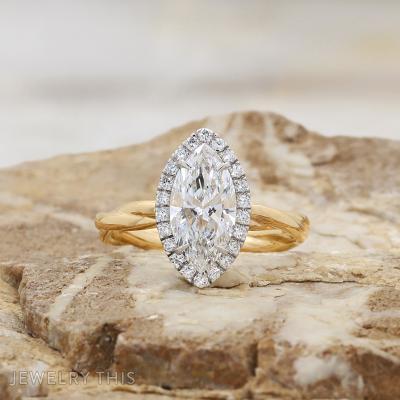
This elegant two-tone engagement ring beautifully combines modern brilliance with timeless design. At its heart, ...

This custom engagement ring is a celebration of unity, designed to symbolize the merging of ...

Elegance and grace converge in this exquisite yellow gold engagement ring, showcasing a 1.2carat marquise ...

This unique set of wedding rings is designed for golf lovers, symbolizing a shared passion ...

This custom 14k white gold engagement ring exudes elegance and charm with a timeless high-polish ...

This beautiful White gold ring is brimming with symbolism to celebrate a marriage of 20 ...

This white gold wedding band is a masterful fusion of elegance and individuality. The U-shaped ...

This white gold ring draws you in immediately with the captivating 9 carat rose cut ...

This unique yellow gold engagement ring celebrates the allure of the color green with its ...