


Art Deco Garnet Trilogy Ring in 14k Yellow Gold
$$$
14k yellow gold, natural garnet
A. found a vintage garnet trilogy ring online and regretted not buying it on the spot. She came back to have it recreated as closely as possible — matching the sand-textured petal finish and avoiding the darker, brownish garnets she didn't care for in favor of true red stones. When it arrived, she wrote: 'I can't tell you how much I love my ring. Honestly, it exceeded my expectations!'
'I can't tell you how much I love my ring. Honestly, it exceeded my expectations!' — on delivery
Quick specs
Design type
Primary Metal
Shape / Cut
Primary Stone
Accent Stones
Design Complexity
Intent: Certainty
Size
Ring size 6 US (16.51mm).
How they made it distinctive
-
01
Three garnets specifically sourced and photographed for client approval to ensure a true red tone rather than a brownish or near-black hue
-
02
Two distinct hand-applied finishes — sand/satin texture on the petal motifs and polished scrollwork on the shank — replicated from a vintage reference piece
-
03
Prongs deliberately lowered and all edges rounded so the dense three-stone setting would not catch on clothing or skin
-
04
Scalloped petal motifs at top and bottom of the setting designed to mirror the found vintage design as closely as possible
-
05
Openwork scroll filigree on the shank sides adds period-appropriate detail without adding bulk
How you'd make it yours
Stone: this piece uses three red garnets; a new commission could use sapphires, rubies, or a single larger center stone instead
Metal: this piece is 14k yellow gold; the same art deco detailing works equally well in 18k yellow gold or rose gold
Finish: the sand-textured petals and polished scrollwork combination can be adjusted to an all-polished or all-matte look on a new piece
Stone count: this piece uses a three-stone trilogy setting; a new commission could use a single stone or five-stone arrangement
Engraving: the smooth interior of the band can carry a new inscription on a fresh commission
One of a kind: this exact ring was designed to recreate a specific vintage piece for one client and is not reproduced — a new commission is an original piece inspired by this one, not a copy
Design changes made
Design matched the initial brief without major changes. The only refinements were finishing details confirmed during the render review — replicating the distinct brushed and sand-textured finishes seen in the original and rounding all edges for comfort — rather than changes to the design itself.
Who this is for
This piece is for someone who found a design they loved and couldn't let go of the specific details — the exact finish, the exact stone color, the exact proportions. It's especially right for anyone with a strong eye for detail who wants a faithful recreation rather than a loose reinterpretation of a piece that caught their attention.
How it's made
Once the render was approved, the design moved into production with a quality-assurance pass on the 3D model before the three garnets were sourced and matched for color. A resin model was 3D printed from the file and shared as a preview, confirming proportions before the piece was cast in 14k yellow gold using the lost-wax casting method.
After casting, the ring was hand-finished in two distinct zones to match the original design: the scalloped petal motifs at the top and bottom of the setting were given a sand/satin texture, while the scrollwork filigree on the shank was polished smooth. All edges and prong tips were rounded and lowered by hand during finishing so the dense setting would sit comfortably against skin and fabric. The three round garnets were then set last, secured with lowered prongs bent carefully over each stone.
Key note
The textured and polished finishes seen on the petals versus the shank scrollwork are both applied entirely by hand after casting, which is why each one varies slightly from the render.
Pricing guidance
A three-stone garnet ring in 14k gold with this level of filigree and hand-applied texture work sits in the mid range for custom rings of complex design. Most of the cost comes from the hand-finishing labor needed to achieve two distinct surface textures and from matching three garnets for consistent color. Metal karat and stone count are the next biggest variables.
Moves price up ↑
- ↑ Upgrading from 14k to 18k yellow gold increases material cost
- ↑ Adding more stones beyond the three-stone trilogy setting
- ↑ Requesting hand-carved detail across a larger portion of the shank rather than just the sides
- ↑ Sourcing rarer high-saturation red garnets or a larger carat size per stone
- ↑ Adding milgrain or additional filigree detail to more surfaces of the ring
Moves price down ↓
- ↓ Using a single larger garnet instead of a three-stone setting
- ↓ Simplifying the filigree scrollwork on the shank to a plain polished band
- ↓ Reducing the petal texture to a smaller area or omitting it
- ↓ Choosing 10k gold instead of 14k
- ↓ Selecting a less dense, lower-profile setting overall
Questions people ask
Yes. This ring was recreated from a vintage listing the client found online, matched as closely as possible using photos and written details rather than the physical piece. The process starts with a sketch, moves to a 3D model, and then a photorealistic render for approval before any metal is cast. Small details like surface finish and stone color can be refined during the render stage to get as close to the reference as possible.
Garnet rates about 6.5 to 7.5 on the Mohs hardness scale depending on the variety, which makes it suitable for regular wear with reasonable care. It is not as hard as sapphire or diamond, so it can scratch if knocked against harder surfaces, but it holds up well in a protected three-stone setting like this one. Garnet does not require special cleaning beyond standard warm soapy water and a soft brush. Avoid ultrasonic cleaners if the stone has any visible inclusions.
Yes, garnet color can vary quite a bit from brownish-red to a more saturated true red, and this is something that can be discussed and confirmed before stones are set. In this case, the client specifically wanted to avoid garnets that lean brown or appear nearly black in a dense setting, and redder stones were sourced and photographed for approval before production. Color matching across multiple stones in the same piece is also something that gets extra attention so the final look is consistent. A photo of the sourced stones can usually be shared before they're set.
A three-stone garnet ring in 14k gold with filigree detailing and hand-applied texture work generally falls in the mid range for custom ring work. The main cost drivers are the hand-finishing labor for multiple surface textures and the gold content itself. Simpler settings with fewer stones or less ornamental detail would typically cost less, while upgrading metal karat or adding more stones would push the cost higher.
The full process from approved design to finished ring typically takes about four to six weeks total. The design phase, including sketch, 3D model, and render approval, usually takes about a week. Once the design is approved, production including casting, hand-finishing, and stone setting generally takes three to four additional weeks before the piece ships.
Yes, edge comfort is a standard part of the finishing process on detailed rings. Renders often look sharper and thicker than the finished piece because final edges, prong tips, and surface transitions are rounded and polished by hand during finishing. On this ring specifically, the prongs were lowered and rounded so they would not catch on clothing or scratch skin despite the dense three-stone setting.
A brushed finish is created with fine parallel lines that give a soft, directional sheen, while a sand or satin finish has a more uniform, matte, slightly textured surface without directional lines. Both are achieved by hand after casting and polishing, using different abrasive techniques. On a piece with multiple finish zones, like scalloped petal details versus smooth scrollwork, each area can be finished differently to create contrast. Because these finishes are applied by hand, there is normally some natural variation from piece to piece.
Yes, this is a common technique in detailed custom work where different areas of a piece carry different visual weight. On a ring like this, the scalloped petal motifs were given a sand-textured finish while the scrollwork filigree on the shank was polished smooth, creating contrast between the ornamental top and the structural sides. These finishes are applied in sequence by hand after casting and before stone setting.
Explore Similar Creations
Every masterpiece starts with a spark. Explore how our clients raw ideas - sketches, heirlooms, inspirations - were transformed into bespoke works of arts.
A heartfelt recreation of a cherished gift passed down from the client’s grandmother, the ring ...

Immerse yourself in the allure of this custom ring, a harmonious blend of sophistication and ...

This custom ring combines tradition and elegance in perfect harmony. The intricate design reflects the ...

This stunning rose gold ring features a captivating center oval-shaped opal cabochon that’s perfectly bezel ...
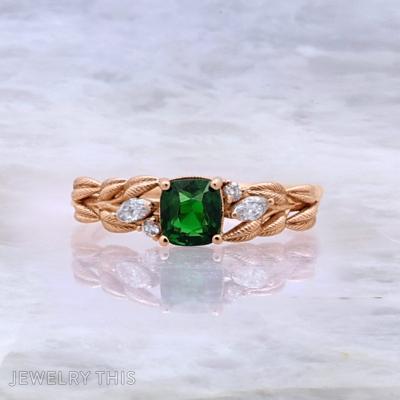
This exquisite rose gold engagement ring is a celebration of vibrant color and intricate craftsmanship. ...

This wide crossover band was recreated from a client’s photos of a ring his wife ...

This wedding-style band is built around a three-row stone layout: two outer rows of round ...

This meticulously recreated ring set is a breathtaking testament to enduring love. Crafted in gleaming ...

This 18karat white gold men’s ring is a masterpiece of refined elegance. At its heart ...

Crafted in yellow gold, this nature-inspired band showcases a lush array of sculpted leaves that ...

This ring was recreated from photographs of a family heirloom that had been lost. Built ...

This ring harmoniously blends bold design with personalized symbolism. Crafted from black rhodium plated silver, ...



