


Heptagon Star Pendant in 14k Gold with Center Diamond
$$
14k yellow gold, lab diamond
A client came to us with a reference photo of a star-in-polygon design and a clear idea of how she wanted it built differently — chain fixed at two points on the heptagon rather than hanging from a single bail, so it would sit flat and centered. She chose a lab diamond center stone over the emerald option after seeing both in the render. When it arrived, she wrote simply: 'I got it and it's perfect!'
'Looks great thank you!' — on seeing the resin production preview
'Thank you I got it and it's perfect!' — on delivery
Quick specs
Design type
Primary Metal
Shape / Cut
Primary Stone
Accent Stones
Design Complexity
Intent: Certainty
Size
Pendant approximately 1 inch (25mm) heptagon. Chain: 14k yellow gold cable link, 1.3mm width, 16in total length including pendant.
How they made it distinctive
-
01
Chain soldered to two fixed points on the heptagon instead of a single bail — keeps the pendant centered and prevents it from twisting during wear
-
02
Thicker outer border paired with thin interior spokes creates a deliberate visual hierarchy between frame and detail
-
03
Center stone is bezel-set exactly at the convergence point of all six interior spokes
-
04
Lab-created diamond chosen over the natural emerald option after comparing both in the design render
-
05
Fully open cut-out construction rather than a solid plate, giving the piece a lighter, architectural look despite its geometric boldness
How you'd make it yours
Stone: this piece uses a lab diamond; a new commission could use a natural diamond, emerald, ruby, or a colored stone like garnet or topaz
Metal: this piece is 14k yellow gold; the same open-wire design works in white gold or rose gold
Size: this piece is made at approximately 1 inch; a new commission can be scaled larger or smaller
Chain: this piece uses a 1.3mm cable chain fixed at two points; a new piece could use a thicker chain or a different link style
One of a kind: this exact pendant was designed for one client and is not reproduced — a new commission is an original piece inspired by this one, not a copy
Design changes made
The chain gauge was adjusted from 1.5mm to 1.3mm during production at the jeweler's recommendation for better proportion with the pendant, and the final chain length was confirmed at 16 inches total including the pendant rather than 16 inches of chain alone.
Who this is for
This piece is for someone drawn to clean geometric design who wants a statement pendant that still feels minimal rather than ornate. It's especially right if you had a reference image in mind but wanted a specific construction detail changed to suit how you actually want to wear it.
How it's made
Once the heptagon design was approved, the team built a 3D model and printed a resin version on a 3D printer — shared with the client as a production preview. The resin was attached to a wax tree, invested in plaster, and the wax burned out in a kiln to leave a hollow mold. Molten 14k yellow gold was then cast into the mold, producing the open-wire heptagon and star structure in one piece.
After casting, the frame was cleaned, polished, and finished to a bright, even shine across both the thick outer border and the thin interior spokes. The lab-created diamond was bezel-set at the center point where all six spokes converge, securing the stone flush within the geometric framework. The chain was soldered directly to two fixed points on the heptagon's upper edge rather than threaded through a single bail, keeping the pendant from rotating or hanging off-center.
Key note
The chain is soldered to two separate points on the heptagon rather than run through a single bail, which is what keeps an open geometric pendant like this from twisting to one side during wear.
Pricing guidance
A geometric cut-out pendant like this sits in the low-to-mid range for custom gold pendants of moderate complexity. Most of the cost comes from the open-wire construction itself — more individual wire segments and junctions mean more hand-finishing and polishing than a solid pendant of the same size. Center stone choice and chain material are the next biggest cost variables.
Moves price up ↑
- ↑ Upgrading the center stone from lab diamond to natural diamond or a larger carat weight
- ↑ Choosing a higher karat gold such as 18k instead of 14k
- ↑ Adding stones along the spokes or border instead of a single center stone
- ↑ Increasing the pendant size beyond 1 inch, which requires more wire and more finishing
- ↑ Upgrading the chain to a thicker gauge or a more complex link style
Moves price down ↓
- ↓ Choosing a colored stone such as garnet or topaz instead of diamond
- ↓ Reducing the pendant size slightly to use less metal
- ↓ Selecting a simpler chain style or a shorter length
- ↓ Leaving the center open with no stone at all
- ↓ Choosing sterling silver with gold plating instead of solid 14k gold
Questions people ask
The center stone in this pendant is a lab-created diamond, VS1 clarity, which is chemically identical to a natural diamond — same hardness, same brilliance, same durability for everyday wear. The only difference between lab and natural diamonds is where they are formed: one is grown in a controlled lab environment, the other is mined. Lab diamonds typically cost significantly less than natural diamonds of the same size and clarity grade. Visually and structurally there is no difference a jeweler or wearer would notice.
Instead of a single bail or loop at the top, this pendant's chain is soldered directly to two separate points along the upper edge of the heptagon frame. This fixed, two-point attachment keeps an open geometric design like this one from rotating or twisting to one side while worn, which is a common issue with single-bail pendants that have an asymmetrical or wide silhouette. The tradeoff is that the chain cannot be swapped out as easily as a standard slide-on pendant.
A cut-out geometric pendant in 14k gold with a center stone sits in the low-to-mid range for custom pendant work. The open-wire construction requires more hand-finishing per piece than a solid pendant of similar size, since every wire segment and junction point needs to be cleaned and polished individually. Stone choice has the biggest impact on final cost — a lab diamond keeps the price lower than a natural diamond or emerald of comparable size.
The full process from approved design to finished piece typically takes about one week for the design and render stage, followed by three to four weeks of production. Production includes building a 3D model, 3D-printing a resin preview, casting the metal, and finishing and stone-setting the piece. Most custom pendant projects on a standard timeline are complete within five to six weeks total from deposit to shipping.
Yes, a design like this one works well with a variety of center stones beyond diamond. Emerald and ruby were both offered as options on this piece, and other colored stones such as garnet or topaz would also sit well in a bezel setting at the center of the star. The main consideration is durability for daily wear — diamond and ruby are both very hard stones, while emerald is softer and needs slightly more care.
A well-cast open-wire pendant in 14k gold with a thicker outer border is built to hold its shape under normal wear, since the thicker frame does most of the structural work while the thinner interior spokes are mostly decorative. That said, any open-wire design is more vulnerable to bending than a solid pendant if it is dropped, crushed, or caught on something, because there is less metal mass distributing force. Avoiding harsh impacts and removing the piece before activities with a high risk of snagging will keep the shape intact longer.
Yes, repeat orders of an identical design are possible, and the cost is typically somewhat lower than the original because the design and 3D modeling work is already complete. Material and stone costs still apply in full for the second piece. Changing the center stone on a repeat order — for example switching from diamond to ruby — is also possible and would adjust the price based on the new stone's cost.
For a geometric statement pendant like this one, a size in the 1 to 1.5 inch range tends to read as noticeable but still wearable for daily use, while anything larger shifts toward a bolder statement piece. Chain length also affects how the pendant sits — a shorter 16 inch chain positions it higher on the chest, while longer lengths let it sit lower. The best approach is to measure a similar-sized object against your chest at the length you're considering before finalizing dimensions.
Explore Similar Creations
Every masterpiece starts with a spark. Explore how our clients raw ideas - sketches, heirlooms, inspirations - were transformed into bespoke works of arts.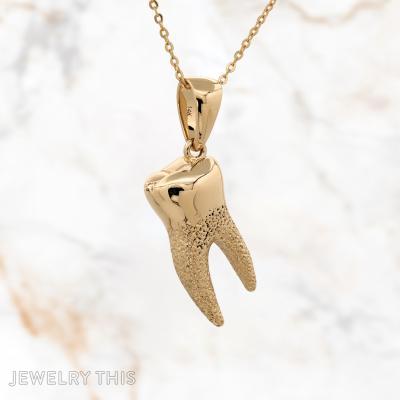
This pendant takes the familiar shape of a molar tooth and renders it fully three-dimensional ...

Crafted with meticulous attention to detail, this custom initial pendant exudes elegance and sophistication. Made ...

This circular pendant recreates a lost piece from memory and a single low-quality photo. A ...

This custom pendant features a unique diamond-shaped design with an intricate cut-out cloud motif at ...

This custom pendant is a striking blend of classic and intricate design, crafted in silver ...

This double-sided pendant was designed from a client-supplied reference image, combining two distinct design languages ...

This sterling silver round pendant was designed to represent the client’s heritage and captures the ...

This 14k yellow gold pendant necklace was rebuilt from faded photographs and a hand-drawn sketch ...

This custom pendant features a distinctive panda logo adorned with a crown, meticulously crafted to ...

This pendant reinterprets the traditional palaoa form — historically carved from whale ivory — in ...

This pendant symbolizes strength, unity, and spiritual purpose, drawing inspiration from a powerful logo. The ...

A radiant homage to a cherished costume piece, this pendant captures the essence of tropical ...



