

Family Birthstone Crescent Moon Pendant with Star Accent
$$$
14k white gold, 14k yellow gold accent, natural peridot, natural ruby, natural garnet, diamonds, blue enamel
A new father wanted to mark his girlfriend's birthday with a pendant that represented their growing family — his peridot, her ruby, and their six-month-old son's garnet, with room left for more birthstones down the road. Through several rounds of sketches he refined small details himself: a hidden letter K worked into the bail, a single star at the base of the moon, and the royal blue enamel he didn't want to lose along the way. When it arrived he wrote: 'I got it! Looks gorgeous — she loves it!'
'I got it! Looks gorgeous — she loves it!' — on delivery
Quick specs
Design type
Primary Metal
Secondary Metal
Shape / Cut
Primary Stone
Accent Stones
Design Complexity
Intent: Certainty
Size
Pendant approximately 0.75-1 inch in length. Chain: 14k yellow gold figaro, 2.4mm width, 18 inches.
How they made it distinctive
-
01
Bail worked into a scrolling letter K rather than a plain loop — a hidden nod to the family name
-
02
Three natural birthstones set along the arch, one for each family member, with room left for more
-
03
Single yellow gold star set apart in a warmer alloy against the white gold body for contrast
-
04
Royal blue enamel fired into the inner curve, a detail the client specifically asked to preserve after an early render omitted it
-
05
Sized to 0.75-1 inch specifically to allow the pave detail and stones to survive casting at a dainty scale
How you'd make it yours
Stone selection: this piece uses peridot, ruby, and garnet; a new commission could use any birthstone combination for a different family
Metal: this piece is two-tone white and yellow gold; the same design language works in a single tone
Bail design: this piece hides a letter K; a new piece could hide a different initial or symbol
Enamel color: this piece uses royal blue; other enamel colors are possible in the same inner-curve placement
One of a kind: this exact pendant was designed for one family and is not reproduced — a new commission is an original piece inspired by this one, not a copy
Design changes made
The bail was reworked into a scrolling letter K after the first sketch, and a single yellow star was added at the base of the moon in place of an earlier plan for small color accents along the arch, which proved too fine to execute at this scale.
Who this is for
This piece is for someone who wants a family milestone piece that can grow over time, not just mark a single moment. It's especially right for a parent who wants each person in the family represented individually rather than through one generic symbol, and who appreciates a personal detail — like an initial hidden in the design — that only they know is there.
How it's made
Once the design was approved, a 3D-printed resin model was produced and shared with the client before casting — the first physical form of the piece. The resin was invested in plaster and fired to burn out the model, leaving a mold that molten 14k white gold was cast into under pressure. After cooling, the piece was cut from the tree, cleaned, and prepared for finishing.
The scrolling letter-K bail was hand-finished to soften its lines before the crescent's outer arch was set with a row of small pave stones, into which the peridot, ruby, and garnet were seated individually. Royal blue enamel was fired into the inner curve of the crescent, and the yellow gold star was cast separately in a warmer alloy and attached near the base, giving the piece its two-tone finish.
Key note
The bail was deliberately designed as a disguised letter K — a personal detail worked into a structural part of the piece rather than added as decoration.
Pricing guidance
A two-tone gold pendant with multiple natural birthstones, enamel work, and pave accent stones sits toward the upper end of the mid range for custom pendant work. The complexity driver here is the combination of enamel firing, multiple individually set stones, and a two-metal construction, each of which adds separate labor steps. Chain choice and gemstone quality add further variation on top of the base pendant cost.
Moves price up ↑
- ↑ Adding more birthstones as the family grows, each requiring its own setting
- ↑ Upgrading accent stones from lab to natural diamonds throughout the arch
- ↑ Choosing a heavier or wider chain in solid gold
- ↑ Adding enamel in additional colors or zones
- ↑ Increasing the pendant size, which increases metal weight and stone scale
Moves price down ↓
- ↓ Using a single metal tone instead of two
- ↓ Reducing the number of individually set birthstones
- ↓ Choosing a lab-created stone in place of one or more natural birthstones
- ↓ Selecting a thinner, lighter chain
- ↓ Simplifying the outer arch to fewer pave stones
Questions people ask
Yes, this is a common request and is well suited to a design with room along an arch or border to set several small stones individually. It helps to plan for future additions early, since leaving physical space in the design is easier than modifying a finished piece later. Each stone is typically set one at a time rather than cast in place, which keeps the setting secure and allows slight adjustments in position. Natural stones in different colors, like peridot, ruby, and garnet, read clearly next to each other because their hues are distinct.
Fired enamel is a glass-like coating bonded to the metal at high heat, which makes it more durable than cold enamel or paint, but it can still chip if struck hard against a solid surface. It holds up well to normal daily wear, including light contact with clothing. Avoiding impact against hard surfaces, like countertops or jewelry boxes packed too tightly, is the main way to protect it long-term. If it does chip, the enamel section can typically be refired by a jeweler experienced with the technique.
Natural and lab-created stones of the same type share the same chemical structure, hardness, and appearance to the eye. The difference is origin: natural stones form in the earth over long periods, while lab-created stones are grown in controlled conditions in a fraction of the time. Some clients specifically want natural stones for family or birthstone pieces because of the traditional association, while others choose lab stones for cost or consistency. Both are durable enough for a pendant that isn't worn against hard daily impact.
A pendant with this level of detail typically takes about one week for the design phase — sketch, then a 3D render for approval — followed by three to five weeks of production. Production includes 3D-printed resin modeling, casting, hand-finishing, enamel work, and individual stone setting, each of which adds time compared to a simple cast pendant. Enamel work in particular requires a firing step that isn't part of a standard casting process. Rush timelines are sometimes possible but depend on the complexity of the specific design.
Very small pendants — under about half an inch — do limit how much detail and how many stones can be included, since gemstones need a minimum amount of metal around them to sit securely after casting. Sizing a piece to around three-quarters of an inch to one inch, rather than half an inch, usually allows small stars, birthstones, and pave detail to survive casting cleanly. Extremely fine detail, like tiny colored dots, may not be feasible at very small scale even if it looks fine in a sketch. A jeweler can usually tell you before production whether a specific detail will hold up at a given size.
A pendant combining multiple natural birthstones, enamel detailing, pave accent stones, and two-tone metal falls in the upper-mid range for custom pendant work, largely because of the number of separate production steps involved. Cost is driven primarily by labor — enamel firing, individual stone setting, and finishing two different metal tones — more than by material cost alone. A chain is typically priced separately from the pendant itself. Simpler versions with fewer stones or a single metal tone would come in lower.
It depends on the design — pieces built with a defined arch or row of stones can sometimes accommodate one or two more stones if space was intentionally left during the original design. This typically requires sending the piece back so a jeweler can assess the setting and add stones without disturbing the existing ones. It's not guaranteed to work on every design, so it's worth mentioning future additions during the initial design conversation. Planning ahead, even loosely, makes later additions more feasible than trying to retrofit a fully finished piece.
The bail — the loop that connects the pendant to the chain — is structural, but it can also be shaped into a letter, symbol, or decorative form without compromising its function. Turning it into an initial or monogram is a way to add a personal detail without altering the main body of the design. It does take additional design and casting care to make sure the shape still holds the chain securely. This kind of detail is usually worked out during the sketch phase, before the 3D model is built.
Explore Similar Creations
Every masterpiece starts with a spark. Explore how our clients raw ideas - sketches, heirlooms, inspirations - were transformed into bespoke works of arts.
This sterling silver dog tag-shaped pendant features a beautifully detailed scene commemorating a beloved woman. ...

A stunning 14k white gold pendant featuring a beautiful Mugunghwa Flower design on a matte ...

Crafted as a distinctive emblem of craftsmanship and pride, this custom logo pendant embodies Millikan ...

This exquisite 14k yellow gold logo charm pendant is a dazzling representation of personal style ...

The centerpiece of this 14 karat yellow gold necklace is a beautifully detailed ship’s helm ...
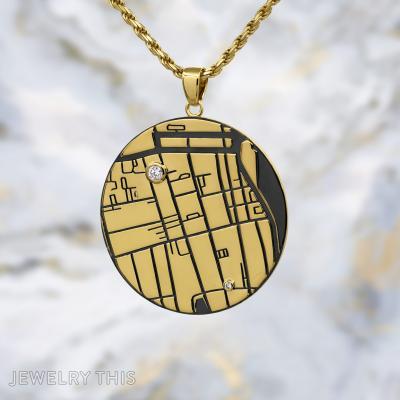
This round pendant reproduces a street map as fine engraved linework across a solid gold-plated ...
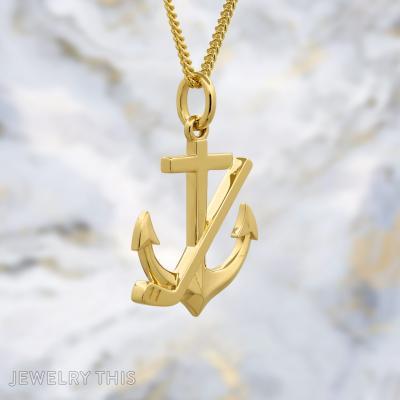
This 14k yellow gold pendant merges three meaningful symbols into one cohesive design: a cross, ...

A 14k yellow gold pendant with dimensional cross, rainbow, and arrow symbols on a sandblasted ...

This custom pendant is a beautifully crafted sterling silver key design, making it a symbol ...

Embrace the natural beauty of the wilderness with this captivating custom pendant. Entirely three-dimensional, it ...

This pendant reimagines two state outlines as one wearable design: the state of Georgia forms ...

This striking 14K yellow gold plated pendant features a Southern Cross design. This unique piece ...



