Custom City Map Pendant in Gold with Diamond Markers
$$$
14k gold-plated sterling silver, natural diamonds
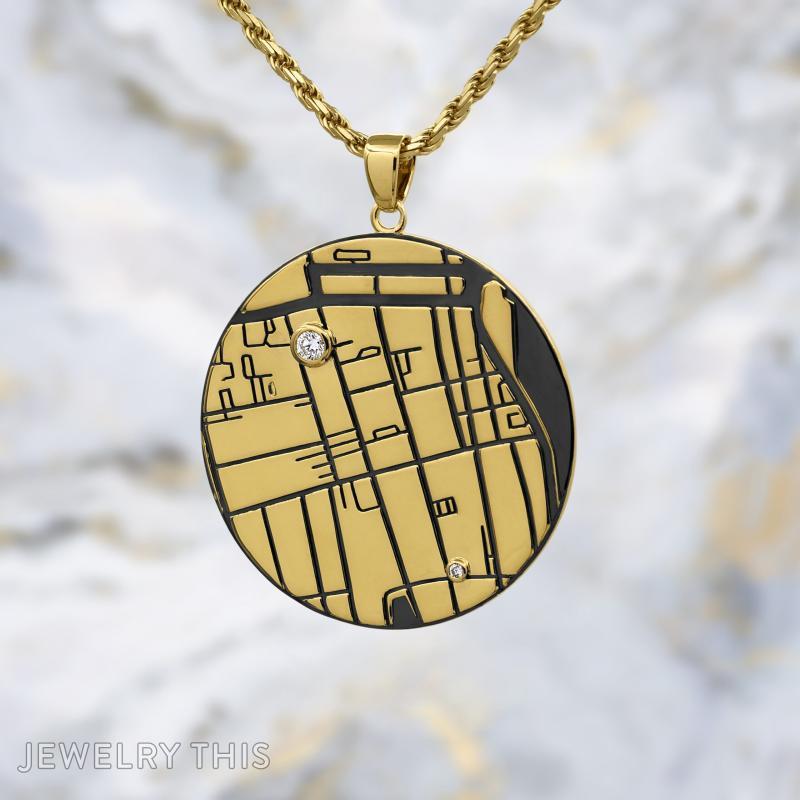
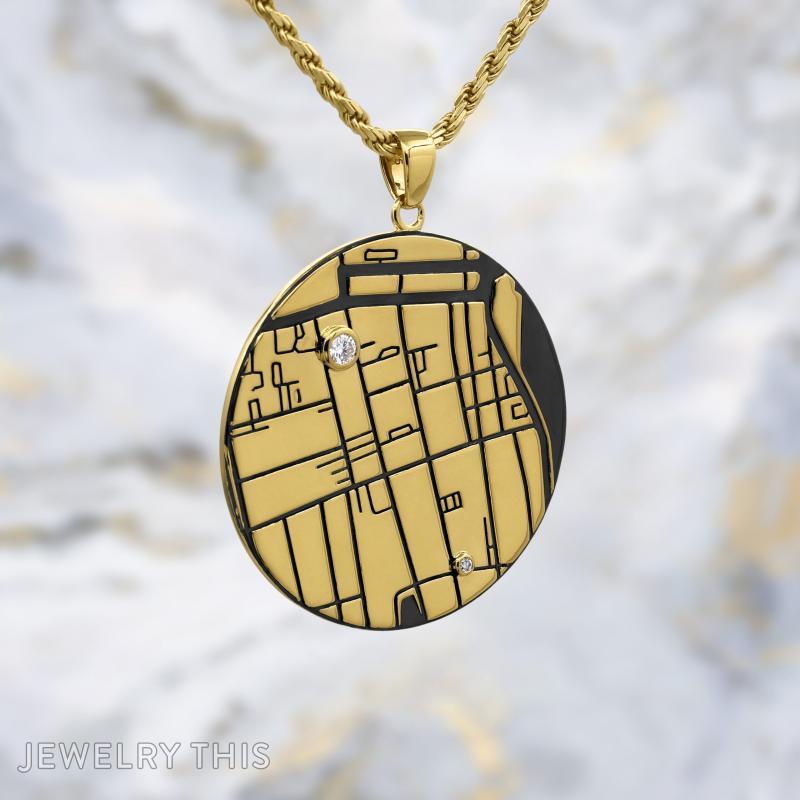
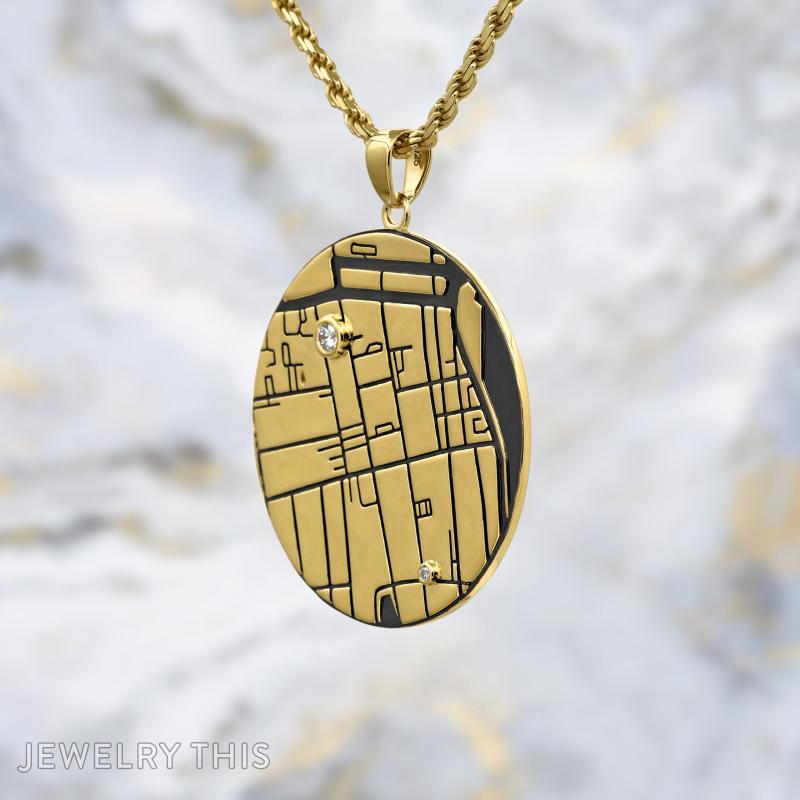
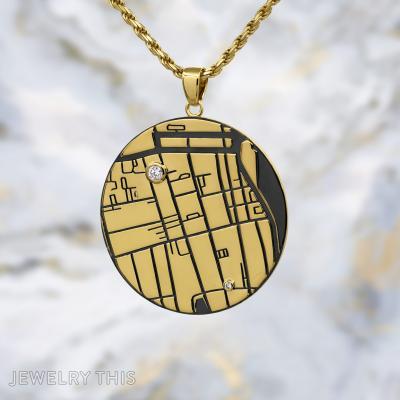
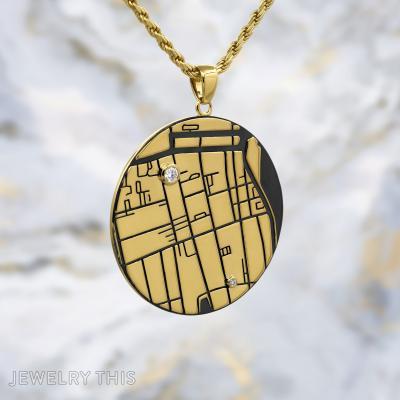
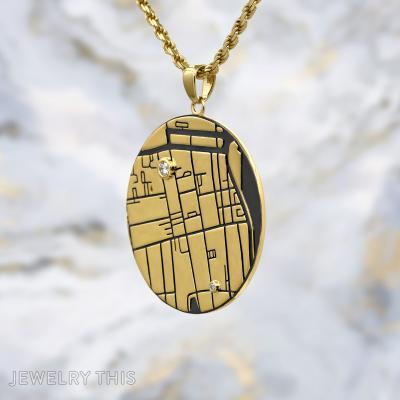
A client wanted to carry a specific place with him — a map of a meaningful area rendered in gold, with two diamonds marking two exact spots on it. The original cut-out design had to be adapted after the production team found the fine street lines wouldn't cast reliably in silver, so the piece became an engraved, blackened map instead. He approved the final look right away: 'I think that looks great.'
'I think darkening the engraved parts sounds like a good idea and would make it look more like an actual map than just a gold disc.' — on reviewing the first render
'I think that looks great.' — on approving the final render
Quick specs
Design type
Primary Metal
Shape / Cut
Primary Stone
Accent Stones
Design Complexity
Intent: Certainty
Size
Pendant 38mm (1.5in) diameter. Chain sold separately.
How they made it distinctive
-
01
Engraved, oxidized-black street lines chosen over an open cut-out design because fine silver linework couldn't be cast reliably
-
02
Two round diamonds bezel-set at two specific, personally meaningful points on the map rather than as generic accents
-
03
Engraving darkened after the first render specifically so the piece would read as a real map rather than a decorative pattern
-
04
Sized at 1.5 inches to keep the map detail legible while remaining wearable as an everyday pendant
How you'd make it yours
Stone type: this piece uses natural diamonds; a new commission could use lab diamonds or moissanite for the same look at lower cost
Metal: this piece is 14k gold-plated sterling silver; the same map design works in solid 14k or 18k gold for more durability
Design style: this piece uses engraved lines; a true cut-out design is possible in a sturdier metal like solid gold
Map area and marked points: a new piece would use its own chosen location and its own meaningful coordinates
Size: this piece is 1.5 inches; a new commission can be sized larger or smaller depending on how much map detail is wanted
One of a kind: this exact pendant reproduces one specific map and is not reproduced — a new commission is an original piece inspired by this one, not a copy
Design changes made
The design shifted from an open cut-out map to a solid disc with engraved, oxidized-black street lines after the master jeweler determined the fine cut-out lines would be too fragile and difficult to cast in silver. The client also asked for the engraved lines to be darkened after the first render, to make the map read more clearly.
Who this is for
This piece is for someone who wants to carry a specific place with them, not just a decorative pendant. It's especially right if you have one or two exact locations that matter to you and want them marked permanently on something you wear every day.
How it's made
The approved design was built into a 3D CAD model and 3D-printed as a resin pattern, which was shared with the client as a preview before casting. The resin was attached to a wax tree, invested in plaster, and fired in a kiln to burn out the pattern, leaving a hollow mold. Molten 14k gold-plated sterling silver was then cast into the mold, cooled, and released from the plaster.
After casting, the pendant was cleaned and polished to a bright finish on the raised map surface, while the engraved street lines were oxidized and blackened to create contrast against the gold. Two round natural diamonds were then bezel-set directly into the map at the two locations the client specified, securing the stones flush with the engraved surface.
Key note
The map's cut-out design was changed to solid-and-engraved specifically because silver is too soft to reliably cast the fine, narrow street lines the original open design required.
Pricing guidance
A moderately complex engraved map pendant with two diamond accents sits in the mid range for custom pendant work. Most of the cost comes from the CAD modeling required to convert a real map into engraved linework, plus the diamond setting. Stone choice and pendant size are the biggest variables from there.
Moves price up ↑
- ↑ Increasing pendant size beyond 1.5 inches, which requires more metal and more detailed engraving
- ↑ Adding more diamonds or larger diamonds at additional map locations
- ↑ Upgrading from gold-plated silver to solid 14k or 18k gold
- ↑ Requesting a true cut-out design in a metal sturdy enough to support it, such as solid gold
Moves price down ↓
- ↓ Switching from natural diamonds to lab diamonds or moissanite for the same look at lower cost
- ↓ Reducing to a single accent stone instead of two
- ↓ Choosing a smaller pendant size, such as 1 inch
- ↓ Omitting the chain and using an existing one
Questions people ask
Yes. A specific street map area can be converted into a CAD model and engraved onto a metal pendant, reproducing the actual road layout as fine linework. Very thin, open cut-out street patterns can be difficult to cast in softer metals like silver, so an engraved and oxidized design is often used instead to keep the same visual detail while making the piece more durable. The map area, size, and which streets are included are all customizable based on the coordinates or address given.
Cut-out designs rely on thin, unsupported metal lines, and very fine or intricate line work can be too delicate to cast reliably, especially in silver, which is a softer metal than gold. When lines are too thin, the molten metal may not fill the mold completely during casting, leading to breaks or an incomplete piece. An engraved and oxidized design achieves the same visual map detail with far more structural stability, since the background stays solid and only the surface is carved. This is a common adjustment for detailed map or pattern pendants and is usually caught during the 3D modeling stage before casting.
Gold-plated sterling silver is a solid .925 silver base with a layer of real gold applied over the surface. It gives the appearance and warmth of solid gold at a lower material cost, but the gold layer is a coating rather than solid-through metal. With daily wear, the plating will gradually wear thinner over time, particularly at points of friction like the pendant's edges. Higher-karat plating and less frequent contact with skin oils, lotions, and moisture will help it last longer before it needs re-plating.
A pendant like this, with detailed engraving and two natural diamond accents, sits in the mid range for custom pendant work of this complexity. The main cost drivers are the CAD design work needed to translate a real map into engraved detail, and the diamond sourcing and setting. Choosing lab diamonds or moissanite instead of natural stones, or reducing the pendant size, are the most effective ways to bring the cost down while keeping the same design.
Yes. Diamonds or other small accent stones can be bezel-set at any specific point on the map that has personal meaning, such as a home, a meeting place, or a landmark. In this piece, one diamond marks one location and a second, smaller diamond marks another. The exact points are planned during the 3D modeling stage so the stones sit securely within the engraved design rather than on a delicate unsupported line.
The full process typically takes about five to six weeks from approved design to delivery. The first week or so covers the 3D design and render review, where the client can request adjustments like line thickness or added darkening on the engraving. Once the design is approved, production including casting, polishing, oxidizing, and stone setting generally takes about four to five weeks. A resin or wax preview is often shared partway through production so the client can see the piece before it's cast in metal.
Yes. The depth and color of the oxidized engraving can be adjusted after the first render if the client wants the design to stand out more or less against the polished metal. Darkening the engraved lines, as was done on this piece, increases the contrast between the raised gold surface and the recessed map detail, making the map easier to read at a glance. This kind of adjustment is made before the piece goes into final production.
Not by default — pendant pricing typically covers the pendant itself, with a chain available as an optional add-on. A standard rope-style chain in a matching gold finish is a common choice for a pendant like this. Clients who already own a suitable chain can skip this add-on and use their own to reduce the total cost.
Explore Similar Creations
Every masterpiece starts with a spark. Explore how our clients raw ideas - sketches, heirlooms, inspirations - were transformed into bespoke works of arts.
This delicate and sentimental pendant was designed as a touching tribute to a beloved husband ...


Indulge in the timeless beauty of this custom sterling silver pendant. Expertly crafted, this oval-shaped ...

Indulge in the captivating allure of this custom pendant crafted from 14k white gold, this ...

This 14k yellow gold custom initial pendant is a personalized masterpiece that radiates individuality. Crafted ...

This sterling silver lighthouse pendant captures the charm of the sea. This stunning piece is ...

This striking 1-inch pendant, crafted in black rhodium-plated silver, brings a company logo to life ...

Crafted as a unique business logo pendant, this custom piece features a whimsical scene: a ...


This coin-style pendant reproduces a client’s personal logo design as a wearable medallion in 14k ...

Indulge in a distinctive piece with this 3D miniature whiskey bottle pendant, a masterful creation ...

Discover the power of expression. This exquisite silver pendant, designed to embody the essence of ...