
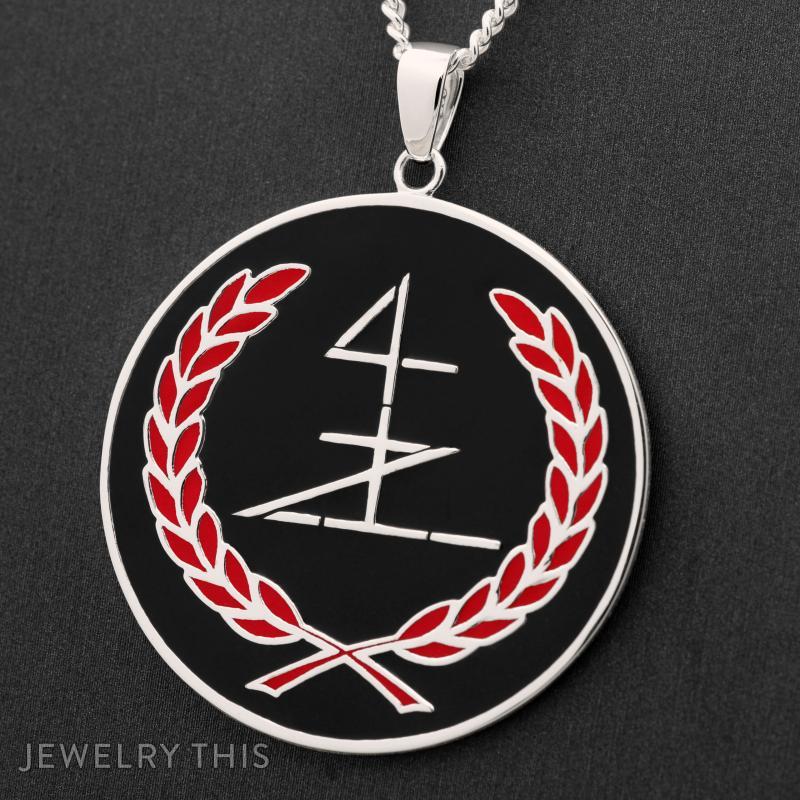


Custom Silver Logo Medallion with Red Enamel Laurel Wreath
$$
Sterling silver, red enamel, black enamel
S. came to us wanting a pendant built around his own logo — a design that mattered enough to him that he wanted it worn, not just owned. The color scheme went through a few rounds of back-and-forth before landing on a red enamel wreath framing the logo in silver against black, and he added a single engraved word on the back after the design was already locked in. The piece that arrived carries that word where only he will see it.
Quick specs
Design type
Primary Metal
Primary Stone
Accent Stones
Design Complexity
Intent: Certainty
Size
Pendant approximately 1.5in diameter. Chain: silver curb, 20in length.
How they made it distinctive
-
01
Raised silver logo sits above the enamel surface, keeping the personal mark as the visual focal point against the flat color fields
-
02
Red enamel wreath and black enamel background are separated by thin raised silver borders, a structural requirement of the enamel technique rather than a decorative choice
-
03
Color scheme was deliberately narrowed down from an all-silver design to a two-color enamel treatment through several rounds of client feedback
-
04
Back left smooth and polished specifically to carry a personal engraved word, added after the main design was already approved
-
05
Scaled to 1.5 inches specifically to suit the wearer's larger frame
How you'd make it yours
Enamel colors: this piece uses red and black — a new commission could use any two-color combination, or a single color for a simpler look
Metal: this piece is sterling silver; the same raised-logo-and-enamel language could work in gold-plated silver for a warmer tone
Engraving: the smooth polished back can carry a different word or short phrase on a new piece
Chain: this piece uses a silver curb chain; a new commission could pair with a cable, figaro, or leather chain instead
Size: this piece is scaled to 1.5 inches for a larger build; a new piece would be sized to its own wearer
One of a kind: this exact pendant was designed around one client's personal logo and is not reproduced — a new commission is an original piece inspired by this one, not a copy
Design changes made
The original brief called for a laurel wreath in silver with no added color; the client went back and forth on which elements should be red versus silver before settling on a red enamel wreath with the logo kept in silver for contrast. He also added a back engraving after the main design was approved.
Who this is for
This piece is for someone who wants a personal symbol worn visibly, not tucked away — a mark that means something specific to them rendered in metal and color rather than ink. It's especially right if you have your own logo, symbol, or design you want translated into a wearable piece, and you want a say in every color and finish decision along the way.
How it's made
Once the final design was approved, the piece moved into 3D modeling and a technical sketch for client sign-off before any metal was cast. The pendant was then cast in sterling silver as a single disc with the logo raised above the surrounding surface, creating the separation needed to hold each enamel color in its own recessed field.
Finishing began with the enamel work: the red was laid into the wreath recesses first, followed by the black background, each color contained by its own thin silver border so the two never bled together. The raised logo and the pendant's edge were polished to a bright finish, while the reverse was left smooth and polished before the word "Antifragile" was engraved in block lettering. The piece was then fitted with a silver curb chain sized to the client's neck.
Key note
The silver lines separating the red wreath from the black background aren't just decorative — they're the physical dams that keep each liquid enamel color from mixing with its neighbor before it cures.
Pricing guidance
A sizable enamel logo pendant like this sits in the mid range for custom silver work — the cost is driven mainly by the multi-color enamel application and the raised metalwork needed to separate each color field, not by the silver itself. Engraving and a sourced chain add modestly on top of that base. Complexity in the logo shape and the number of enamel colors are what move the price most from there.
Moves price up ↑
- ↑ Adding a third or fourth enamel color, each requiring its own separated field
- ↑ Increasing the pendant size beyond 1.5 inches, which increases both metal weight and enamel surface area
- ↑ Upgrading the chain to a heavier gauge or to gold rather than silver
- ↑ Adding gemstones or diamond accents to the design
- ↑ Two-sided engraving instead of a single back inscription
Moves price down ↓
- ↓ Reducing to a single enamel color instead of two
- ↓ Omitting the back engraving
- ↓ Choosing a smaller pendant size, such as 1 inch instead of 1.5
- ↓ Skipping the sourced chain and supplying one's own
- ↓ Simplifying the logo to reduce the number of raised/recessed metal divisions needed
Questions people ask
Enamel is a glass-like material fused to the metal surface, and on a piece like this it sits in recessed fields bordered by raised silver walls, which helps protect the edges from chipping. It holds up well under normal daily wear, though any enamel can chip if struck hard against a hard surface. Avoiding contact sports or heavy impact while wearing it will keep it looking sharp for years. If a chip ever occurs, re-enameling that section is possible but requires sending the piece back to a jeweler experienced with the process.
Enamel starts as a liquid that's applied into a recessed area and then fired to harden, so it needs a physical barrier to stay within its intended shape — similar to pouring water into separate compartments of an ice tray. Without a raised metal border between two enamel colors, they would run together before curing. This is why a two-color enamel design, like a red wreath on a black background, requires a thin silver outline separating every color boundary. It's a structural requirement of the technique, not just a stylistic choice.
Yes, a personal logo or symbol can be rendered as a pendant through 3D modeling, which translates a flat image into a design with depth — typically raising the logo lines above the surrounding surface so they read clearly. The process usually starts with a sketch or render for approval before anything is cast. Background treatment, like a cut-out design versus a solid enamel-filled background, is one of the first decisions to make, since it affects how the piece holds together structurally. Working from a clear image of the logo makes the modeling process faster and more accurate.
A pendant combining a raised metal logo, a two-color enamel background, engraving, and a sourced chain falls in the mid range for custom silver pieces. Most of the cost comes from the enamel application process and the raised/recessed metalwork required to keep each color contained, rather than from the silver itself. Adding features like engraving or a chain increases the total modestly. Simpler single-color designs or smaller sizes would bring the cost down from there.
The design phase — sketches, 3D modeling, and a photorealistic render for approval — typically takes about a week. Once the design is approved and production begins, casting, multi-color enamel application, engraving, and finishing usually take an additional several weeks. A piece with two enamel colors and back engraving, like this one, falls on the longer end of that range since each enamel color is applied and cured as a separate step. Sourcing a chain separately can add a little more time depending on style and availability.
Yes, engraving can often be added after the main design is locked in, as long as it's requested before the piece goes into final production. The back of a solid pendant like this is typically left smooth and polished specifically to accommodate an inscription. Font style — block versus script — is worth choosing early, since it affects how the engraving reads at a small scale. A short word or phrase is the most common choice for this kind of personal touch.
A cut-out design removes the background metal entirely, leaving only the raised design elements connected to each other, which requires every part of the design to be physically joined or the piece won't hold together. A solid background, by contrast, keeps a full metal disc behind the design, which allows for recessed enamel fields and doesn't require every line of the design to connect. Solid backgrounds are generally more structurally forgiving for complex or abstract logos. The choice also affects the final look — cut-out designs feel more open and dimensional, while solid backgrounds read more like a traditional medallion.
Explore Similar Creations
Every masterpiece starts with a spark. Explore how our clients raw ideas - sketches, heirlooms, inspirations - were transformed into bespoke works of arts.
This sterling silver pendant was created to celebrate the pride and spirit of their university. ...

Embrace your rebellious spirit with this unique custom heart-shaped pendant. Crafted in sterling silver, the ...

Sterling silver pendant featuring combination of the first letter of each family member’s name. Pendant: ...

This pure silver pendant combines two design languages on a single oval form. The front ...

A uniquely shaped sterling silver pendant modeled after a sculpture set with a blue sapphire ...

This 14k yellow gold trinity knot pendant is a beautiful symbol of everlasting love and ...

This 3D dog pendant is a heartfelt tribute to a beloved canine companion. This pendant ...

This heart-shaped pendant is cast in two golds — white gold forming the upper portion, ...

This elegant gold pendant is designed in a rectangular shape, showcasing a name in Hebrew ...

This pendant depicts a small winged fairy figure rendered in polished 14k white gold, holding ...

Celebrate corporate identity with our 1-inch double H pendant, a business logo in resplendent 14kt ...

This exquisite custom pendant is a remarkable piece that beautifully captures the love and connection ...



