


Art Deco-Inspired Floral Pendant in White Gold
$$$
14k white gold, diamonds, sapphire, moonstone
G. came across a vintage Art Deco brooch online and found herself breathless over the design, though the original was out of reach. She asked for the same look reimagined as a pendant in white gold, with moonstones swapped in for two of the sapphire centers. When it arrived, she wrote: 'My necklace is stunning! I was breathless. Thank you so much!'
'Oh my goodness. Lovely.' — on seeing the first render
'My necklace is stunning! I was breathless. Thank you so much!' — on delivery
Quick specs
Design type
Primary Metal
Shape / Cut
Primary Stone
Accent Stones
Design Complexity
Intent: Certainty
Size
Pendant approximately 1.5in long. Chain 18in, 14k white gold.
How they made it distinctive
-
01
Hidden bail construction — the chain emerges invisibly from the back so nothing interrupts the geometric border design
-
02
Flower petals carved in white gold rather than stone, because the antique original's hand-carved gem petals couldn't be custom-cut to match
-
03
Two flower centers changed to moonstone cabochons at the client's request, mixing moonstone and sapphire for subtle color variation
-
04
Adapted from a brooch to a pendant format while preserving the original's rectangular Art Deco proportions and triangular corner motifs
-
05
Baguette diamond accents placed precisely at the top and bottom points to echo the geometric framing of the original design
How you'd make it yours
Stone: this piece uses moonstone and sapphire cabochons; a new commission could use all sapphire, all moonstone, or other cabochon-cut colored stones
Metal: this piece is 14k white gold; the same carved floral design works in yellow or rose gold
Size: this piece is 1.5 inches long; a new commission can be scaled larger or smaller
Chain: this piece has an 18-inch chain with a hidden bail; a new piece could use a visible bail or a different chain length
Border density: the diamond pave border can be made denser or more open on a new commission
One of a kind: this exact pendant was designed for one client and is not reproduced — a new commission is an original piece inspired by its Art Deco proportions and floral motif, not a copy
Design changes made
The original brooch design was adapted into a hidden-bail pendant format at the client's request, and two of the flower centers were changed from sapphire to moonstone cabochons after the client asked if moonstone could be incorporated.
Who this is for
This piece is for someone drawn to a specific historical design language who wants a wearable version of something they fell in love with but couldn't acquire as-is. It's especially right if you appreciate dimensional, hand-finished detail over a flat engraved look, and you're open to thoughtful material substitutions that keep the spirit of the original intact.
How it's made
The design began with a 3D render built from the inspiration photo and the client's description, translating the brooch's dimensional detailing into a pendant format sized at 1.5 inches. Once approved, the piece was cast in 14k white gold, producing the openwork floral cluster, geometric border, and hidden bail as a single structure ready for stone setting.
After casting, the pave diamonds were set along the geometric border and the baguette diamonds were set at the top and bottom points. The moonstone and sapphire cabochons were set last into the carved flower centers, since cabochons are set into prepared sockets rather than prong-secured like faceted stones. The piece was then polished to bring out the dimensional carving of the petals against the recessed openwork background.
Key note
The flower petals are carved directly in white gold rather than hand-carved from stone, because the moonstone and sapphire material used in the original brooch's flowers could not be custom-cut to match — so the dimensional petal shaping had to be achieved in metal instead.
Pricing guidance
A complex Art Deco-style pendant with pave diamonds, carved openwork, and multiple cabochon stones sits toward the higher end for custom pendant work. Most of the cost comes from the diamond pave setting and the hand-finished dimensional carving of the floral cluster, rather than from the cabochon stones themselves. Metal karat and total diamond count are the next biggest levers on price.
Moves price up ↑
- ↑ Increasing the diamond pave density or upgrading to a higher clarity/color grade
- ↑ Using 18k gold instead of 14k for more gold content
- ↑ Adding more cabochon stones or enlarging the pendant beyond 1.5 inches
- ↑ Hand-carving petal details in additional precious metal zones
- ↑ Upgrading the chain to a thicker or higher-karat style
Moves price down ↓
- ↓ Reducing the diamond count along the border
- ↓ Using a single stone type instead of mixing moonstone and sapphire
- ↓ Simplifying the geometric border to fewer line and triangle elements
- ↓ Choosing a smaller pendant size
- ↓ Using lab-created sapphires instead of natural cabochons
Questions people ask
Yes, a vintage brooch can be reinterpreted as a pendant by adapting its dimensional elements — like carved flower petals and a geometric border — into a smaller format with a bail or hidden chain attachment. The original materials sometimes need to be substituted, since antique pieces may use hand-carved gemstone flowers that cannot be custom-cut to match today. A photo and detailed description are usually enough to build an accurate 3D render before anything is cast. Minor differences from the original are expected since the piece is built from a render, not the physical antique.
A regular bail is a visible loop or ring at the top of a pendant that the chain passes through, while a hidden bail routes the chain through the back of the piece so no loop is visible from the front. Hidden bails are common on rectangular or geometric pendants where a visible loop would interrupt the design's clean lines. They require the chain attachment point to be engineered into the piece's structure during the casting stage, not added afterward. This style is popular on Art Deco and geometric designs for exactly this reason.
Yes, moonstone and sapphire pair well together and are often combined in antique-inspired designs for subtle color variation across a piece. Moonstone has a soft, glowing blue-white sheen called adularescence, while sapphire offers a deeper, more saturated blue. Moonstone is a softer stone at around 6 to 6.5 on the Mohs hardness scale, so it is best set in protected cabochon settings rather than exposed prong settings. Using both allows a design to have visual variety without needing a large number of different gem types.
A pendant with hand-carved openwork, a full diamond pave border, and multiple cabochon stones falls toward the higher end for custom pendant work. The primary cost driver is labor — the diamond setting along a pave border and the dimensional carving of a floral cluster both take significant hand-finishing time. Metal karat, total diamond count, and pendant size are the next factors that move the price from there. Simpler versions with fewer stones or a smaller size bring the cost down substantially.
A pendant of this complexity typically takes about five to six weeks from design approval to completion. The first week covers the 3D render and design revisions, including any stone substitutions the client requests. After approval, casting, diamond pave setting, cabochon setting, and final polishing make up the remaining production time. The exact timeline can shift slightly depending on how many design revisions are needed before approval.
Moonstone is softer than diamond or sapphire, ranking about 6 to 6.5 on the Mohs hardness scale, so it needs a bit more care than harder stones. It holds up well in protected settings like cabochon sockets, which is how it's typically used in pendants and other pieces that aren't subject to constant impact. It's not recommended for ring settings exposed to daily knocks, but in a pendant worn against fabric, it performs reliably. Avoiding harsh chemicals and ultrasonic cleaners will help preserve its signature glow over time.
Yes, a pave border can be set with lab-created diamonds, moissanite, or smaller colored stones instead of natural diamonds, depending on the look and durability needed. Lab diamonds offer the same brilliance and hardness as natural diamonds at a lower cost, making them a common substitution in pave settings where many small stones are needed. Moissanite is also an option for a similar sparkle at an even lower cost, though its refractive quality is slightly different. The choice mostly comes down to budget and whether the client wants natural stones specifically.
White gold is a strong choice for a hidden-bail pendant because it provides a cool, neutral tone that complements diamonds and blue stones like sapphire and moonstone. The hidden bail structure needs to be engineered into the casting, so the metal needs enough strength to support the chain's weight at that connection point without thinning out. 14k white gold balances durability and cost well for this kind of structural detail. Platinum would also work but adds significant weight and cost for a pendant of this size.
Explore Similar Creations
Every masterpiece starts with a spark. Explore how our clients raw ideas - sketches, heirlooms, inspirations - were transformed into bespoke works of arts.
This 3-inch sterling silver cross pendant combines a Southwestern design sensibility with personal symbolism. Flared, ...

This pendant takes a six-heart interlocking pattern — one the client’s wife had doodled for ...

Celebrate the cherished bond of love with this custom “Grammie” word pendant, a heartfelt tribute ...
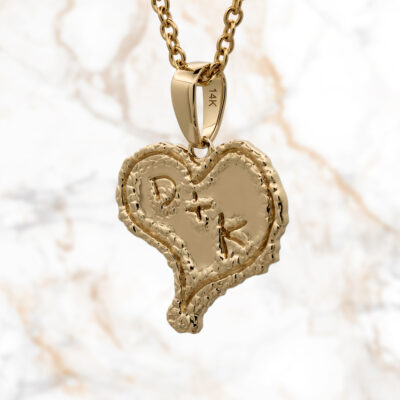

This custom pendant is a striking tribute to strength and heritage, featuring a meticulously crafted ...

This symbolic key-shaped piece was crafted to represent different levels of a charity organization. At ...

A passion immortalized in precious metal, this pendant reflects the client’s dedication to their craft. ...

Sterling silver cut out pendant featuring design of swan and lilly. Pendant: 1.5inches in size. ...
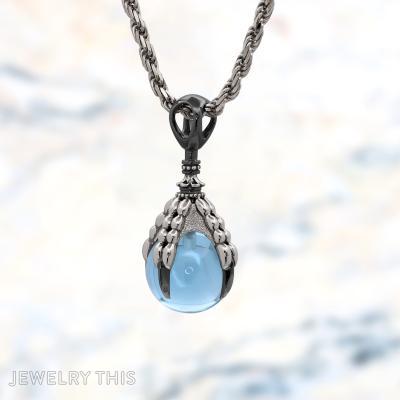
This pendant recreates a dragon’s claw gripping a round sky blue topaz orb, rebuilt after ...

This pendant was created as a mother’s day gift and features two interlocking hearts. One ...


This pendant translates a black belt logo into a wearable, dimensional piece rather than a ...



