


Twisted Crescent Hoop Earrings in 14k Yellow Gold
$$$
14k yellow gold, lab diamond
L. came to us wanting to recreate an earring she already loved, but lighter and with her own twist — literally. Getting the exact angle of that twist right took real back-and-forth: she wanted the flared end turned so it sat parallel to the curve instead of crossing it, and a small diamond placed right where the twist begins. When the render came through, she said it looked amazing and asked only to shorten the ear wire a bit more before giving the final go-ahead.
'It does look amazing, can we shorten the ear thingy a little more then id say go.' — on seeing the first render
'Thank you so very much Trish, it has been my absolute pleasure working with you.' — on delivery
Quick specs
Primary Metal
Shape / Cut
Primary Stone
Accent Stones
Design Complexity
Intent: Certainty
Size
Ear wire length approximately 15.5mm (shortened from 31mm original). Each earring approximately 5-6 grams.
How they made it distinctive
-
01
Twist engineered into the metal specifically to rotate the flared end parallel to the curve, taking multiple rounds of sketches to resolve
-
02
Gold weight reduced through several iterations to keep each earring under roughly 6 grams for comfortable daily wear
-
03
Bezel-set diamond placed precisely at the point where the twist begins, marking the transition in the design
-
04
Ear wire shortened twice at the client's request, ending at roughly half its original length
-
05
Flared triangular end kept intentionally flat and geometric against the smooth curved body
How you'd make it yours
Stone: this piece uses a lab diamond; a new commission could use moissanite, cubic zirconia, or a small colored gemstone instead
Metal: this piece is 14k yellow gold; the same curved, twisted design works in 18k yellow, white, or rose gold
Gold weight: this piece was made lightweight at 5-6 grams per earring; a new piece could be made bolder and heavier for a more substantial feel
Ear wire length: this piece uses a shortened wire; a new commission can be sized to the wearer's preference
One of a kind: this exact pair was designed for one client through months of sketches and adjustments, and is not reproduced — a new commission is an original piece inspired by this one
Design changes made
The flared end was rotated using a twist in the metal so it sits parallel to the earring's curve rather than horizontal to it, and the ear wire was shortened twice at the client's request — once by half, then slightly more after seeing the render. The gold weight was also reduced from the original concept to keep each earring lighter.
Who this is for
This piece is for someone who already has a design in mind and wants to see it refined exactly the way they picture it, even if that takes several rounds of back-and-forth. It suits someone who prioritizes comfort and everyday wearability — a lightweight earring with a distinctive silhouette rather than a heavy statement piece.
How it's made
Once the design was finalized, the earrings were 3D printed in wax and attached to a wax tree inside a flask. The flask went into a kiln to burn out the wax, leaving a hollow mold, and molten 14k yellow gold was cast into that mold under pressure. After cooling, the raw castings were removed from the mold and prepared for cleaning and finishing.
Each earring was cleaned up and polished to a high-shine finish across the curved body and the flat flared end. The small round diamond was set into a bezel at the point where the twist begins, chosen specifically because a bezel holds up better than prongs on a piece this lightweight. The ear wire was finished separately and shortened to the client's requested length before final assembly.
Key note
The twist in the metal was engineered specifically to rotate the flared end a quarter turn without breaking the earring's original crescent silhouette — solving a design problem that took multiple rounds of sketches to resolve.
Pricing guidance
A sculptural gold drop earring of moderate complexity with a single accent stone sits toward the lower-to-mid range for custom earrings. Because the piece is almost entirely sculpted metal rather than stone-driven, most of the cost comes from the gold weight and the hand-finishing needed to achieve the curved, twisted form. Stone choice has only a small effect on the total compared to the metal itself.
Moves price up ↑
- ↑ Increasing the gold weight or thickness of the curved body for a bolder look
- ↑ Upgrading from 14k to 18k gold
- ↑ Adding diamonds along the full length of the curve instead of a single accent stone
- ↑ Choosing a heavier karat white or rose gold in addition to yellow
- ↑ Adding a matching twist detail to both the front and back of the earring
Moves price down ↓
- ↓ Switching the diamond to a moissanite or cubic zirconia accent
- ↓ Reducing the gold weight further for a slimmer, lighter profile
- ↓ Using 10k gold instead of 14k
- ↓ Simplifying the twist to a flat flared end with no rotation
- ↓ Omitting the accent stone entirely for a pure sculptural metal piece
Questions people ask
This pair was brought down to around 5 to 6 grams per earring, which is considered lightweight for a sculptural drop earring of this size. Weight is driven mainly by how much metal is used to form the curved body, so a thinner or smaller profile can reduce it further. Clients who want all-day comfort often prioritize weight reduction even if it means a slightly more delicate feel. A jeweler can usually adjust the model to hit a target weight before casting.
Yes, though it typically takes a few rounds of sketches and renders to get right. A twist can be engineered into a specific section of the metal — for example, rotating a flared end a quarter turn — while keeping the rest of the silhouette, like a curved or crescent shape, intact. The challenge is usually communication: describing a 3D twist in words is harder than it sounds, so sketches and reference photos speed up the process significantly. A 3D render before casting lets you confirm the twist looks right before any metal is committed.
Yes. Lab diamonds are chemically and visually identical to natural diamonds, just grown in a controlled environment rather than mined. For a small accent stone like this, a lab diamond in VS1 clarity offers excellent brilliance at a lower cost than a natural stone of the same grade. Moissanite or cubic zirconia are also viable lower-cost alternatives if the budget is tighter, since a stone this small has only a modest effect on the overall price.
A piece like this — lightweight sculptural gold with a single accent stone — falls in the lower-to-mid range for custom earrings. The bulk of the cost comes from the gold itself and the hand-finishing required to shape and polish a curved, twisted form, not from the stone. Choosing a lower karat gold or a non-diamond accent stone are the most effective ways to bring the price down further.
From final design approval to delivery, a pair like this typically takes several weeks: about a week for 3D design and render approval, followed by casting, finishing, and stone setting. This particular pair took longer than average because the design itself required several rounds of sketches to nail down the exact twist and proportions before the 3D render stage even began. Once a design is approved, production and shipping typically move within a few weeks.
Yes, ear wire length is one of the easiest things to adjust before casting. A standard ear wire might run over an inch long, but it can be shortened significantly if a client prefers a snugger fit against the earlobe. It's worth requesting this adjustment during the render stage, since changing it after casting is more difficult than specifying it upfront. Shorter ear wires are a common request for comfort, especially on heavier or larger earring designs.
Ear wires need to be made from hardened gold to hold their shape and stay durable through daily removal and insertion. A softer or thinner wire can bend out of shape or weaken over time, which affects both comfort and security. This is a functional requirement rather than a stylistic choice, and it is one of the reasons earring hooks have a cost floor even in a lower karat gold. Hardened gold wire also resists metal fatigue better than cast wire of the same thickness.
Yes. The diamond in this design is a small bezel-set accent, and that setting style works equally well with moissanite, cubic zirconia, or a small colored gemstone. Because the stone is a secondary detail rather than the focal point of the design, swapping it has a relatively small impact on the overall look or cost. This makes it an easy point of customization for a similar commission.
Explore Similar Creations
Every masterpiece starts with a spark. Explore how our clients raw ideas - sketches, heirlooms, inspirations - were transformed into bespoke works of arts.
These drop earrings take their geometry directly from a matching pendant design, scaled down and ...
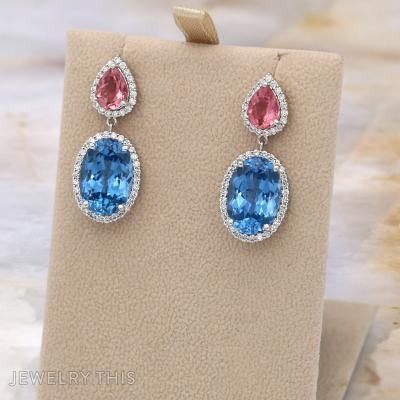
This two-tier drop earring design rebuilds a stolen pair as closely as possible from photographs, ...
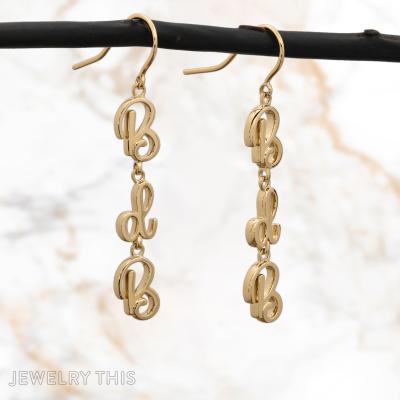
These dangle earrings spell out a set of initials in cursive script, with three letter ...

This pair of drop earrings recreates a lost earring’s open web pattern in polished sterling ...
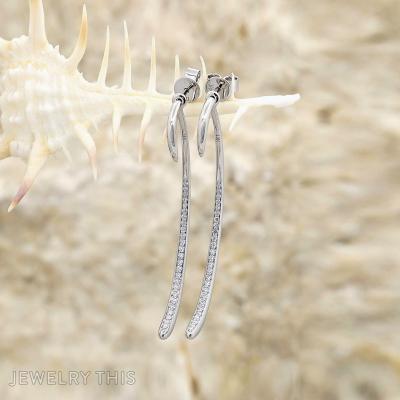
These drop earrings reinterpret a celebrity-inspired tusk silhouette as a two-part design: a small front ...

These drop earrings pair a sculpted 14k yellow gold fan element — its surface finished ...

These drop earrings were built around a reference photo the client loved, translated into three ...

These drop earrings turn a teenager’s own sketch into a wearable monogram. Each circular disc ...



