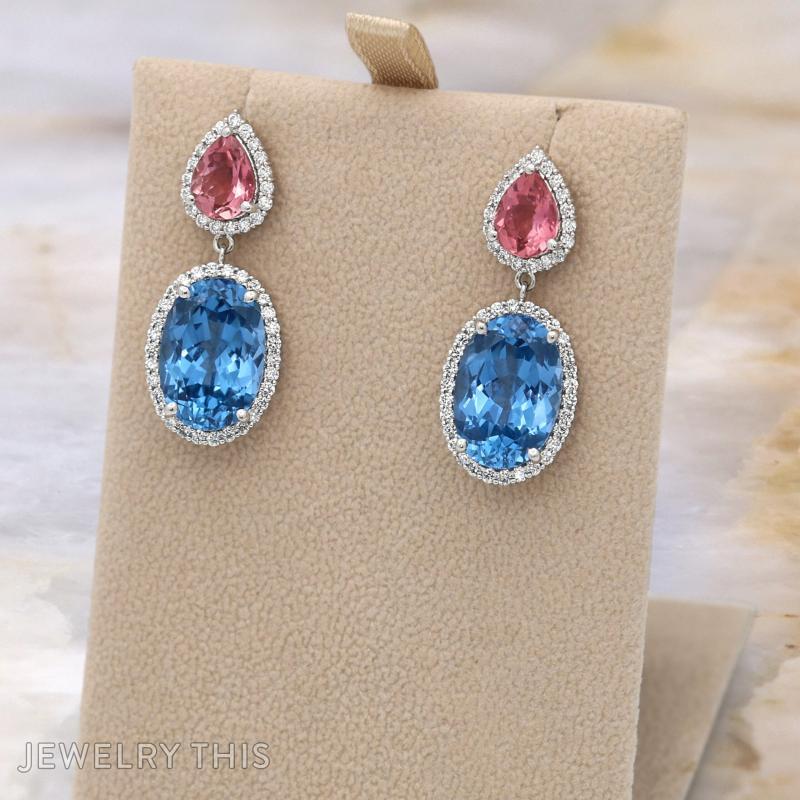
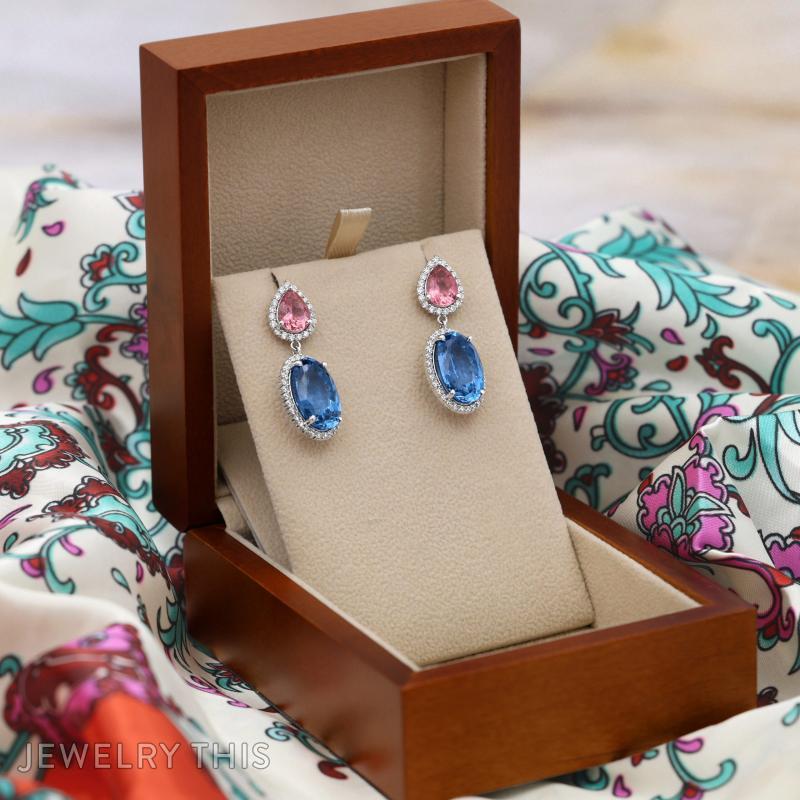
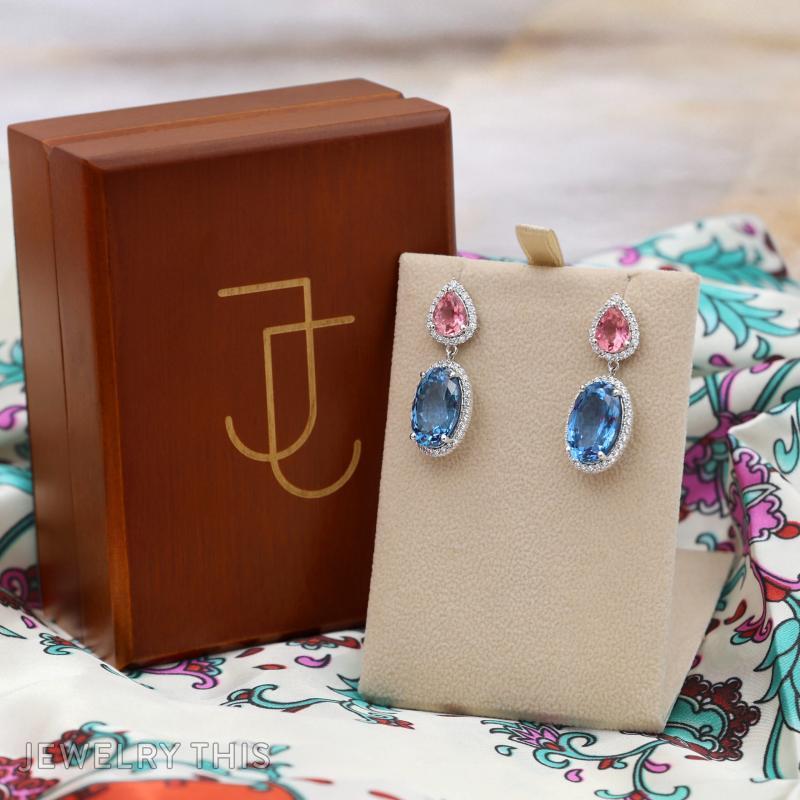
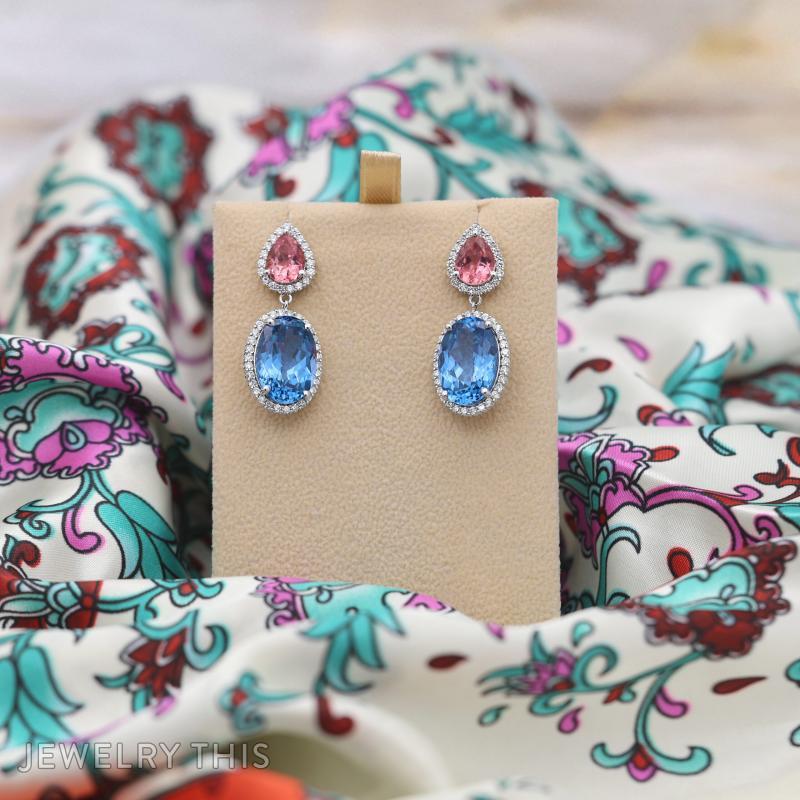
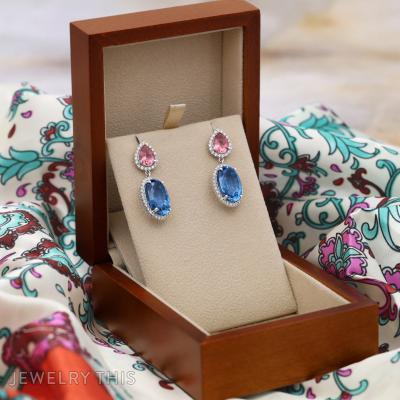
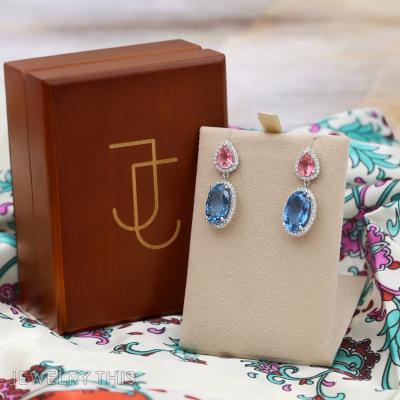
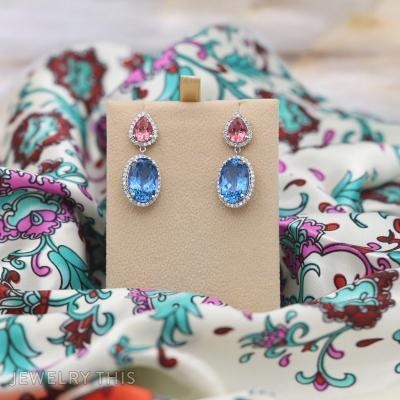
Recreated Aquamarine & Tourmaline Drop Earrings
$$$$$
14k white gold, lab-grown spinel (aquamarine color), pink tourmaline, lab-grown diamonds
A client came to us wanting to recreate a pair of drop earrings that had been stolen — designed originally by her husband. Working from an old photo, a decade-old appraisal, and her own memory of the color and proportions, the design went through several rounds of stone-size and color adjustments before landing on the right combination. When they arrived, she wrote: 'Yes, they're beautiful. Thank you for all the effort to make them perfect.'
'Yes, they're beautiful. Thank you for all the effort to make them perfect.' — on delivery
Quick specs
Primary Metal
Shape / Cut
Primary Stone
Design Complexity
Intent: Certainty
Size
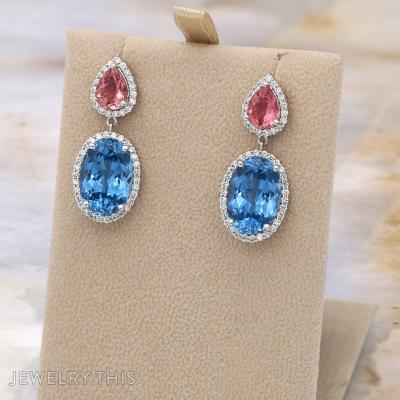
Drop length approximately 1 1/3 inch. Lower stone 16mm x 11mm oval; upper stone 9.06mm x 6.89mm pear (3.32 carats total weight for the pair).
How they made it distinctive
-
01
Blue center stones are custom-cut lab-grown spinel rather than natural aquamarine, chosen specifically to hit an exact color match the client remembered
-
02
Two different stone shapes — pear on top, oval below — deliberately mixed to mirror the original pair as closely as possible
-
03
Diamond halos kept modest in scale so the colored center stones remain the visual focus, per the client's explicit request
-
04
Pink tourmaline selected over quartz or morganite after multiple rounds of color comparison to match a specific remembered shade
-
05
Flat-backed setting design specifically chosen so the earrings would sit close to the earlobe, matching how the original pair was worn
How you'd make it yours
Stone type: this piece uses lab-grown spinel for the blue stones — a new commission could use natural aquamarine, moissanite, or a different blue gem depending on budget and sourcing
Stone shape: this piece pairs a pear-shaped pink stone with an oval blue stone — a new design could use two matching shapes or a different pairing
Metal: this piece is 14k white gold — the same two-tier halo design works in yellow or rose gold
Halo style: this piece uses a modest single-row diamond halo — a new commission could use a bolder double halo or a more minimal bezel edge
One of a kind: this exact pair was designed to recreate one client's stolen earrings and is not reproduced — a new commission is an original piece inspired by this design, not a copy
Design changes made
The pink stone shape was corrected from oval to pear after re-reading the original appraisal, and the material for the blue stone shifted from natural aquamarine to a custom-cut lab-grown alternative after natural stones in the right color and size proved difficult to source within budget.
Who this is for
This piece is for someone trying to bring back a specific piece of jewelry that mattered to them, where getting the color and proportion right matters more than using the exact original materials. It's especially right if you have some documentation — an old photo, an appraisal, even just a strong memory of how it looked and felt — and you're willing to work through a few rounds of refinement to get it close.
How it's made
Once the stone sizes and shapes were finalized against the original appraisal, a technical drawing was produced and used to build a 3D digital model of the earrings. A resin model was printed and shipped to the client so she could confirm the scale and proportions by hand before any stones were sourced. After she approved the resin, the pink tourmaline pair was purchased and the blue center stones were custom-cut from lab-grown rough material to the exact oval dimensions the design required, since a natural pair in the needed size and color was not practical to source.
Once all stones were in hand, the 3D model was revised to fit their exact measurements before casting in 14k white gold. Small diamonds were set first around both the upper and lower frames to form the halos, followed by the setting of the pink tourmaline and the larger custom-cut center stones. The settings were kept flat on the back so the earrings would sit close against the earlobe, matching how the original pair was worn.
Key note
The blue center stones are not aquamarine at all but a lab-grown spinel custom-cut to mimic aquamarine's color, chosen because beryl (the mineral aquamarine is made of) is far harder to replicate synthetically than spinel.
Pricing guidance
A two-tier diamond-halo drop earring with two sets of colored center stones sits toward the higher end of custom earring work, largely due to the size and sourcing of the center stones rather than the setting itself. Custom-cut stones, whether natural or lab-grown, add both cost and lead time compared to stones pulled from existing inventory. Metal and diamond accents make up a smaller share of the total than the stones themselves at this scale.
Moves price up ↑
- ↑ Custom-cutting the center stones to an exact size rather than using stones already cut and in stock
- ↑ Increasing the carat weight of the center stones beyond roughly 10 carats each
- ↑ Sourcing natural, origin-verified gemstones instead of lab-grown alternatives
- ↑ Upgrading the diamond halos to larger or higher-clarity stones
- ↑ Adding more ornate detailing to the backside of the setting
Moves price down ↓
- ↓ Using smaller center stones closer to 3-5 carats each
- ↓ Choosing stones already cut and available in inventory rather than custom sizing
- ↓ Selecting lab-grown diamonds throughout instead of natural
- ↓ Simplifying to a single-tier design without the secondary pear-shaped stone
- ↓ Reducing the diamond halo to fewer, smaller accent stones
Questions people ask
Yes, recreation from a photo and memory is a common request, and having an old appraisal on file makes it significantly more accurate. The process typically starts with a rough sketch or description, refines the stone shapes and sizes against any documentation available, and confirms proportions with a 3D render and often a physical resin model before any stones are sourced. Photos taken at odd angles or with hair covering part of the earring can make initial stone shape identification tricky, so multiple images and a written appraisal both help enormously. The final piece will closely match the original in proportion and color, though it will not be a literal duplicate of the exact original stones.
True aquamarine is a natural mineral called beryl, and its complex crystal structure makes it very difficult to grow synthetically at larger sizes. For a color-accurate lab-grown alternative, cutters often use lab-grown spinel instead, which can be grown in an aqua-blue shade that closely matches natural aquamarine's appearance. The two materials are chemically and structurally different, but visually the color can be matched closely, especially once custom-cut to a specific size. This route is often chosen when a natural stone in the needed carat weight and color proves difficult or expensive to source as a matched pair.
A two-tier drop earring with diamond halos around two sets of colored center stones typically falls toward the higher end of custom earring pricing, mostly because of the size and sourcing complexity of the center stones rather than the metalwork. Custom-cutting stones to an exact size, whether natural or lab-grown, adds cost compared to using stones already cut and available. The diamonds used in the halo and whether they are lab-grown or natural also affect the total. Metal choice has a comparatively small impact on price at this scale.
When custom-cut stones are involved, the timeline runs longer than a standard piece — typically several weeks longer to allow the cutter to source rough material and cut a matched pair to exact specifications. After stone sourcing, building and revising the 3D model, casting, and stone setting typically takes another four to five weeks. A resin model is often sent to the client partway through so they can confirm scale and proportion before the stones are finalized. Total turnaround for a piece like this commonly runs several months when custom-cut stones are involved, compared to five to six weeks for a standard piece using in-stock stones.
Yes, colored gemstones are especially sensitive to lighting conditions, camera settings, and even the surface they're photographed against, and the same stone can look noticeably lighter or darker in a video versus a still photo versus natural daylight. Digital renders used during the design phase are even less reliable for color accuracy since they rely on a limited color library rather than the exact stone in hand. For this reason, reputable jewelers will confirm color choices using physical photos or videos of the actual stones before they are set, rather than relying on renders. If color accuracy is a top priority, it's worth asking to see the physical stone under multiple lighting conditions before approving.
Can diamonds around a colored stone be made less prominent so they don't overpower the center stone?
Yes, a diamond halo's visual weight can be controlled by using smaller diamonds, a thinner metal frame between the stones and the diamonds, or simply a single row of modestly sized stones rather than a large or double halo. The goal in a halo design like this is typically to frame and accent the center stone's color rather than compete with it. Choosing diamonds with a size proportional to the center stone, rather than maximizing diamond size, keeps the color of the center stone as the visual focus. This is a common request when the center stone's color is the main reason the piece was designed in the first place.
Yes, pairing two different stone shapes in a single earring design is a well-established style, often called a two-tier or drop design. The key to making mixed shapes work visually is proportion — the smaller accent shape (often a pear or round) sits above a larger primary shape (often an oval or cushion) so the eye reads them as a cohesive unit rather than two unrelated stones. This approach is especially useful when recreating an earring design from memory or an old photo, since it allows some flexibility in exact stone availability while preserving the overall silhouette. Color harmony between the two stones matters more than matching their exact shape family.
Custom cutting means a cutter shapes a piece of rough gemstone material to a specific size and shape requested for a particular design, rather than selecting from stones that have already been cut and are sitting in inventory. This is often necessary for larger stones, unusual shapes, or when a closely matched pair is needed for symmetry, since off-the-shelf inventory rarely has an exact match at larger sizes. Custom cutting adds both time, typically three to four weeks, and cost compared to using an already-cut stone, but it allows the finished dimensions to be tailored exactly to the design. This process applies to both natural and lab-grown rough material.
Explore Similar Creations
Every masterpiece starts with a spark. Explore how our clients raw ideas - sketches, heirlooms, inspirations - were transformed into bespoke works of arts.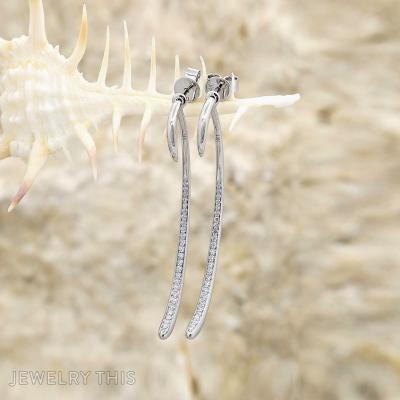
These drop earrings reinterpret a celebrity-inspired tusk silhouette as a two-part design: a small front ...

These drop earrings pair a sculpted 14k yellow gold fan element — its surface finished ...

This pair of drop earrings recreates a lost earring’s open web pattern in polished sterling ...
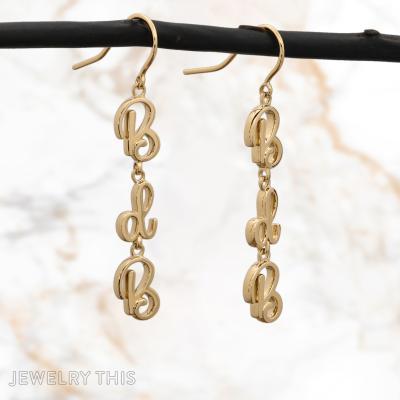
These dangle earrings spell out a set of initials in cursive script, with three letter ...