


Sculptural Figure Cuff Bracelet — Recreated Keepsake
$$
Brass
Two sisters bought matching bracelets for a 40th birthday 25 years ago — one in silver, one in brass — and wore them every single day until both were lost, one stolen years ago and one misplaced during an errand. The client set out to recreate them starting with her sister's piece, working through months of careful back-and-forth on the sculpted figure's proportions to get the posture, waist, and legs right. When it finally arrived, she wrote: 'I finally got the bracelet last night!! I like the craftsmanship a lot.'
'I finally got the bracelet last night!! I like the craftsmanship a lot.' — on delivery
Quick specs
Primary Metal
Primary Stone
Accent Stones
Style
Design Complexity
Intent: Certainty
Size
Inside opening approximately 1.5in end-to-end; enlarged from initial resin fit after client could not slide it onto her wrist. Hollow construction with thick walls.
How they made it distinctive
-
01
Hollow, thick-walled construction chosen specifically to preserve the substantial feel of the original bracelets without excessive weight
-
02
Oval-rather-than-round shape and flat-ended opening carried over intentionally from the original design for all-day comfort
-
03
Figure's posture adjusted through multiple rounds of feedback to read as active and stretching rather than resting
-
04
A soft matte finish applied after casting to move the metal's shiny out-of-production look closer to a natural aged patina
-
05
Recreated primarily from the client's memory and instructions rather than the original piece, since both originals were lost years apart
How you'd make it yours
Metal: this piece is brass; a new commission could use sterling silver or bronze for a different tone and finish
Finish: this piece has a soft matte finish; a new piece could be left high-polish or brushed instead
Figure posture: the reclining figure's pose, leg position, and waist curve can all be adjusted on a new commission
Opening size: fit is tested with a resin prototype before casting, so a new piece is sized to its own wearer's wrist
One of a kind: this exact bracelet was designed for one client and is not reproduced — a new commission is an original piece inspired by this one, not a copy
Design changes made
The figure's waist was widened and her legs adjusted several times to move from a resting posture to a more active, stretching one, and the cuff opening was enlarged twice after resin fit tests showed it was too snug to slide over the wrist.
Who this is for
This piece is for someone who wants a bracelet with real sculptural weight and presence, not a delicate accessory. It's especially right for anyone recreating a meaningful piece that was lost or worn out, who cares more about capturing a feeling and proportion than an exact replica, and who wants something substantial enough to wear every single day without a clasp to fuss with.
How it's made
Once the sculpted design was approved through several rounds of a 3D model and resin fit test, the piece was cast in brass using a lost-wax casting process. A resin prototype was mailed to the client to confirm fit and proportion before the metal casting was finalized, and adjustments to the opening width were made based on that physical trial.
After casting, the piece was hand-finished and polished to bring out the sculpted detail in the figure's body, hair, and beaded necklace. A soft matte finish was then applied over the brass to soften the initial high shine and move it closer to the natural patina of the original piece, rather than a mirror polish.
Key note
Because the design has a hollow, thick-walled structure rather than a solid casting, the bracelet holds the visual heft of the original piece at a more comfortable daily-wear weight.
Pricing guidance
A sculptural figural cuff like this sits in the mid range for custom bracelet work, largely because of the extensive 3D modeling time a highly organic, hand-posed figure requires. Metal choice and the complexity of the hollow-wall construction are the next biggest cost drivers beyond the base modeling work.
Moves price up ↑
- ↑ Casting in sterling silver or gold instead of brass, which increases material cost significantly
- ↑ Adding stone-set details, such as eyes or accent points, which require separate setting work
- ↑ Increasing the overall size or wall thickness of the piece, which raises metal weight and finishing time
- ↑ Requesting a high-polish mirror finish across the entire piece rather than a matte treatment
Moves price down ↓
- ↓ Simplifying the figure to a lower level of dimensional detail
- ↓ Choosing a smaller bracelet size, which reduces metal weight
- ↓ Casting only one piece rather than a matching pair, since the second piece in a pair costs less once the model exists
- ↓ Selecting a solid thin-wall design over a thick hollow-wall structure
Questions people ask
Brass is a durable, everyday-wearable metal that holds up well to daily use, including exposure to water. Unlike plated metals, solid brass will not flake or wear through, though it will develop a natural patina over time as the surface reacts with air and skin oils. Some people find this patina appealing, since it gives the piece a warmer, aged character rather than staying perpetually shiny. A soft matte or brushed finish, like the one applied here, tends to show this natural aging more gracefully than a high-polish finish.
An open cuff design like this one has some built-in flexibility because it does not close with a clasp, but a cast cuff cannot be significantly resized the way a ring can. If the opening is too narrow, a jeweler can sometimes widen it by hand after casting, as was done here. For anyone concerned about getting the size right, requesting a resin or wax prototype to test fit on the actual wrist before casting is the best way to avoid this issue altogether.
A highly detailed figural cuff sits in the mid range for custom bracelet work, largely driven by the labor of building a hand-posed 3D figure rather than a geometric or simple band shape. The cost also depends on whether the piece is hollow or solid, since a hollow, thick-walled design uses less metal by weight while still holding structural strength. Choosing a precious metal like sterling silver instead of brass would move the cost noticeably higher.
A hollow design with thick walls is a common approach for large sculptural pieces because it keeps the bracelet from feeling too heavy on the wrist while still resisting bending or denting during normal wear. A fully solid casting of the same size would have significantly more heft and use much more metal. This construction method lets a piece look and feel substantial without the discomfort that a solid casting of the same scale would create.
For a piece with this level of sculptural detail, the design phase alone can take several weeks or longer because the proportions of a hand-posed figure typically go through multiple rounds of review and adjustment. Once the design and fit are approved, production of the metal casting and hand-finishing generally takes about three to four weeks. Complex organic designs like this one often take longer than a standard band or simple bangle because of the extra modeling and finishing work involved.
Yes, matte and brushed finishes are both achievable on brass and other metals, and they tend to better replicate the natural patina that brass jewelry develops over years of wear. A high-polish finish will look brighter and shinier right out of production, while a matte finish mutes the shine and can be applied to select areas or the entire piece. It's worth specifying the desired finish clearly before production, since converting a piece afterward requires an additional finishing pass.
Brass is an alloy of copper and zinc, giving it a warm yellow-gold tone, while bronze is an alloy of copper and tin, which tends to have a slightly redder or deeper tone. Both are durable, affordable alternatives to precious metals and both develop a natural patina over time. The two metals are sometimes used interchangeably in casual conversation, so it's worth confirming which one is actually being used for a project to set accurate expectations for color and finish.
Yes, an open cuff design can be scaled to different wrist sizes, though the opening width and overall proportions need to be tested against the actual wrist rather than estimated from measurements alone. A resin or wax prototype is the most reliable way to confirm fit before the final metal casting is made. Because the piece does not have an adjustable clasp, getting the opening size right before casting is more important than it would be for a chain-style bracelet.
Explore Similar Creations
Every masterpiece starts with a spark. Explore how our clients raw ideas - sketches, heirlooms, inspirations - were transformed into bespoke works of arts.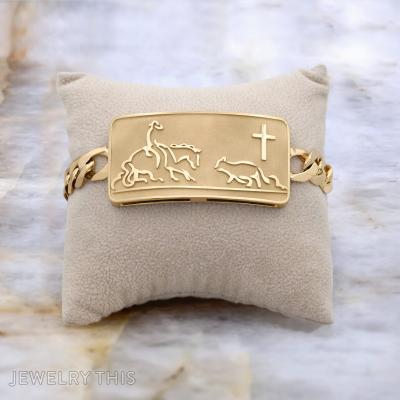
This bracelet centers on a large rectangular ID plate cast in solid 14k yellow gold, ...
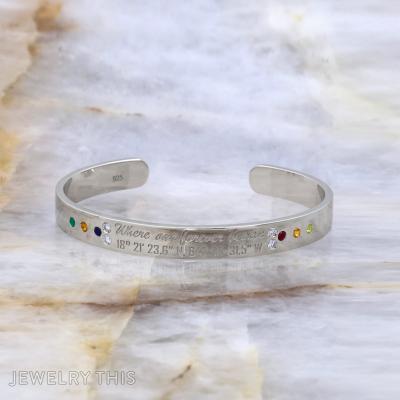
This sterling silver cuff bracelet was designed around a couple’s wedding coordinates and a phrase ...

This cuff-style bracelet is crafted in 14k white gold with a raised block-letter inscription running ...

This cuff bracelet was designed as a companion piece to a ring the client already ...



