


Barbed Wire Gate Cuff — Gold Initial Bracelet
$$$
Gold-plated sterling silver
A client came to us wanting to work a personal symbol of resilience into a wearable piece, after a ring he already owned set the design direction. Several concepts were tried and set aside before the design landed on a barbed-wire fence with a center gate carrying his initials, W and H. When it arrived, he wrote: 'The bracelet is absolutely stunning! You nailed it. This piece has deep meaning for me and I will treasure it always.'
'The bracelet is absolutely stunning! You nailed it.' — on delivery
Quick specs
Primary Metal
Primary Stone
Accent Stones
Style
Design Complexity
Intent: Certainty
Size
Cuff, approximately 1 to 1.5 inches wide. Upper/lower wrist and wrist-bone measurements provided by client for fit.
How they made it distinctive
-
01
Barbed-wire relief motif chosen specifically to represent a personal idea of breaking free, carried through several design revisions until it worked in metal
-
02
Matte background finish applied only behind the barbed-wire panels so that detail reads clearly against the polished rest of the cuff
-
03
Raised W and H lettering placed at the visual center of the piece rather than as a small side engraving
-
04
Design deliberately shifted from silver to a gold-plated finish specifically to match a ring the client already owned
-
05
Rigid cuff construction chosen over a hinged or flexible band for a bolder, more substantial feel on the wrist
How you'd make it yours
Metal: this piece is gold-plated sterling silver — a new commission could use solid 14k or 18k gold for a heavier, more permanent finish
Width: this cuff is roughly 1 to 1.5 inches wide — a new piece could be made narrower or wider depending on preference
Lettering: this piece carries two raised initials at center — a new commission could use a different letter count or a word instead
Finish contrast: this piece pairs a matte background with polished relief — a new piece could use an all-polished or all-matte finish instead
Border detail: this piece uses a rope-trim edge top and bottom — a new commission could use a plain edge or a different border pattern
One of a kind: this exact cuff was designed for one client to match a ring he already owned and is not reproduced — a new commission is an original piece inspired by this one, not a copy
Design changes made
The design went through several concept changes before landing on the final direction: early sketches explored a horse breaking through chains, but the client found the angles and composition weren't translating well into metal. He pivoted to a barbed-wire fence and gate motif that matched a ring he had separately purchased, which also meant switching the metal from sterling silver to a gold-plated finish.
Who this is for
This piece is for someone who wants a bold, masculine statement bracelet that carries real personal meaning rather than a decorative motif chosen for its looks alone. It's especially right if you have a specific symbol or story you want built into the design itself — not added as an engraving afterward — and you're willing to work through a few rounds of revision to get the composition right.
How it's made
Once the final design was approved, a wax model was 3D-printed and sent to the client as a resin trial so he could confirm the cuff fit his wrist before any metal was committed. The wax was then attached to a tree, invested in plaster, and fired in a kiln to burn out the wax and leave a hollow mold. Molten gold-plated sterling silver was cast into the mold, then the raw cuff was extracted, cleaned, and prepared for finishing.
After casting, the rope-trim borders and barbed-wire panels were polished to a bright finish, while a matte finish was applied specifically to the background areas behind the barbed-wire detail so that motif would stand out against the rest of the cuff. The raised W and H lettering at center was finished to match the polished elements, and the entire piece received its gold plating as the final step.
Key note
The barbed-wire panels were deliberately given a matte background finish while the rest of the cuff was polished bright, a contrast-finishing step used specifically to make that motif read clearly against the surrounding metal.
Pricing guidance
A wide sculptural cuff with raised lettering and repeating relief detail like barbed wire sits toward the higher end for custom bracelet work, largely because of its width and the amount of hand-finishing needed on a dimensional design. Rigid cuffs also require a resin fit trial before casting, which adds a production step most simpler bracelets skip. Metal choice and the amount of surface detail are what move the price most from there.
Moves price up ↑
- ↑ Casting in solid 14k or 18k gold rather than gold-plated silver
- ↑ Increasing the cuff width beyond 1.5 inches, which adds significant metal weight
- ↑ Adding stone-set accents into the barbed-wire or border detail
- ↑ Extending the raised lettering or adding additional engraved text on the interior
Moves price down ↓
- ↓ Narrowing the cuff width to reduce metal weight and finishing time
- ↓ Simplifying the barbed-wire relief to a single strand instead of three
- ↓ Removing the rope-trim border detail along the top and bottom edges
- ↓ Choosing a flat polished finish throughout instead of the matte/polish contrast
Questions people ask
Yes. This cuff was designed to mirror the aesthetic of a ring the client already owned, translating the same barbed-wire and lettering motifs into a wider bracelet format. The process typically starts by reviewing photos of the existing piece so the design team can match its proportions, texture, and finish. Matching an existing piece closely usually takes an extra design pass or two to get the details aligned, but it is a common and achievable request.
Gold-plated silver is a sterling silver base with a layer of gold plating applied over the surface, giving the look of solid gold at a lower material cost. The plating is a surface coat, not solid metal all the way through, so it will gradually wear with daily contact, especially on raised or high-touch areas. Higher-karat plating tends to last longer before it needs attention. Re-plating is a standard jewelry service that can refresh the finish once it starts to show wear.
Cuffs in the 1 to 1.5 inch range, like this one, are on the wider end for a comfortable everyday cuff without becoming impractically heavy. Beyond that width, metal weight increases quickly, especially with raised or dimensional detail like lettering or relief patterns. Solid gold at this width would be considerably heavier than a gold-plated silver version. Most cuffs in this size range are sent as a 3D-printed resin model first so the wearer can confirm comfort and fit before the metal is cast.
Yes, initials can be integrated as a structural part of a design rather than added as a separate engraving. In this piece, the initials were placed at the center of the cuff as raised lettering set against a textured background, functioning as a focal point rather than a small side detail. Font style, size, and placement can all be adjusted depending on how prominent the wearer wants the lettering to be. This approach works well when the initials carry personal meaning central to the design concept.
A wide cuff with raised lettering and a repeating relief pattern like barbed wire sits toward the higher end for custom bracelet work, mainly due to its width and the hand-finishing required on the dimensional detail. Metal choice makes a significant difference in cost at this scale, since a wider cuff uses considerably more material than a standard band. Adding or removing decorative elements, like the rope-trim border, also shifts the price. A simpler, narrower version of a similar concept would fall toward the lower end of custom bracelet pricing.
The full process usually runs longer than a standard timeline when a design goes through multiple concept revisions, as this one did. Once a final design is approved, a resin model is typically 3D-printed and sent to the client to confirm fit before casting begins, which adds one to two weeks. Casting, finishing, and stone or lettering detail work typically take another four to five weeks after the design is locked in. Extensive design exploration before approval can add several additional weeks beyond that.
Rigid cuffs have some flexibility for minor adjustments since the open-ended design allows for gentle bending, but they are not resized the way a closed ring or bangle would be. Getting the fit right before casting is important, which is why a resin trial fitting is recommended for wider or heavier cuffs like this one. If the fit needs a bigger change after the piece is cast, that typically requires the piece to be sent back for reshaping rather than a simple at-home adjustment.
Yes, repeating linear relief patterns like barbed wire translate well into cast metal jewelry, particularly on wider surfaces like cuffs where there's enough real estate for the detail to read clearly. The key production consideration is contrast: a matte finish is often applied to the background areas so the raised wire detail stands out clearly against the rest of the piece. This kind of motif works especially well paired with a bold, dimensional letter or symbol as a central focal point.
Explore Similar Creations
Every masterpiece starts with a spark. Explore how our clients raw ideas - sketches, heirlooms, inspirations - were transformed into bespoke works of arts.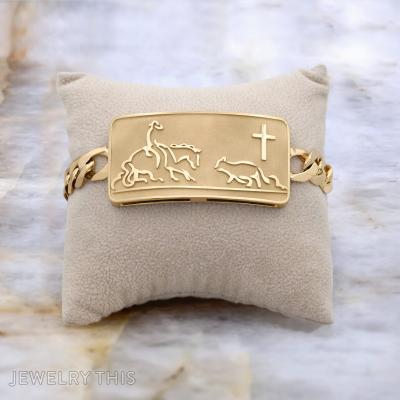
This bracelet centers on a large rectangular ID plate cast in solid 14k yellow gold, ...
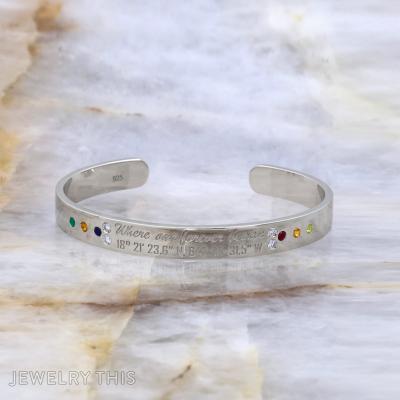
This sterling silver cuff bracelet was designed around a couple’s wedding coordinates and a phrase ...

This cuff-style bracelet is crafted in 14k white gold with a raised block-letter inscription running ...

This open cuff bracelet centers on a dimensional, hand-sculpted female figure whose body wraps around ...



