


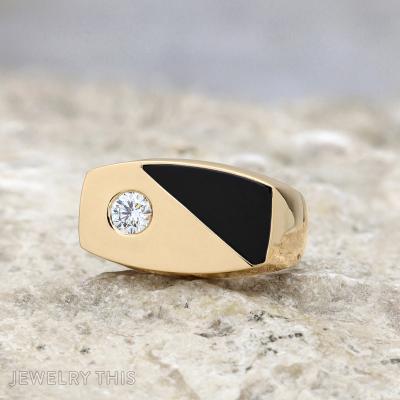


Signet Ring Recreation — Gold, Onyx & Diamond Inlay
$$$
10k yellow gold, lab-created diamond, black onyx
A client came to us wanting to recreate his late grandfather's ring, which his grandmother had given him and which he had since lost. He wanted it trimmed down to a size that felt more wearable, working from a single photo to guide the design. When it arrived, he wrote simply: 'Thank you very much! It looks awesome.'
'Wow! You're right, I think it looks great.' — on seeing the first render
'Thank you very much! It looks awesome.' — on delivery
Quick specs
Primary Metal
Shape / Cut
Primary Stone
Accent Stones
Style
Design Complexity
Intent: Certainty
Size
Ring size 10.25 US. Band tapers to 5mm; top face width 8mm.
How they made it distinctive
-
01
Custom-cut triangular onyx panel, shaped after casting specifically to fit this ring's asymmetrical mounting
-
02
Top face narrowed from an estimated 10mm to 8mm, and the band tapered to 5mm, to give a bold design a smaller, more wearable footprint
-
03
Bezel-set diamond chosen to mirror the exact placement seen in the original piece
-
04
10k gold selected for its added scratch-resistance and durability for daily wear
-
05
Recreated from a single photograph and the client's memory, with no physical original to work from
How you'd make it yours
Stone: this piece uses a lab-created diamond and custom-cut onyx; a new commission could use moissanite or a natural diamond instead
Metal: this piece is 10k yellow gold; the same design works in 14k or 18k yellow gold for a richer color
Top width: this piece is 8mm at the top face; a new piece could be made wider or narrower depending on preferred scale
Engraving: the inside of the band can carry a new inscription on a fresh commission
One of a kind: this exact ring was designed to recreate one client's family piece and is not reproduced — a new commission is an original piece inspired by this one, not a copy
Design changes made
The top face was narrowed from an estimated 10mm on the original to 8mm, and the band was tapered down to 5mm at the shank, based on the client's request for a less prominent, more wearable scale.
Who this is for
This piece is for someone carrying forward a design that means something to them, but who wants it scaled to fit how they actually want to wear it day to day. It's especially right if you have only a photo to work from and want a design team to fill in the technical gaps while staying true to the original's character.
How it's made
Once the client approved the 3D render, the design moved to a resin model — a 3D-printed preview of the ring in its exact final geometry, shared with the client before any metal was cast. The resin was then used to create an investment mold, and molten 10k yellow gold was cast into the hollow cavity to form the raw ring body.
After casting, the piece was cleaned up and polished to a mirror finish across the gold surfaces. The black onyx panel was custom-cut after casting specifically to fit the ring's mounting, since a pre-cut stone could not match the asymmetrical triangular shape. The lab-created diamond was then bezel-set into its round opening, and the finished onyx panel was set into its recess alongside it.
Key note
The onyx wasn't cut before casting — it was custom-shaped afterward specifically to fit this ring's mounting, since no pre-cut stone could match its asymmetrical triangular face.
Pricing guidance
A signet-style ring with a custom-cut stone inlay and a bezel-set diamond sits in the mid range for custom rings of this complexity. Most of the cost comes from the custom stone-cutting work and the gold content in a wider, substantial top face. Metal karat and stone choice are what move the price most from there.
Moves price up ↑
- ↑ Upgrading from 10k to 14k or 18k gold, which increases material cost substantially at this weight
- ↑ Using a natural diamond instead of a lab-created diamond
- ↑ Choosing a larger top face or wider band, which increases gold weight
- ↑ Adding a second custom-cut stone panel instead of one
Moves price down ↓
- ↓ Using a standard pre-cut stone shape instead of a custom-cut inlay
- ↓ Substituting moissanite for the lab diamond
- ↓ Reducing the top face width for a smaller, lower-profile design
- ↓ Choosing a lighter-weight band construction
Questions people ask
Yes, a single clear photo can be enough to start a recreation, though some details like exact proportions have to be estimated. The design team builds a 3D model and render based on the photo and the client's descriptions, and any assumptions are reviewed with the client before approval. Stone dimensions and setting depth are typically the hardest details to pin down from a photo alone. The final piece will closely match the original's look even though it isn't a scan of the actual item.
Lab-created diamonds are chemically identical to natural diamonds, just grown in a controlled setting rather than mined, so they have the same hardness and sparkle. Moissanite is a different mineral entirely, with a higher refractive index that gives it a slightly different sparkle pattern and a lower cost than diamond. Both are durable enough for daily wear in a ring setting. The choice mostly comes down to preferred appearance and budget rather than durability.
A pre-cut stone is selected from existing inventory shaped to standard dimensions, while a custom cut requires a cutter to shape the stone specifically for one ring's mounting. This adds both time and skilled labor, since the cutter has to work to the exact geometry the setting requires. It's most common on asymmetrical or unusually shaped design elements, like a triangular panel set against a curved edge. The result is a tighter, more precise fit than a standard stone would allow.
From design approval to shipping, a piece like this typically takes around five to six weeks, with an additional one to two weeks upfront for the design and render process. Custom-cut stones can add extra time, since the cutting itself takes two to three weeks and happens after the metal casting is complete. The total timeline depends on stone complexity and any design revisions needed along the way. Rings without custom-cut elements are usually faster.
Yes, the width of the top face and the taper of the band are both adjustable in the design phase before casting. Narrowing the top reduces the overall visual footprint while keeping the same design elements, like a stone panel or gem placement, in proportion. This works well for anyone who wants a bold design without an oversized feel on the hand. The trade-off is that very intricate details may need slight resizing to remain balanced at a smaller scale.
Yes, 10k gold is actually harder and more scratch-resistant than higher-karat golds like 14k or 18k, because it contains a higher percentage of alloy metals. It's a common choice for rings that see daily wear and potential impact. The tradeoff is a slightly less rich color compared to higher-karat gold. It also tends to be more budget-conscious than 14k or 18k options of the same design.
Onyx is a fairly durable stone for jewelry, rating around 7 on the Mohs hardness scale, but it can chip if struck directly at an angle, particularly along a thin custom-cut edge. Daily wear is generally fine, but it's worth being mindful during activities with a high risk of hard impacts. If a panel is ever damaged, a replacement can typically be custom-cut again to match the setting. Keeping the ring stored separately from other jewelry can help prevent surface scratches over time.
A custom-cut stone adds cost beyond the base price of the ring itself, since a cutter has to shape the stone specifically for that mounting rather than pulling from pre-cut inventory. On a piece like this, the custom cutting and the gold weight from a wider top face are the two biggest cost drivers. Choosing a standard pre-cut stone shape instead can bring the price down noticeably. The rest of the cost is driven by metal karat and the specific gems chosen.
Explore Similar Creations
Every masterpiece starts with a spark. Explore how our clients raw ideas - sketches, heirlooms, inspirations - were transformed into bespoke works of arts.

This chunky, rectangular-top ring was remade in solid 14k yellow gold from a plastic original ...

This signet-style logo ring combines classic elegance with modern design. The ring features a round ...

These rings represent exquisite pieces of personalized artistry. Crafted with precision, the initials “DK” come ...

Personalized signet ring featuring enamel filled symbol inlayed into the top of the ring which ...

This set of four signet rings recreates a single silver original in solid 24 karat ...

Meticulously crafted in 14K gold, this men’s ring is a stunning combination of classic style ...

This classic14k yellow gold ring is a recreateion of a beloved family heirloom. The ring ...

This custom 14k yellow gold signet style ring is a beautiful replica of an original ...

Bold and refined, this sterling silver signet ring features a striking 15 mm round top ...
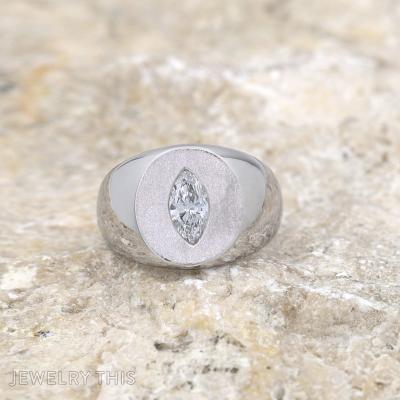
This is a men’s wedding band built around a signet-ring silhouette: an oval face with ...




