


Dimensional Skull Signet Ring in 10k Yellow Gold
$$$
10k yellow gold
J. came to us wanting a ring built around a group logo — a skull face in a bandana, originally paired with crossed wrenches and a name. Over a few rounds of sketches he asked to strip it back to just the face, deciding it would look bigger and bolder without the extra elements. When it arrived, he wrote: 'The ring is perfect and exactly what i wanted.'
'Its perfect yes please proceed' — on design approval
'Looks incredible! Thank you' — on delivery
'The ring is perfect and exactly what i wanted. Thank you so much for your efforts.' — on delivery follow-up
Quick specs
Primary Metal
Primary Stone
Accent Stones
Style
Design Complexity
Intent: Certainty
Size
Ring size 10 US (19.76mm). Approximately 30 grams pre-polish weight.
How they made it distinctive
-
01
Signet form reimagined as a fully dimensional skull face rather than a flat engraved table
-
02
Bandana and sunburst emblem carved directly into the forehead, referencing the client's original logo concept
-
03
Wrenches and name text removed mid-design so the face could read larger and bolder, per the client's request
-
04
Dreadlock-style hair and beard texture carved down both sides of the face for added depth
-
05
Cast in 10k yellow gold specifically chosen for durability and to fit the client's budget after starting in 18k
How you'd make it yours
Design subject: this piece uses a skull-and-bandana face; a new commission could use a different face, animal, or emblem in the same dimensional carving style
Metal: this piece is 10k yellow gold; the same sculptural design works in 14k or 18k yellow gold for a richer tone
Side details: this piece omits the wrenches and name seen in the first sketch; a new commission could reintroduce side elements or text
Stones: this piece has no stones; a new commission could add small accent stones in the eye sockets or elsewhere
Engraving: this piece has no engraving; a new commission could add engraving inside the band
One of a kind: this exact ring was designed for one client and is not reproduced — a new commission is an original piece inspired by this one, not a copy
Design changes made
The client removed the crossed wrenches and the name element that appeared in the first sketch, asking to keep only the skull face so it would read larger on the ring. The design was finalized around the face-only version after one round of revision.
Who this is for
This piece is for someone who wants a ring with real physical presence — bold, sculptural, and impossible to mistake for a mass-produced band. It's especially right if you have a logo, symbol, or image you want turned into something wearable rather than just worn as a flat emblem, and you're drawn to carved detail over stones or engraving.
How it's made
Once the sketch was approved, the design moved into a formal 3D model, which was 3D printed in wax and attached to a wax tree inside a flask. The flask was invested in plaster and fired in a kiln to burn out the wax, leaving a hollow mold shaped exactly like the ring. Molten 10k yellow gold was then cast into that mold under heat and pressure, producing the raw ring at approximately 30 grams before any cleanup.
After casting, the piece was cleaned and polished to bring out the dimensional detail in the skull's carved features — the recessed eye sockets, teeth, and the textured hair and beard strands — while the broad shank was finished to a smooth, high-polish surface. No stones were set and no engraving was added, keeping the entire finishing pass focused on sculpting contrast between the carved face and the plain polished band.
Key note
The ring's weight came in heavier than the original estimate because the dimensional skull carving required more metal volume than a flat signet top, which is why the final cost shifted up from the initial quote.
Pricing guidance
A heavy, dimensional novelty signet ring like this sits in the mid range for custom work of this complexity. Most of the cost comes from the 3D modeling and hand-finishing needed to carve a recognizable face in relief, plus the metal weight required to support that level of carving. Metal karat and any added stones or engraving are what move the price from there.
Moves price up ↑
- ↑ Upgrading from 10k to 14k or 18k yellow gold, which raises both metal cost and weight-based pricing
- ↑ Adding side details such as the wrenches or a name that were removed from this design
- ↑ Adding engraving inside the band or on the shank
- ↑ Setting a gemstone into the eye sockets or elsewhere on the design
- ↑ Increasing the overall ring size or face dimensions, which adds metal volume
Moves price down ↓
- ↓ Using a lighter-weight design with less dimensional carving depth
- ↓ Choosing a smaller face size relative to the band
- ↓ Keeping the design to a single flat relief rather than full 3D sculpting
- ↓ Limiting the piece to one finish (all-polish) rather than mixed texture and polish zones
- ↓ Reducing the shank width or ring size
Questions people ask
Yes, a flat logo or emblem can be reworked into a dimensional carved design on a ring top, similar to how this skull-and-bandana face was developed from an original flat logo concept. The process starts with a rough sketch based on your reference image, which is refined through a few rounds of feedback before moving to a formal 3D render. Elements like extra text, symbols, or background details can be added or removed at this stage. Once the 3D render is approved, the design is locked in for production.
On highly dimensional pieces, the final metal weight is not fully known until the 3D model is complete, because deep relief carving requires more metal volume than a flat design. In this case, the ring ended up heavier than the original estimate once the sculpted detail was finalized, which shifted the price slightly above the initial budget figure. This is more common on pieces with deep 3D carving than on flat or simple designs. Reputable custom jewelers will flag this before moving to production rather than after.
10k gold contains 41.7% pure gold, with the remainder made up of other metals for strength, compared to 58.3% in 14k and 75% in 18k. This makes 10k gold the hardest and most scratch-resistant of the three, which suits a large, heavy signet-style ring meant for daily wear. The tradeoff is a slightly less rich, more muted yellow tone compared to higher-karat gold. 10k is also typically the most accessible option in terms of cost for a given metal weight.
From deposit to finished piece, a ring like this typically takes around five to six weeks total. The first week or so covers the sketch and 3D render phase, including any revisions. Once the design is approved, casting and finishing takes roughly four to five weeks, depending on the complexity of the carving and metal weight. This piece followed that standard timeline from design approval to shipping.
Resizing a heavy, solid signet ring with deep carving is possible but more limited than with a plain band, because there's less flat, uncarved metal to work with at the shank. Small adjustments, generally within about half a size up or down, are usually manageable without disturbing the design. Larger resizing requests should be discussed with a jeweler before committing, since cutting and re-soldering a thick, sculpted shank carries more risk than a simple band. It's worth confirming your size carefully before casting on a piece like this.
Solid 10k gold is fairly low-maintenance day to day — it resists scratching well and doesn't require replating the way gold-plated pieces do. The main consideration with deep relief carving is that dirt and polish residue can collect in the recessed detail (eye sockets, hair texture) over time, so an occasional gentle cleaning with a soft brush keeps the contrast between the carved and polished areas looking sharp. There's no special coating or finish here that wears off, since it's solid gold rather than plated. Routine jewelry cleaning is sufficient.
Yes, stones can be set into a dimensional design like this, commonly in the eye sockets or as small accents elsewhere in the carving, though this particular ring was made without any stones at the client's request. Adding stones increases both cost and production complexity since the setting has to be built into the 3D model before casting rather than added afterward. If you're considering a similar piece with stones, it's worth deciding on that early in the design phase rather than after the render is approved. Common choices for eye-socket accents include small black or colored stones for contrast against the gold.
Check what our clients say about us

J Stapleton
4 years ago
Incredible work. Detail. Patience. And perfection. Very easy to work with and would use again!
Explore Similar Creations
Every masterpiece starts with a spark. Explore how our clients raw ideas - sketches, heirlooms, inspirations - were transformed into bespoke works of arts.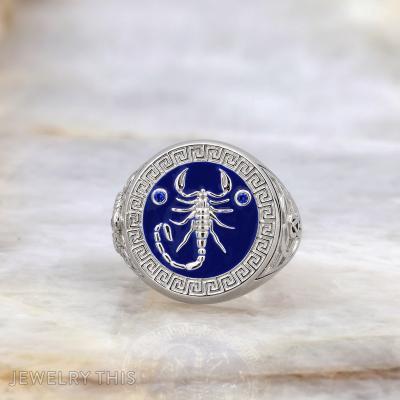
This men’s signet ring was designed to honor both a Greek heritage and an Irish ...

This chunky, rectangular-top ring was remade in solid 14k yellow gold from a plastic original ...

Custom made sterling silver ring featuring a family name, symbolic detailing and colored enamel.

This signet-style logo ring combines classic elegance with modern design. The ring features a round ...

This large-format signet ring turns a smoke shop’s brand mark into a wearable piece, with ...

This ring recreates the wearer’s original piece in 18k white gold, replacing the standard-cut center ...
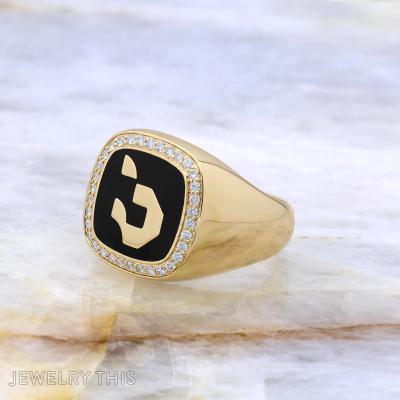
This signet-style ring was designed around a company’s logo, rendered in raised 14k yellow gold ...

This exquisite sterling silver signet-like ring features a rectangular shaped bright blue turquoise which has ...

White and Yellow gold boxing signet ring with incredible detail. It also includes 4 diamond ...

14k white gold men’s wedding ring. Channel set through center with vertically set baguette moissanite ...
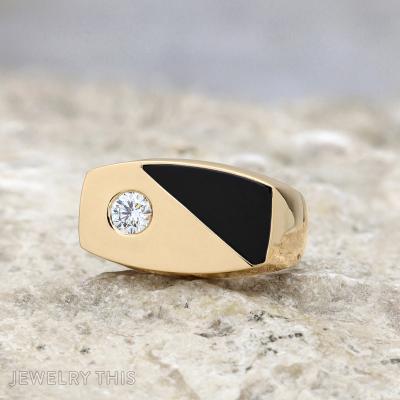
This ring reimagines a family piece in a trimmed, more wearable scale. An asymmetrical top ...

This heartfelt custom signet ring is crafted in luminous 10K yellow gold. This special ring ...



