


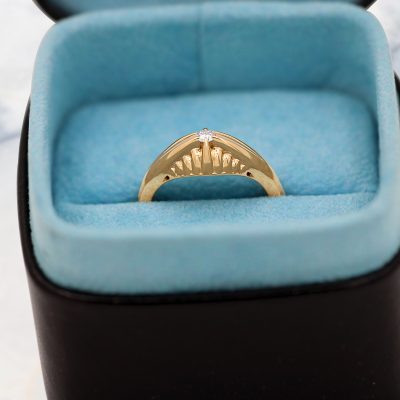

Recreated Yellow Gold Pyramid Ring With Diamond Accent
$
14k yellow gold, 14k white gold accents, natural diamond
A client came to us hoping to recreate her mother's ring, which had gone missing with no photos of the physical piece on hand except a few reference images. Working from her descriptions and those photos alone, the team sketched and refined the design over several rounds until she confirmed: 'That's perfect.' The finished ring arrived in 14k yellow gold with the pyramid-shaped top and white gold detailing she remembered.
'That's perfect.' — on design approval
Quick specs
Design type
Primary Metal
Secondary Metal
Shape / Cut
Primary Stone
Accent Stones
Style
Design Complexity
Intent: Certainty
Size
Ring size 5 US (15.7mm).
How they made it distinctive
-
01
Pyramid-shaped top with an open, hollow underside — a specific structural detail recreated from the original ring, not a standard setting style
-
02
Two-tone white gold added to the center ridge and stone setting after the first render, to match the original's specific color detailing
-
03
Single round diamond set at the peak within the ridge pattern, rather than in a standalone prong setting
-
04
Ridged texture on the pyramid top left matte/textured while the lower band was polished smooth, creating contrast between the two zones
How you'd make it yours
Stone: this piece uses a natural diamond; a new commission could use a lab diamond or moissanite for the same look at lower cost
Metal: this piece is 14k yellow gold with white gold accents; the same pyramid design works in 18k gold or an all-yellow-gold version
Diamond count: this piece has one stone at the peak; a new commission could add stones along additional ridge lines
Engraving: the inside of the band can carry a new inscription on a fresh commission
One of a kind: this exact ring was rebuilt to recreate one client's lost original and is not reproduced — a new commission is an original piece inspired by this one, not a copy
Design changes made
The first sketch left the top of the pyramid shape unclear, and the client clarified that the underside was open and hollow with a small round diamond at the peak. White gold was then added to the center ridge and around the diamond to match the two-tone look of the original, which had not been part of the initial render.
Who this is for
This piece is for someone who has a very specific design already fixed in their memory and wants it rebuilt faithfully, not reinterpreted. It's especially right if you only have a few photos to work from and need a team willing to sketch, revise, and confirm details with you until the shape is exactly right.
How it's made
Once the design was approved, the jewelry model was 3D printed in wax and attached to a wax tree inside a flask. The flask was invested in plaster and placed in a kiln, where the wax was burned away to leave a hollow mold in its place. Molten 14k yellow gold was then cast into the mold under pressure, producing the raw ring once it cooled and was removed from the cast.
After casting, the piece was cleaned and polished to bring up the shine on the smooth lower band, while the ridged pyramid top was kept textured to preserve its dimensional lines. White gold was applied to the center channel and around the stone setting to create the two-tone contrast seen in the original ring. The round diamond was then set by hand at the peak of the pyramid, secured within the ridge detail.
Key note
The pyramid top is cast with an open, hollow underside rather than a solid back — a deliberate structural detail carried over from the original ring's construction, not a simplification for production.
Pricing guidance
A yellow gold ring with a sculpted pyramid top, two-tone white gold detailing, and a single round diamond sits toward the lower end of custom work in this category. Most of the cost comes from the hand-finishing needed to keep the ridged texture crisp while polishing the smooth sections, plus the labor of adding the white gold accents. Metal karat and diamond quality are the two biggest levers on price from there.
Moves price up ↑
- ↑ Upgrading from 14k to 18k yellow gold
- ↑ Choosing a higher clarity or larger diamond at the peak
- ↑ Expanding the white gold detailing to cover more of the ridge pattern
- ↑ Adding diamonds along additional ridge lines instead of a single stone
Moves price down ↓
- ↓ Using 10k yellow gold instead of 14k
- ↓ Switching to gold-plated sterling silver for the body
- ↓ Replacing the natural diamond with a lab-grown diamond or moissanite
- ↓ Simplifying the two-tone detailing to a single metal color
Questions people ask
Yes, this is a common request and the process relies on detailed photos plus a clear description from the client. The design team builds a rough sketch first, then refines it based on feedback until the shape, proportions, and details match what you remember. A 3D render is shared for approval before anything is cast, so adjustments can be made without any cost to remaking metal. The more reference photos and specific descriptions you can provide, the closer the first draft will land.
A two-tone ring combines two different gold colors in a single piece, usually yellow and white gold, to create contrast within the design. For a piece like this, the white gold is applied to specific recessed sections of the design, like a ridge or channel, while the main structure stays in yellow gold. This requires more hand-finishing than a single-metal piece because the two metals must be applied cleanly without bleeding into each other. The result is a design that reads as more dimensional and detailed than a single-color piece would.
14k gold is a solid choice for everyday wear because it's hard enough to resist denting while still being workable for detailed designs like ridges and raised sections. A raised pyramid-style top does sit higher than a flat band, so it's worth being mindful of catching on gloves or heavy fabric during very hands-on activities. Normal daily wear, including handwashing and typical desk work, is not a concern for this kind of design. The ridged texture is also durable long-term since it's cast into the metal rather than applied as a surface treatment.
A ring with this level of detail — a sculpted pyramid top, white gold accenting, and a single round diamond — typically falls toward the lower end of custom ring pricing. The main cost drivers are the metal karat chosen, the diamond's clarity and size, and the amount of two-tone detailing included. Simpler versions in lower-karat gold or with a lab-grown stone can bring the price down further. The design and production process is the same regardless of these choices, so the final number flexes based on material selections rather than labor.
Yes, lab-grown diamonds are a straightforward substitution for natural diamonds in a setting like this one. They are chemically identical to natural diamonds and look the same to the eye, including under magnification for a stone this size. The main difference is cost, since lab-grown diamonds are generally less expensive than natural diamonds of comparable size and clarity. Swapping the stone type does not change the design, setting, or production timeline.
From design approval to a finished ring, production typically takes about four to five weeks. This includes 3D printing the wax model, casting the metal, and completing all finishing work like polishing, two-tone detailing, and stone setting. Before that, the initial design and render phase usually takes about a week, though it can take longer if multiple rounds of sketch revisions are needed. The total timeline from first design sketch to delivery is usually five to six weeks.
A ring with a solid lower band like this one can typically be resized within a modest range using standard jewelry resizing techniques. Because the decorative element sits at the top of the ring and the band itself stays smooth and simple, resizing does not interfere with the pyramid design or the stone setting. Larger resizing needs may require more significant rework, so it's worth confirming your size as precisely as possible before production begins. Standard resizing is a routine service available after delivery.
Explore Similar Creations
Every masterpiece starts with a spark. Explore how our clients raw ideas - sketches, heirlooms, inspirations - were transformed into bespoke works of arts.
This stunning wedding set is crafted from 18karat and features a breathtaking 2.8carat Round Diamond ...

Celebrate familial bonds with this 1-inch cut-out silver ring, a recreated family heirloom lost to ...

This unique custom jewelry ring is handcrafted in 14k yellow gold. This stunning piece showcases ...

This custom engagement ring features a stunning “Toi et Moi” design, symbolizing the union of ...

Bold and refined, this sterling silver signet ring features a striking 15 mm round top ...

This ring rebuilds a grandmother’s cracked and lost original into a wearable 14k yellow gold ...

This exquisite platinum band is a stunning tribute to family and cherished bonds. Along each ...


This stunning 10k yellow gold engagement ring is a masterpiece in recreation and continuity. At ...

This is a custom-designed travel ring created to replicate the client’s original engagement ring. The ...

This bypass-style ring is built around a single white pearl set where two tapering rose ...

This captivating yellow gold engagement ring features a stunning pear-shaped diamond as its centerpiece. The ...



