

Sea Turtle Engagement Ring with Moon Diamond
$$$$
14k rose gold, natural diamond, natural ruby, natural sapphire
A. wanted an engagement ring built around a sea turtle swimming toward the moon, with a red stone and a blue stone worked into the design. The moon element went through several changes — half-moon diamonds, a custom-cut moonstone, and finally a hand-cut antique-style diamond — before landing on a shape that felt right without overpowering the turtle. He wrote when he saw the final render: 'Wow I love it.'
'Wow I love it.' — on seeing the 3D render
Quick specs
Design type
Primary Metal
Shape / Cut
Primary Stone
Design Complexity
Intent: Certainty
Size
Ring size 7 US. Center stone approximately 1.03 carats old mine cut. Ruby and sapphire accents 2mm each.
How they made it distinctive
-
01
Turtle motif oriented to appear swimming toward the moon element rather than away from it, per the client's specific direction
-
02
Antique hand-cut diamond chosen as the moon stone after half-moon diamonds and a custom moonstone were both ruled out
-
03
Turtle and moon elements positioned close together for structural support without a visible connecting bar, preserving the open design the client preferred
-
04
Ruby and Montana-style sapphire set within the turtle motif as distinct color accents rather than flanking the center stone
-
05
Center diamond set in a cupped gallery rather than an open setting, reinforcing the enclosed, moon-like appearance
How you'd make it yours
Stone type: this piece uses natural ruby, sapphire, and an antique-cut natural diamond; a new commission could use lab-created versions of any of these for the same look
Metal: this piece is 14k rose gold; the same turtle-and-moon design language works equally well in yellow or white gold
Diamond cut: this piece uses an old mine cut diamond; a new commission could use a rose cut, round brilliant, or other antique cut for a different moon effect
Motif scale: the turtle and moon proportions on this piece were tuned to this center stone's size; a new commission is rebalanced around its own chosen stone
Connection style: this piece keeps the turtle and moon elements close but unconnected; a new commission could join them with a small bar for added durability
One of a kind: this exact ring was designed for one client and is not reproduced — a new commission is an original piece inspired by this one, not a copy
Design changes made
The moon stone shifted twice: first from a half-moon diamond (unavailable as a single stone) to a custom-cut moonstone, then to an antique hand-cut diamond after concerns the moonstone wouldn't feel substantial enough for an engagement ring. The red stone was also changed from a garnet to a ruby, and the turtle was reoriented to appear to swim toward the moon rather than away from it.
Who this is for
This piece is for someone who wants their engagement ring to carry a specific, personal symbol — not just a conventional stone-forward design. It's especially right for a couple who has a shared meaningful image in mind and wants that image built into fine jewelry without it reading as costume or novelty.
How it's made
Once the design was approved, the ring was 3D printed in wax and attached to a wax tree inside a flask. The flask was placed in a kiln to burn out the wax, leaving a hollow mold, and molten 14k rose gold was cast into that mold under pressure. After cooling, the raw casting was removed from the mold and prepared for cleanup before finishing began.
The cast piece was cleaned and polished to bring up the rose gold finish across the band and turtle motif. The center diamond was set into a cupped gallery that supports its depth, with a halo of small diamonds set around it by hand. The ruby and sapphire accents were then set by hand into the turtle motif, and the turtle element was positioned close to the moon setting to add structural support without a visible connecting bar.
Key note
The center diamond sits in a solid cupped setting rather than an open gallery because of the stone's cut depth — a deliberate structural choice that also reinforces the moon-like, enclosed look the client wanted.
Pricing guidance
A complex custom engagement ring combining a sculptural figural motif, a center diamond, and two additional colored gemstones sits toward the higher end for engagement ring work of this kind. Most of the added cost comes from the labor of designing and hand-finishing a dimensional figural element alongside standard stone setting, plus sourcing a less common antique-style diamond cut. Stone choices and metal karat are what move the price most from there.
Moves price up ↑
- ↑ Choosing a rarer antique diamond cut (old mine, old European, rose cut) over a standard round brilliant
- ↑ Adding a diamond halo around the center stone
- ↑ Using natural ruby and sapphire rather than lab-created versions of the same stones
- ↑ Increasing the center stone carat weight beyond approximately 1 carat
- ↑ Custom-cutting a colored stone to a non-standard shape
Moves price down ↓
- ↓ Using a standard round brilliant cut diamond instead of an antique-style hand-cut stone
- ↓ Switching the ruby and sapphire to lab-created versions
- ↓ Simplifying the figural motif to a flatter, less dimensional design
- ↓ Removing the diamond halo and using a solitaire setting for the center stone
- ↓ Choosing a smaller center stone carat weight
Questions people ask
An old mine cut is an antique diamond cut style from the 1800s, cut by hand rather than by modern machinery, with a squarer outline, a high crown, and larger, less uniform facets than a modern round brilliant. This produces a softer, warmer glow rather than the sharp, high-contrast sparkle of a modern cut. People choose it for the antique character and the fact that each stone is slightly unique, since no two were cut exactly alike. It's a common choice for anyone recreating or designing a vintage-inspired piece.
Yes, a figural motif can absolutely work in fine engagement jewelry when it's balanced carefully against the center stone. The key is proportion — the figural element should support and frame the center stone rather than compete with or overwhelm it. Using fine detailing, appropriate scale, and precious metal and stones (rather than casual materials) keeps a figural design reading as refined jewelry rather than novelty jewelry. A 3D rendering stage before production is especially useful for this kind of design, since it lets the proportions be checked and adjusted before anything is cast.
A ring combining a dimensional figural motif, a center diamond, and two colored accent stones typically falls toward the higher end for custom engagement ring work. The main cost driver is labor — designing and hand-finishing a sculptural element takes significantly more time than a standard prong or halo setting. Stone choices, particularly an antique cut diamond and natural colored gemstones, also add to the cost compared to standard round brilliant diamonds and lab-created color stones.
Yes, rubies and sapphires are both corundum, so they share the same hardness rating of 9 on the Mohs scale, making them equally durable for everyday wear and straightforward to set side by side. Pairing a warm red stone with a cool blue stone is a classic combination that reads as intentional rather than mismatched. Both stones can be sourced in natural or lab-created versions, and either can be cut to match in size for visual balance.
A custom ring at this level of complexity typically takes around 4 to 5 weeks for production once the design is finalized and all stones are sourced. Sourcing an antique-cut diamond or a specific colored gemstone can add additional time before production even begins, since these stones are less common than standard round brilliant diamonds. The process generally includes a wax or resin model stage, casting, and then hand-finishing and stone setting before the piece is ready to ship.
A half moon diamond is cut into a literal crescent or semicircular shape and is typically only available as a matched pair rather than as a single stone, which makes it impractical for a design that needs just one. A rose cut diamond, by contrast, is a round stone with a flat bottom and a faceted dome top, and when set with the domed side up it can visually read as a smooth, glowing sphere — closer to a full moon than a crescent. Both are antique-style cuts valued for their softer light return compared to a modern brilliant cut. The choice between them comes down to whether the design calls for a crescent shape or a rounder, fuller shape.
Yes, switching the metal type — for example from white gold to rose gold — is usually possible even after a 3D design has been approved, as long as the change doesn't affect the stone settings or proportions. Rose gold, white gold, and yellow gold are all gold alloys that differ in the metals mixed with pure gold, so the switch is primarily a cosmetic one rather than a structural one. It typically does not change the overall cost of the piece. It's best to confirm the switch before the piece goes into production rather than after casting.
An open design, where decorative elements aren't fully connected to each other or to the band, can be less durable than a fully connected design, especially for an active wearer. The main risk is that an unsupported element can catch on something and bend or break more easily over time. A common solution is to position the elements close enough together that they provide mutual support without needing a visible connecting bar, which preserves the open visual effect while improving structural strength.
Explore Similar Creations
Every masterpiece starts with a spark. Explore how our clients raw ideas - sketches, heirlooms, inspirations - were transformed into bespoke works of arts.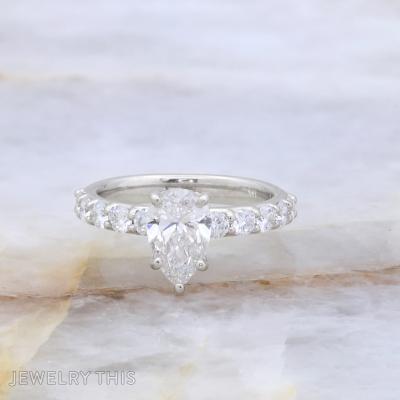
This engagement ring centers a pear-shaped lab-grown diamond set high above a hidden halo, with ...

Recreating the lost engagement set of a beloved grandmother, this set is sure to evoke ...

This raw diamond custom engagement ring is an absolute masterpiece. Crafted in 14k yellow gold ...

Drawing inspiration from the Art Deco era’s harmonious blend of modern geometric aesthetics and delicate ...

This striking yellow gold engagement ring captures the essence of a lush forest through its ...

This striking white gold engagement ring showcases a captivating marquise-shaped black diamond at its center, ...

Introducing this stunning Jade Halo Engagement Ring. A mesmerizing blend of elegance and sophistication. At ...
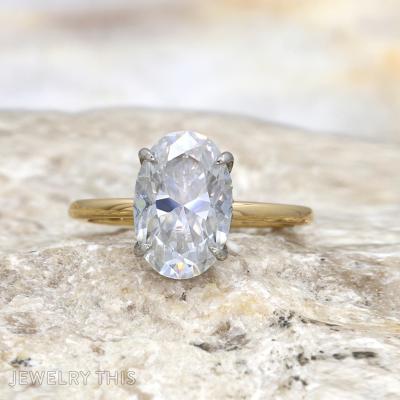
This engagement ring centers a large oval moissanite, chosen for its brilliance and elongated shape, ...

This custom wedding set is a timeless testament to enduring love and commitment. At the ...

This three-stone ring pairs a round center Montana sapphire with two smaller round sapphires in ...
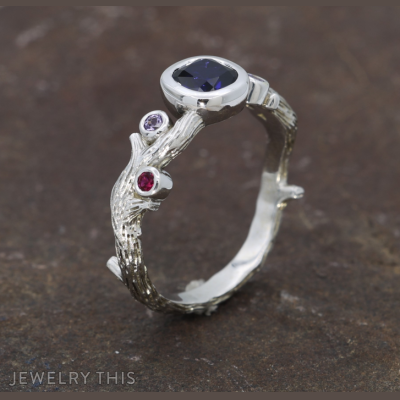
This exquisite engagement ring tells a story of love, individuality, and resilience—crafted to reflect the ...

The rose gold wedding set showcases a harmonious blend of shapes and colors. At the ...



