
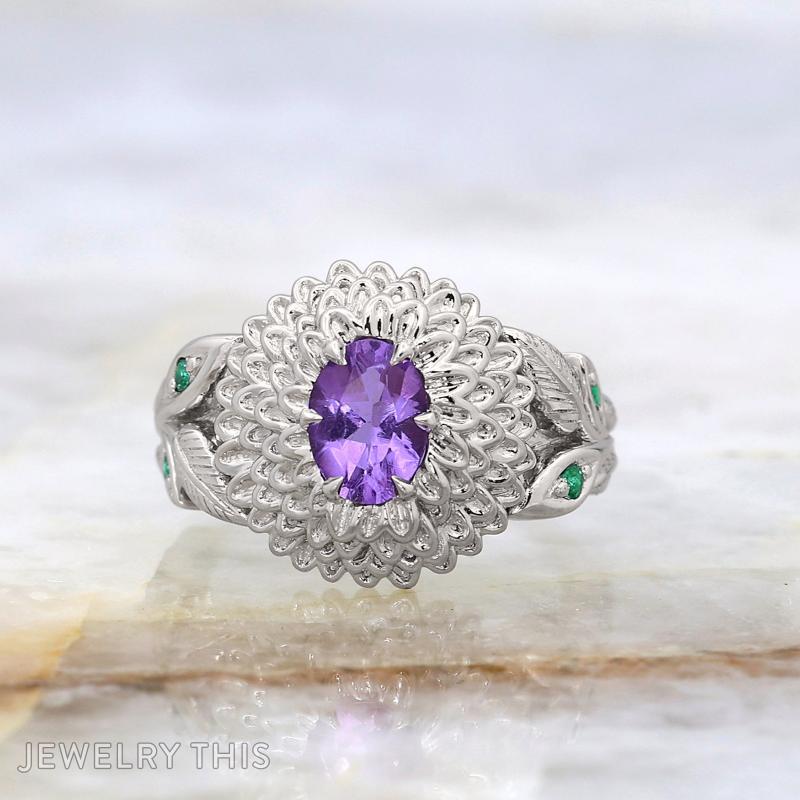
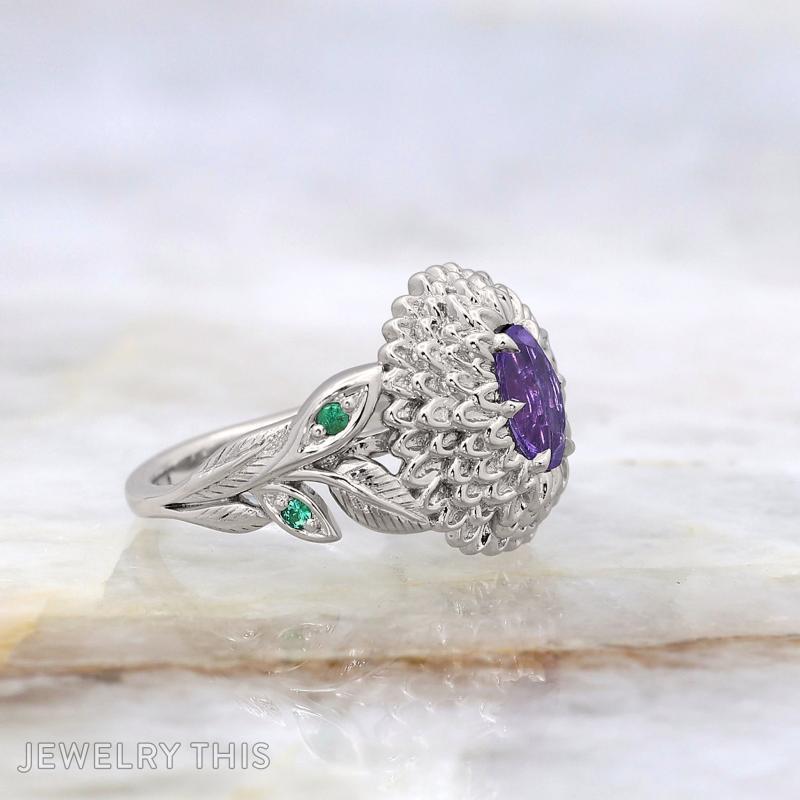
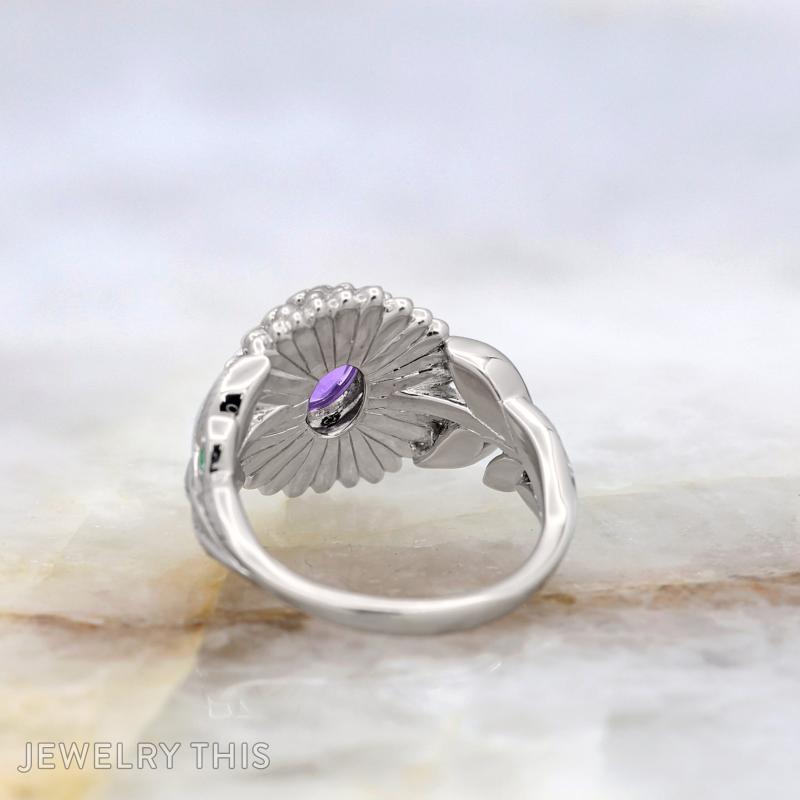
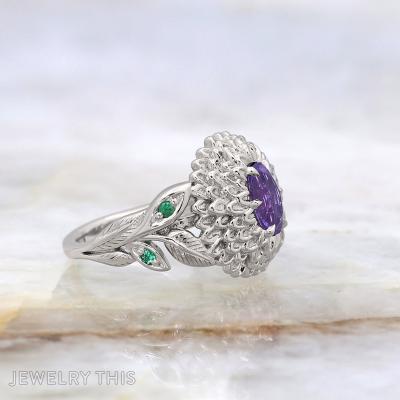
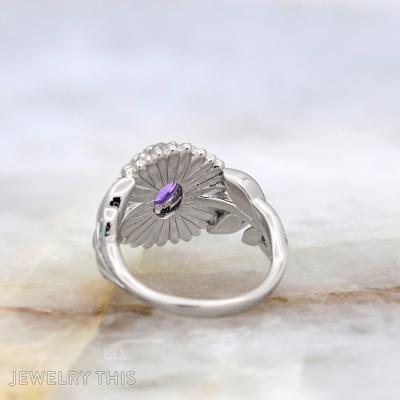
Chrysanthemum Amethyst Engagement Ring in White Gold
$$
14k white gold, amethyst, green tourmaline
A partner came to us wanting to design an engagement ring inspired by his significant other's favorite flower and favorite colors. Working from a chrysanthemum reference and a preference for purple and green, the design came together as a petaled halo cradling a lavender amethyst with green tourmaline leaves along the band. When he saw the finished piece, he wrote: 'It's insane how good of a job you guys did.'
'Oh wow!! That's extremely beautiful I can't wait! Thank you' — on seeing the first sketch
'It's insane how good of a job you guys did thank you so much for everything!!' — on delivery
Quick specs
Design type
Primary Metal
Shape / Cut
Primary Stone
Design Complexity
Intent: Certainty
Size
Ring size 5.5 US. Center stone approximately 0.75-1 carat oval amethyst.
How they made it distinctive
-
01
Chrysanthemum reference translated into a dense multi-layer petal halo rather than a generic floral setting
-
02
Amethyst chosen specifically in a smaller 0.75-1 carat range because the wearer has never liked large center stones
-
03
Green tourmaline used instead of emerald for the leaf-tip accents because it holds up better at small cut sizes
-
04
Leaf and vine detail carried through the shank so the floral theme continues past the center setting
-
05
White gold selected over rose gold specifically because it let the floral texture and center stone read more clearly
How you'd make it yours
Center stone: this piece uses amethyst - a new commission could use a colored sapphire, morganite, or diamond for a different look
Accent stones: this piece uses two green tourmalines - a new piece could mix one colorless and one colored stone, or use a different colored gem entirely
Metal: this piece is 14k white gold - the same floral design language works equally well in rose gold
Petal density: this piece uses a dense multi-layer halo - a new commission could use a simpler single-layer petal ring for a lighter look
Engraving: the inside of the band can carry a date or initials on a new piece
One of a kind: this exact ring was designed for one client's partner and is not reproduced - a new commission is an original piece inspired by this one, not a copy
Design changes made
The client considered mixing white and rose gold or using one colorless and one green accent stone, but ultimately kept both accents green and chose white gold throughout after seeing how the floral detail and center stone stood out more clearly against it.
Who this is for
This piece is for someone designing a ring around a very specific reference - a favorite flower, a favorite color pairing - rather than a generic style. It's especially right if the wearer has never liked large center stones and prefers a ring where the detail and setting do the visual work instead of size.
How it's made
Once the design was approved, a 3D wax model was printed and mounted to a wax tree, then invested in plaster and fired in a kiln to burn out the wax and leave a hollow mold. Molten 14k white gold was cast into that mold, then the piece was cooled, extracted, and cleaned in preparation for finishing.
The dense petal halo was cleaned up by hand to keep each layer of texture distinct after casting, since fine repeating detail like this can blur slightly straight out of the mold. The band was polished to a bright finish to let the floral center and vine detail read clearly, and the oval amethyst was set into the center of the halo using prongs sized to its faceted crown, while the two green tourmalines were set into the leaf tips along the shank.
Key note
The repeating petal texture around the center stone is refined by hand after casting specifically because a mold this fine tends to soften small repeated details, so the crisp layered look comes from post-cast hand-finishing, not the casting itself.
Pricing guidance
A sculptural floral halo ring like this, with a colored center stone and multiple accent stones, sits in the mid range for custom engagement rings of this complexity. Most of the cost comes from the hand-finishing required to keep a dense repeating petal pattern crisp, plus the labor of setting multiple small accent stones. Metal karat and center stone size are the next biggest levers on price.
Moves price up ↑
- ↑ Upgrading from amethyst to a colored sapphire or diamond center stone
- ↑ Increasing the center stone size beyond the 0.75-1 carat range
- ↑ Adding more accent stones around the full halo rather than just two leaf tips
- ↑ Using 18k gold instead of 14k
- ↑ Choosing a fully hand-carved wax model instead of a 3D-printed one for the floral detail
Moves price down ↓
- ↓ Simplifying the petal halo to a single layer of texture instead of a dense multi-layer pattern
- ↓ Reducing the accent stone count from two to one or none
- ↓ Using a smaller center stone under 0.75 carat
- ↓ Choosing a smooth polished band instead of the leaf and vine detail
- ↓ Using lab-created stones in place of natural tourmaline accents
Questions people ask
Amethyst rates about a 7 on the Mohs hardness scale, which makes it reasonably durable for everyday wear but softer than sapphire or diamond. It can hold up well in a protected setting like a halo or bezel, which shields the edges from knocks. It is more prone to scratching than a diamond if it comes into regular contact with harder surfaces, so it is worth avoiding rough manual work while wearing it. Most amethyst engagement rings hold up fine for daily wear with normal care.
Emerald is a relatively soft and included stone, which makes it more prone to chipping when cut small, especially in accent-stone sizes. Green tourmaline offers a similar vivid green color but is more durable and holds up better when cut at a small scale. For accent stones that sit at the edge of a ring and take daily wear, the extra durability makes tourmaline a more practical choice without giving up the color.
A ring with this level of detail - a dense sculptural petal halo, a colored center stone, and multiple hand-set accent stones - typically falls in the mid range for custom engagement rings. The main cost driver is labor: hand-finishing a repeating textured pattern and setting several small stones takes more time than a simple solitaire setting. Metal choice and center stone carat weight are the next factors that move the price up or down.
Yes, a specific flower can be used as the direct reference for a ring's halo or setting shape rather than a generic floral look. The process usually starts with a sketch that translates the flower's petal structure into a wearable setting, followed by a 3D model and render for review. Fine adjustments, like the number of petal layers or how tightly they wrap the center stone, are refined at the render stage before anything is cast.
From approved design to finished ring, production typically takes about four weeks once materials are sourced and the design is finalized. Before that, the sketch and 3D render process usually takes seven to ten days as the design is refined with client feedback. Altogether, most custom engagement rings of this complexity are completed within five to six weeks from deposit to shipping.
For a ring like this, choosing between 14k white gold and 14k rose gold does not significantly change the price, since both use the same amount of the same karat gold. Moving up to 18k gold would increase the cost due to higher gold content. Switching metal color is mainly a style decision rather than a budget one at the same karat level.
Yes, a halo setting like this one can generally accommodate a different center stone as long as the proportions are adjusted to fit the new stone's shape and size. A diamond or sapphire center stone would increase the overall cost compared to amethyst, since both are typically priced higher per carat. The setting style and floral design language would remain the same regardless of which center stone is chosen.
The green tourmaline accents were chosen specifically because they hold up better than a softer stone like emerald at small sizes, so they should wear comparably well to the amethyst center stone with normal use. Prong or leaf-tip settings on accent stones can loosen slightly over years of wear, which is true of any ring with multiple small stones. Periodic inspection by a jeweler, roughly once a year, is a reasonable way to catch any loose stones before they are at risk of falling out.
Explore Similar Creations
Every masterpiece starts with a spark. Explore how our clients raw ideas - sketches, heirlooms, inspirations - were transformed into bespoke works of arts.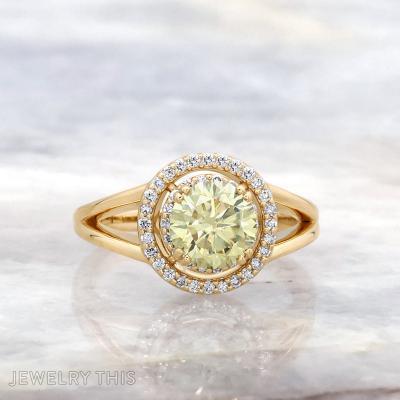
Crafted as a beautiful and cost-effective tribute to a cherished original, this yellow gold engagement ...
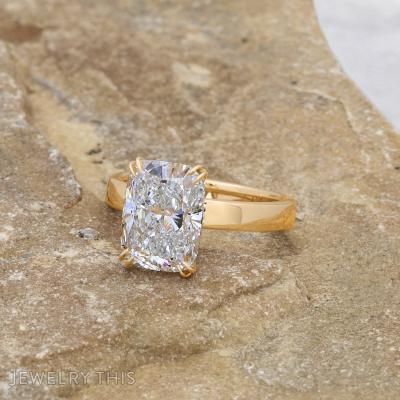
This yellow gold engagement ring highlights the beauty of simplicity and precision with its refined ...

Cat said Yes! This stunning 1.50ct round diamond six claw set in 18ct white gold ...

This 14k yellow gold ring reinterprets the traditional Claddagh design — hands cradling a crowned ...

This timeless three stone engagement ring is crafted in 14k white gold and features a ...

This platinum ring holds the essence of cherished family history. The design blooms, featuring intricate ...

Elegance and grace converge in this exquisite yellow gold engagement ring, showcasing a 1.2carat marquise ...

This ring was built to bring back a one-of-a-kind piece that had been lost — ...

This White gold engagement ring is a mesmerizing ode to love’s enchantement. Nestled at the ...
This white gold wedding set was lovingly created to replicate an original set that was ...

This exquisite Platinum Moissanite And Sapphire Wedding Set. A harmonious blend of elegance and sophistication. ...
This engagement ring centers a large oval moissanite, chosen for its brilliance and elongated shape, ...



