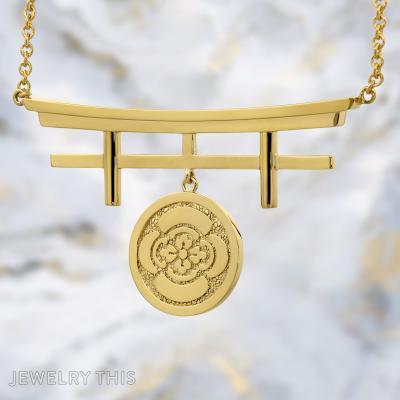
Torii Gate Pendant With Family Crest Mon Coin
$$
Gold plated silver
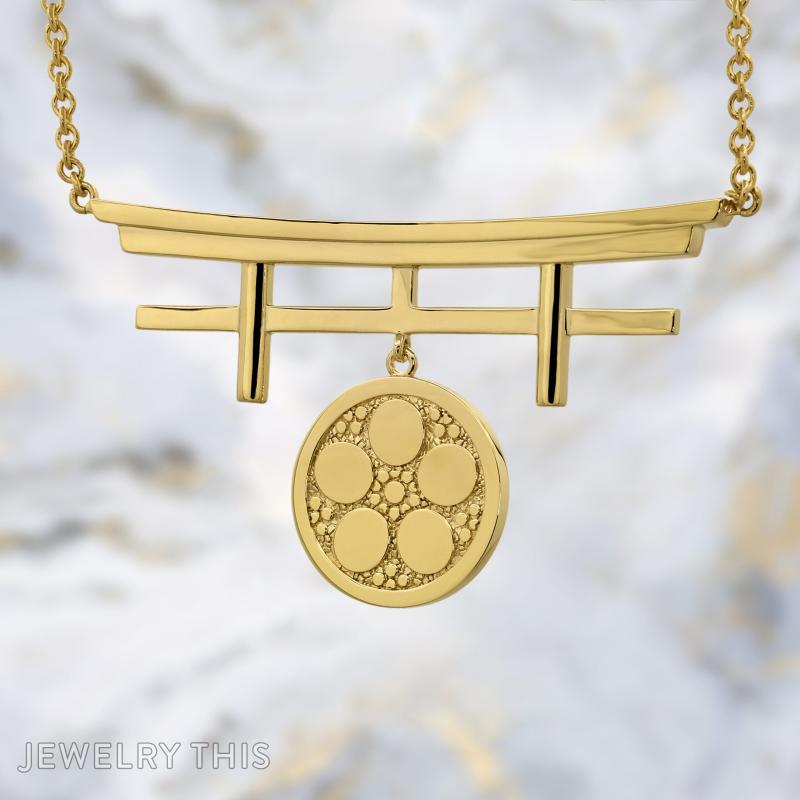
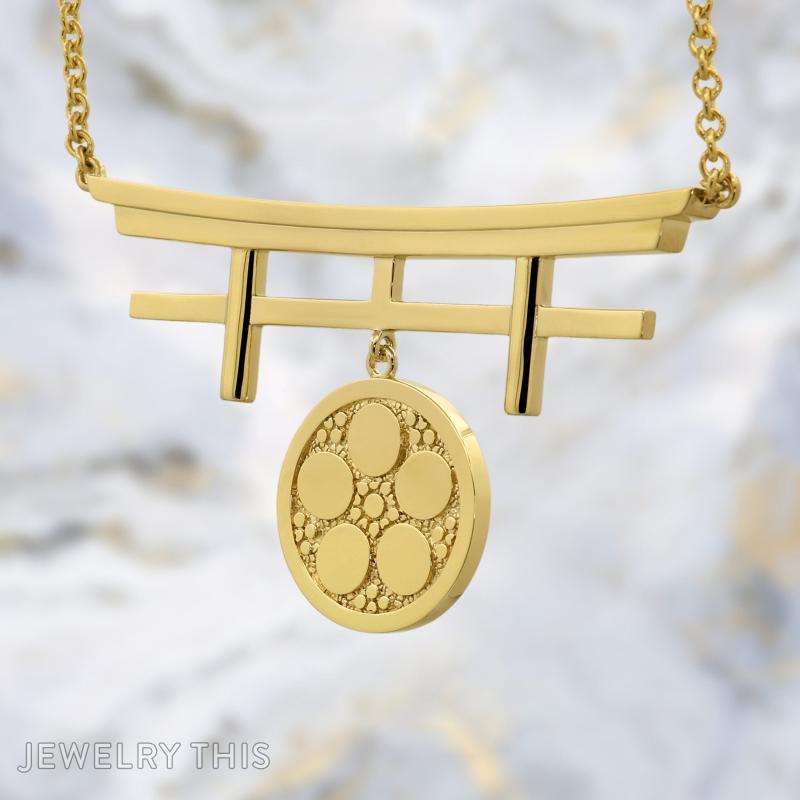
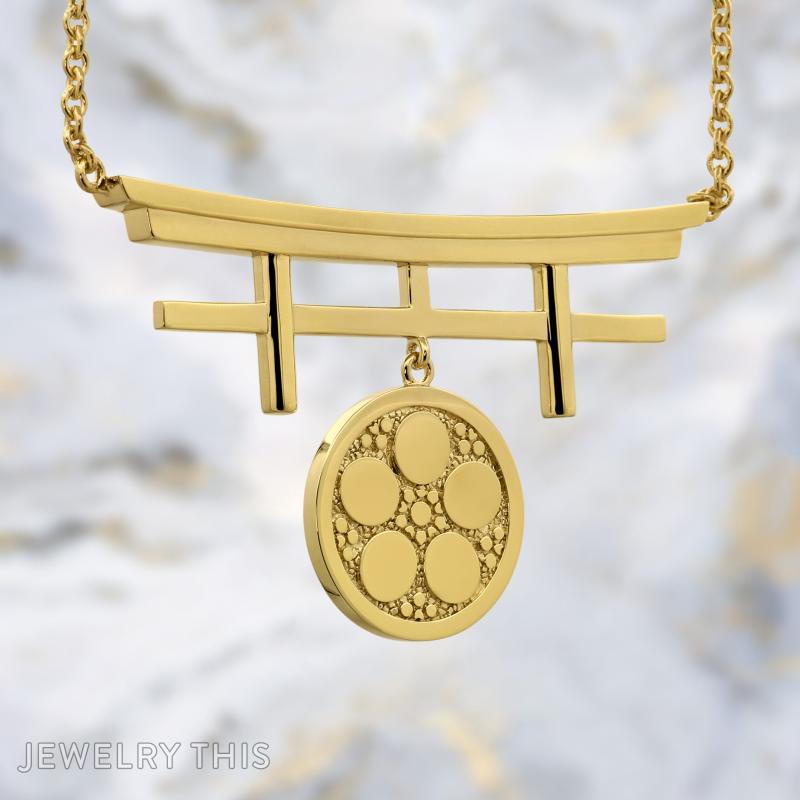
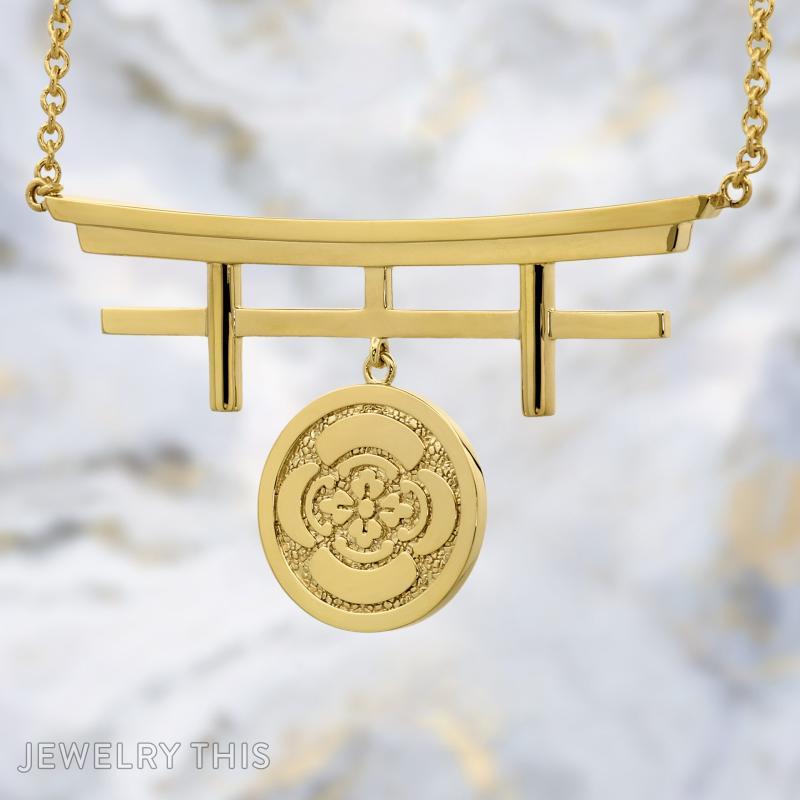
A client wanted to honor his wife's family heritage by turning her family crest into a pendant, pairing it with a torii-gate arch as the frame. Early on he considered having the crest engraved flat for comfort against the skin, but after seeing the render he asked to bring back the raised, textured look of the original crest images instead. When the piece arrived, he wrote to say it was going well and that he was looking forward to sharing his thoughts.
Quick specs
Design type
Primary Metal
Primary Stone
Accent Stones
Design Complexity
Intent: Certainty
Size
Pendant approximately 1in (25mm) coin diameter; torii-gate arch approximately 3in (76mm) wide. Chain: 2.8mm cable, 16in total length (8in each side from clasp to pendant).
How they made it distinctive
-
01
Torii-gate arch used as a structural frame rather than a simple bail, referencing traditional Japanese shrine architecture
-
02
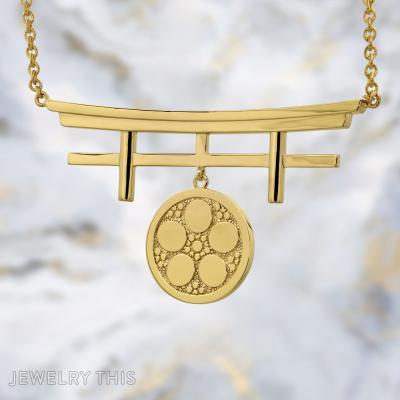
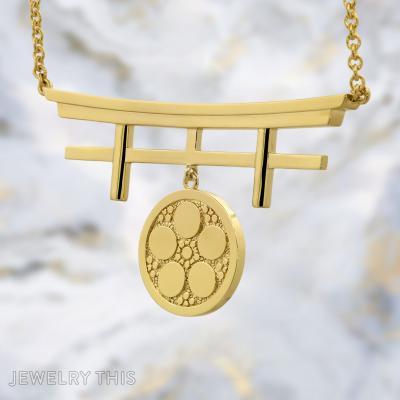
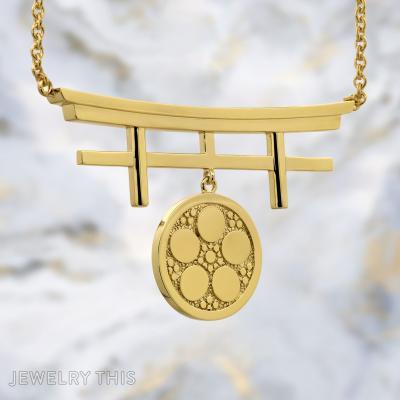
Coin medallion designed to carry two family crests, one on each face, rather than a single-sided design
-
03
Raised, textured medallion finish restored after the client compared an engraved version against his original reference images and preferred the dimensional look
-
04
Two distinct surface treatments — polished crest, stippled field — created in a single casting to add contrast without extra engraving
-
05
Sized larger than a typical pendant coin, closer to a US quarter or bigger, to keep the crest detail legible
How you'd make it yours
Metal: this piece is 14k gold plated silver; a new commission could use solid 14k or 18k yellow gold for a heavier, longer-lasting finish
Medallion finish: this piece uses a raised crest with a stippled background; a new piece could use a smooth polished background or an engraved flush design instead
Arch structure: this piece uses a three-inch tiered torii-gate frame; a new commission could use a simpler single-bar or wider multi-tier arch
Chain: this piece uses a 2.8mm cable chain at 16 inches; a new piece could use a different width, length, or chain style such as curb or figaro
One of a kind: this exact pendant was designed around this client's family crest and is not reproduced — a new commission is an original piece inspired by this one, not a copy
Design changes made
The crest medallion shifted from an engraved, flush design to a raised design with a textured stippled background, after the client reviewed the render and asked to match his original reference images more closely rather than prioritize wear comfort.
Who this is for
This piece is for someone who wants to wear their family heritage rather than keep it stored away, and who cares enough about the details to push back until a design element matched what mattered to them. It's especially fitting for someone drawn to architectural or cultural motifs who wants a pendant with real presence rather than something delicate and understated.
How it's made
Once the design was approved, a 3D-printed resin model was produced first — the physical preview of the piece before any metal was committed, and a photo of this resin stage was shared with the client. The resin was then attached to a wax tree, invested in plaster, and fired in a kiln to burn out the pattern, leaving a hollow mold. Molten 14k yellow gold plated silver was cast into this mold, then cooled and extracted for finishing.
After casting, the torii-gate arch was polished to a bright, mirror finish along its bars and crossbeams. The coin medallion required a different treatment: its raised floral crest was polished smooth while the surrounding field was left with a stippled, textured surface to create contrast between the emblem and its background. The two pieces were then joined with a jump ring so the medallion hangs freely beneath the arch.
Key note
The medallion's textured background and polished raised crest are finished as two distinct surface treatments on the same casting, which is why the emblem reads clearly against the field without any added engraving.
Pricing guidance
A large architectural pendant combining a gate motif with a separate coin medallion sits toward the higher end of pendant pricing due to its size and the two-part construction. Gold-plated silver keeps the cost down relative to solid gold while still achieving the yellow-gold look the client wanted. Most of the cost driver here is the scale of the piece and the hand-finishing needed to create the textured-versus-polished contrast on the medallion.
Moves price up ↑
- ↑ Casting the piece in solid 14k or 18k gold rather than gold-plated silver
- ↑ Increasing the arch width beyond 3 inches or the medallion beyond 1 inch
- ↑ Adding a second crest design engraved rather than cast in relief
- ↑ Upgrading the chain to a wider or solid-gold cable style
- ↑ Adding gemstone accents to the medallion border
Moves price down ↓
- ↓ Reducing the arch to a smaller, single-bar design without the stepped tiers
- ↓ Choosing a smooth polished background instead of the stippled texture
- ↓ Using a thinner 2mm chain instead of 2.8mm
- ↓ Making the medallion single-sided instead of designed for two crests
- ↓ Simplifying the arch structure to remove the tiered crossbeam
Questions people ask
Gold plated silver is a sterling silver base with a layer of 14k or 18k gold applied over the surface. It gives the look and warmth of solid gold at a lower cost, but the plating is a surface coat rather than the metal running all the way through. With regular wear, plating will gradually wear thinner over time, especially on high-contact areas, and can be re-plated by a jeweler when needed. How long it lasts depends on how often the piece is worn and exposure to moisture, lotion, and friction.
Yes, a family crest or emblem can be cast in raised relief so the design sits above the surrounding surface rather than being cut into it. This is typically done by modeling the crest in 3D so it forms part of the casting itself. A raised design gives more visual depth and texture than an engraving, though engraved designs are sometimes preferred for pieces worn against the skin since they sit flush and don't catch on clothing.
A large architectural pendant with a separate hanging element, like a gate paired with a coin medallion, tends to fall in the low-to-mid range for custom pendant work. The primary cost drivers are the overall size of the piece and the amount of hand-finishing required, particularly when there are contrasting surface textures like polished versus stippled areas. Choosing gold-plated silver instead of solid gold is one of the more effective ways to keep the cost down while keeping the yellow-gold appearance.
The full process from design approval to completion typically takes around one week for the design and sketch phase, followed by three to four weeks of production. A resin 3D-printed model is usually produced first as a preview, followed by casting, then finishing and polishing. More complex pieces with multiple textures or two-part construction may fall toward the longer end of that window.
A torii gate design uses the recognizable stepped-arch shape of a traditional Japanese shrine gate as the pendant's structural frame, rather than a simple straight bar. It typically includes a curved top beam and one or two crossbeams beneath it, giving the piece an architectural silhouette. This makes it a more complex casting than a plain bar pendant, since the tiered structure and proportions have to be balanced so the piece reads clearly at pendant scale.
Yes, a coin-style medallion can be designed with different content on each face, such as two different family crests or emblems. Because both faces are cast as part of the same piece, each side can carry its own raised or engraved design independent of the other. This is a common approach when a couple wants to represent two family lines in one pendant.
Yes, both the chain length and its width can be adjusted to suit the wearer and the scale of the pendant. Wider pendants generally look better paired with a slightly heavier chain gauge so the proportions feel balanced, while very fine chains can look undersized under a large piece. Cable chain is one common style choice, and it's available in a range of widths from delicate to statement-sized.
A stippled or textured surface can collect more residue from lotion, skin oils, and everyday wear than a smooth polished surface, simply because it has more surface area and small recesses. Regular gentle cleaning with a soft brush and mild soap helps keep the texture looking crisp. This is a normal maintenance consideration rather than a durability concern, and it does not affect the structural strength of the piece.
Explore Similar Creations
Every masterpiece starts with a spark. Explore how our clients raw ideas - sketches, heirlooms, inspirations - were transformed into bespoke works of arts.
This custom pendant is a beautifully crafted sterling silver key design, making it a symbol ...

This pendant serves as a tangible symbol of the couple’s special connection to this landmark. ...

This captivating custom pendant is a true testament to strength and elegance. Crafted in a ...
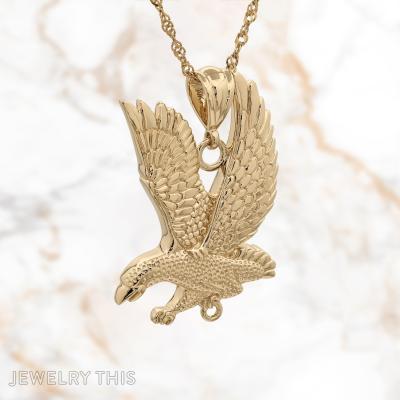
This 10k yellow gold pendant depicts an eagle in flight, wings fully spread and rendered ...


Discover the captivating allure of this one-inch custom pendant, a masterpiece by Capalyon. Crafted in ...

Sterling silver star pendant set around perimeter with alternating diamonds and sapphires. Pendant: 1 inch ...

This rectangular pendant pairs a polished 10k yellow gold plaque with raised 10k white gold ...

This custom pendant is a personal statement of elegance and style. Crafted in radiant 14k ...

This elegant 10k white gold pendant features an intricate trinity knot encasing a dove in ...

Crafted with precision and elegance, this 14k yellow gold pendant showcases the initials HEC in ...
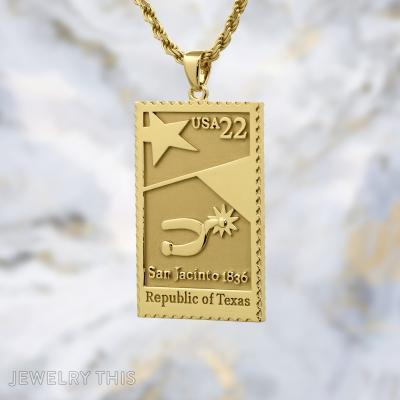
This rectangular pendant recreates two vintage postage stamps in raised, dimensional metalwork on a gold-plated ...