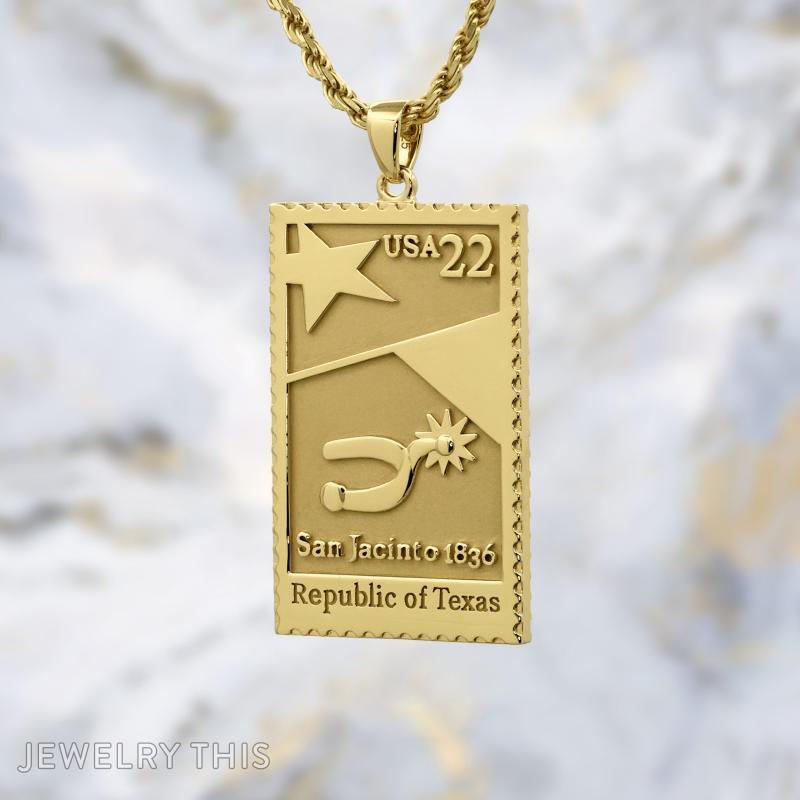
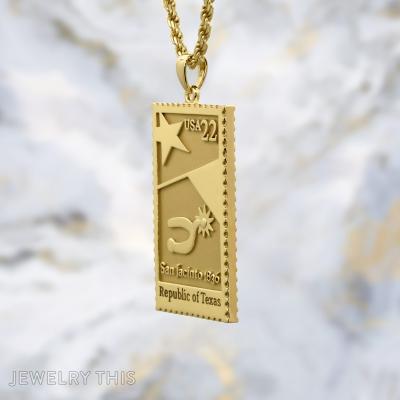
Two-Sided Postage Stamp Pendant — Texas & Tennessee Tribute
$$
Gold-plated sterling silver
A newlywed wanted to honor his wife's maiden name after she took his — building a two-sided pendant using vintage postage stamps from Texas and Tennessee, the home states of her parents. He worked through several rounds of finish choices, going back and forth between gold and silver before landing on gold plating because the raised details 'popped' more. When she received it, he wrote: 'She loves it!! It was a perfect gift.'
'It looks great!' — on seeing the first render
'She loves it!! Thanks so much for your help along the way! It was a perfect gift' — on delivery
Quick specs
Design type
Primary Metal
Primary Stone
Accent Stones
Design Complexity
Intent: Certainty
Size
Pendant approximately 1 to 1.5in tall (rectangular); chain 18in x 2mm.
How they made it distinctive
-
01
Two-sided design pairs a Texas stamp and a Tennessee stamp, representing both of the wife's parents' home states
-
02
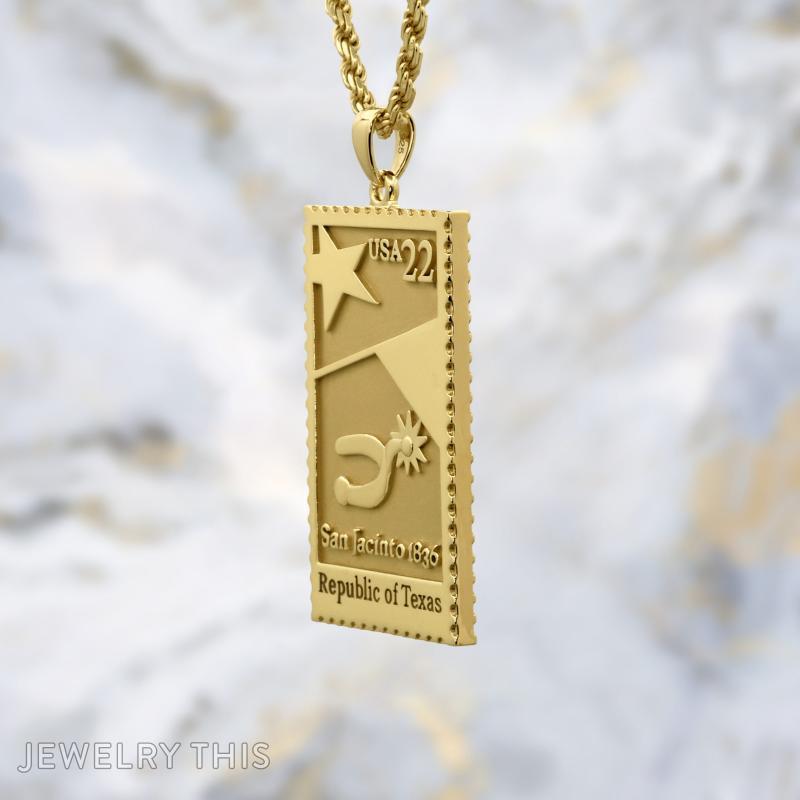
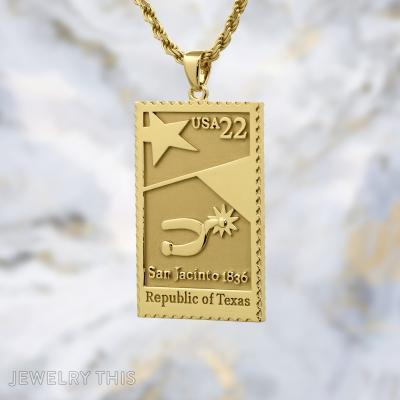
Raised, high-polish detailing contrasted against a matte recessed background gives the stamp imagery visual depth
-
03
Commemorates the wife's maiden name specifically, chosen as a gift right after she took her husband's last name
-
04
Gold-plated finish selected after comparing side-by-side renders because it made the raised details stand out more clearly
-
05
Sized to stay wearable at just over an inch while still fitting detailed text and imagery on both faces
How you'd make it yours
Stamp imagery: this piece uses Texas and Tennessee commemorative stamps; a new commission could use any two states or countries meaningful to the wearer
Metal: this piece is gold-plated sterling silver; the same design works in solid 10k or 14k yellow gold for a longer-lasting finish
Finish: this piece combines matte recessed areas with high-polish raised details; an all high-polish finish is also possible for a more subtle look
Chain: this piece pairs with an 18-inch gold-plated rope chain; a longer or shorter length works the same way
Size: this piece is sized just over an inch tall; a new commission can be sized larger or smaller depending on how much detail is needed
One of a kind: this exact pendant was designed for one couple's family history and is not reproduced — a new commission is an original piece inspired by this one, not a copy
Design changes made
The client considered switching the finish from gold plating to a white silver look partway through design, requesting a second render to compare. He ultimately returned to the original gold-plated finish because the raised stamp details stood out more clearly against it.
Who this is for
This piece is for someone who wants to honor where their family comes from in a way that can be worn every day, not tucked away. It's especially right for a newly married couple looking to preserve one partner's maiden name or family heritage in a piece that means something specific to them.
How it's made
Once the two-sided design was approved, a 3D-printed resin model was produced first — the physical preview of the pendant shared with the client before any metal was committed. The resin was then set into a wax tree, invested in plaster, and fired in a kiln to burn out the pattern, leaving a hollow mold. Molten sterling silver was poured into the mold, cooled, and extracted as the raw two-sided pendant.
After casting, the piece was cleaned and finished in two distinct textures: the raised stamp imagery — the star, spur, lettering, and borders — was brought to a high polish, while the recessed background fields were given a matte finish to create visual depth between the two levels. The entire piece was then gold plated, and a matching 18-inch gold-plated rope chain was added to complete it.
Key note
The matte-versus-polish contrast is applied after casting and before plating, so the raised stamp details catch the light while the recessed background stays visually quiet — a sequencing choice made specifically because a render cannot show where matte and polish zones fall.
Pricing guidance
A two-sided, detailed pendant like this — with raised and recessed elements on both faces — sits toward the lower end of custom pendant work. Most of the cost comes from the extra modeling and hand-finishing required to make two distinct designs work on opposite sides of one small piece, rather than from the metal itself.
Moves price up ↑
- ↑ Casting the piece in solid 14k or 10k gold rather than gold-plated silver
- ↑ Increasing the pendant size beyond 1.5 inches to fit more stamp detail
- ↑ Adding gemstone accents to either stamp face
- ↑ Upgrading the chain to a heavier gauge or solid gold rope chain
Moves price down ↓
- ↓ Reducing the design to a single-sided stamp rather than double-sided
- ↓ Simplifying the stamp artwork to fewer raised elements
- ↓ Choosing a smaller overall pendant size under 1 inch
- ↓ Skipping the chain and using an existing chain at home
Questions people ask
Yes, double-sided pendants are a common request, especially for pieces representing two meaningful things like family origins or two people. Each side is modeled separately in the 3D design phase, so the two faces can carry completely different artwork, as with a pendant showing one state's commemorative stamp on one face and another state's on the reverse. This does add some modeling time since both sides need their own detail work, but it does not require a different production process. The finished piece functions as a single solid pendant with two fully designed faces.
A matte finish scatters light and gives a soft, non-reflective surface, while a high-polish finish is mirror-bright and reflects light directly. Using both on one piece — polish on raised elements and matte on recessed background areas — creates visual contrast that makes dimensional details like lettering or a raised design read more clearly. This combination is a common choice on pieces with a lot of fine detail, like stamp or coin-style pendants. Choosing all high-polish instead is also an option, though it makes the design details slightly more subtle.
Gold-plated sterling silver costs significantly less than solid 10k or 14k gold because it uses a base of silver with a thin layer of gold applied to the surface, rather than solid gold throughout. On a detailed two-sided pendant, the price difference between plated and solid gold can be several times the total cost. Plated pieces look identical to solid gold when new, though the plating will wear gradually with contact and may need occasional re-plating over years of daily wear. Solid gold does not require replating and holds its color permanently.
Yes, gold plating is a thin surface layer and will gradually wear thinner with regular wear, especially at points of frequent contact like the edges of a pendant or clasp. How long it lasts depends on how often the piece is worn and exposure to moisture, lotions, and friction from clothing. Many wearers get several years of good wear before any fading is noticeable, and re-plating is a straightforward service when needed. Storing the piece away from moisture when not worn helps extend the plating's life.
The full process typically runs about six weeks from deposit to delivery on a standard timeline. The first week or so covers the design phase, including a sketch and a 3D render for approval, with revisions as needed if you want to compare finish options like gold versus silver. Once the design is approved, production — casting, finishing, and stone setting if applicable — takes about five additional weeks. Adding a chain or requesting finish changes mid-design can add a small amount of time but does not typically extend the overall timeline significantly.
Yes, the same design can be cast in solid 10k or 14k yellow gold instead of gold-plated sterling silver. Solid gold costs substantially more than plated silver because the entire piece is made of precious metal rather than a base metal with a thin gold layer, but it will never need re-plating and holds its color indefinitely. Many clients start with plated silver for a lower cost and upgrade to solid gold on a future piece once they've lived with the design. The choice mostly comes down to long-term maintenance versus upfront cost.
An 18-inch cable or rope chain in a matching finish is a common pairing for a pendant of this size, roughly one to one and a half inches tall. A chain in the 2mm range is substantial enough to support the pendant's weight without overwhelming it visually. Matching the chain's finish to the pendant, such as pairing a gold-plated pendant with a gold-plated chain, keeps the look cohesive. Clients who already own a compatible chain in the same metal type can typically use their own rather than ordering a new one.
Yes, specific vintage or commemorative postage stamps can be used as reference material for a pendant design, with the stamp's imagery, text, and layout recreated as a raised or engraved dimensional design. The designer works from a photo of the stamp to translate flat printed artwork into a three-dimensional metal piece, with raised elements standing above a recessed background. Small text and fine details are simplified as needed to read clearly at jewelry scale. This approach works well for commemorating a specific place, date, or event tied to a particular stamp.
Explore Similar Creations
Every masterpiece starts with a spark. Explore how our clients raw ideas - sketches, heirlooms, inspirations - were transformed into bespoke works of arts.
This custom pendant features a bold brand design, with a horseshoe at its center, symbolizing ...


This striking custom pendant, measuring 2.5 inches, is a symbol of strength and individuality. It ...

A family crest pendant with dimensional details on a sandblasted background. The piece was made ...

A unique shamrock mother’s pendant crafted in 14k yellow gold and bezel set with three ...

Exuding luxury and sophistication, this custom pendant is a masterpiece crafted in radiant 14k yellow ...


This captivating 14karat rose gold pendant showcases the natural beauty of a kite-shaped moss agate ...

This gold pendant features the timeless Ten Commandments, beautifully inscribed in Hebrew letters with precision. ...

Presenting a stunning memorial pendant. This piece features a captivating two-tone heart shaped pendant. One ...

A sterling silver butterfly pendant with multiple colors of purple in the wings and amethysts ...

This beautiful custom pendant celebrates the love of beloved family pet, Lucy the beagle. Crafted ...