


Geometric Enamel Pendant — Gold-Plated Group Keepsake
$$$
Gold-plated sterling silver, enamel
A. was planning a gathering for sixteen people and wanted everyone to leave with the same symbol made real — a design he brought to us as a reference image. Over several rounds he refined the enamel palette down to the exact aqua, blush, and fuchsia he had in mind, and asked for a matte, slightly rough gold texture rather than a polished finish. When the pieces were finished and shipped out to each person individually, he wrote back: 'these pendants turned out so beautifully and I am quite pleased and grateful.'
'I love it! It's beautiful.' — on seeing the first render
'these pendants turned out so beautifully and I am quite pleased and grateful' — on delivery
Quick specs
Design type
Primary Metal
Primary Stone
Accent Stones
Design Complexity
Intent: Certainty
Size
Pendant approximately 1.5in diameter. Curved/domed surface. Bail with angled-edge loop for chain.
How they made it distinctive
-
01
Produced as a set of sixteen matching pendants, one for each participant in a shared gathering, rather than as a single piece
-
02
Four separate enamel colors — aqua-blue, blush pink, fuchsia, and orange — refined across multiple comparison renders to match the client's reference image as closely as possible
-
03
Matte, hand-applied gold texture chosen over a polished finish after the client referenced a specific textured ring for comparison
-
04
Curved rather than flat surface, matching the dimensional quality of the original reference image
-
05
Bail shaped with an angled opening specifically so the chain could pass through cleanly
-
06
Center stone concept dropped in favor of an enamel-only rendering for more consistent color matching across all sixteen pieces
How you'd make it yours
Enamel palette: this piece uses aqua-blue, blush pink, fuchsia, and orange; a new commission could use any available enamel color combination
Metal: this piece is gold-plated sterling silver; the same design language works in solid gold or a different plating karat
Finish: this piece has a matte-textured gold frame with polished linework; a new piece could be fully polished or fully matte
Surface profile: this piece has a curved, domed surface; a new commission could be made flat instead
Center element: this piece uses enamel only; a new piece could incorporate a set center stone such as turquoise
One of a kind: this exact pendant design was created for one client's gathering and is not reproduced — a new commission is an original piece inspired by this one, not a copy
Design changes made
The design shifted from the client's initial idea of a set turquoise center stone to an enamel-only rendering of the emblem, and the enamel colors were adjusted across several comparison renders — aqua-blue, blush pink, and fuchsia replacing the original purple and lighter blue — until the palette matched the client's vision. A matte, hand-applied gold texture was also added to the plain gold areas at the client's request.
Who this is for
This piece is for someone who wants a shared symbol made real for a group — a way of giving everyone at a gathering the same meaningful design without it feeling mass-produced. It's especially right if you have a specific reference image in mind and want to be closely involved in matching colors and finish before anything goes into production.
How it's made
Once the enamel colors and matte gold texture were finalized, the design was 3D printed in wax and attached to a wax tree inside a flask. The flask was invested in plaster and fired in a kiln to burn out the wax, leaving a hollow mold. Molten gold-plated sterling silver was then cast into the mold, producing sixteen raw pendants that were cleaned and prepared for finishing.
After casting, the matte texture was applied by hand to the plain gold surfaces, while the raised linework was left polished for contrast. The recessed sections of the emblem were then filled with enamel one color at a time, each layer cured before the next was applied, since multiple colors in the same piece require sequential application and drying. The bail was shaped with an angled opening so the chain could pass through cleanly.
Key note
Because the emblem uses four separate enamel colors, each color had to be applied and fully cured before the next could go in, which is why the enamel work took longer than a single-color piece.
Pricing guidance
A multi-color enamel pendant with hand-applied matte gold texture, produced as a set of sixteen, sits in the mid range for custom enamel work of this complexity. The first piece carries the bulk of the design and tooling cost, with each subsequent piece costing meaningfully less once the mold and color palette are established. Enamel work with several colors adds more to the baseline than a single-color or engraved design would.
Moves price up ↑
- ↑ Increasing the number of enamel colors beyond four, since each color requires its own curing step
- ↑ Adding a set stone, such as a turquoise center, rather than an enamel-only center
- ↑ Upgrading from gold-plated sterling silver to solid 14k gold for each piece
- ↑ Making the pendant larger than 1.5 inches, which increases material and enamel surface area
- ↑ Hand-texturing a larger gold surface area across a bigger pendant
Moves price down ↓
- ↓ Reducing the enamel palette to one or two colors instead of four
- ↓ Switching from enamel coloring to a flat color-engraved design
- ↓ Producing a smaller run of pieces, since per-unit cost drops with higher quantity
- ↓ Leaving the gold surface polished rather than hand-textured
- ↓ Reducing the pendant size below 1.5 inches
Questions people ask
Yes, producing a set of identical or near-identical enamel pendants for a group is a common custom request. The first piece carries most of the design and tooling cost, since the 3D model, wax print, and mold all have to be created before any casting happens. Once that first piece is approved, each additional casting costs meaningfully less, since the design work is already done. Enamel color curing time is the main factor that affects how long a larger batch takes to finish.
Enamel is a glass-like coating fired or cured into recessed areas of the metal, and it holds up well to normal daily wear when it isn't repeatedly struck or scraped against hard surfaces. The gold plating underneath it will show wear over time with frequent contact, since plating is a thin surface layer rather than solid gold. Keeping the piece away from harsh chemicals and abrasive contact will extend the life of both the enamel and the plating. If the plating does wear, re-plating is a standard jewelry service available from most jewelers.
Each enamel color has to be applied separately and fully cured before the next color can go in, so a four-color design takes meaningfully longer to finish than a one-color piece. This sequential process is largely manual, which adds labor time rather than material cost. The complexity of the recessed pattern also affects how long the enamel application takes, since more intricate line work means more careful filling. For a multi-color piece like this, the enamel work is often the single biggest driver of extra production time.
A multi-color enamel pendant in gold-plated sterling silver, produced as a complex geometric design, generally sits in the mid range for custom enamel work. The first piece in a set costs more because it includes the full design and mold-making process, while repeat pieces from the same mold cost less per unit. Pendant size, number of enamel colors, and whether a center stone is added are the main variables that move the price up or down from there.
The design phase typically takes about a week, covering the 3D render and any color or texture adjustments the client wants to see compared side by side. Production after design approval generally takes two to three weeks, and multi-color enamel work can push that toward the longer end since each color needs to cure before the next is applied. A larger batch of identical pieces adds some time as well, since every piece goes through the same enamel sequence individually. Rush timelines are possible but should be discussed before the order is placed.
Yes, a matte or slightly rough texture can be hand-applied to gold-plated surfaces during the finishing stage, as an alternative to a mirror-polished look. This is typically done by hand after casting, so the texture sits alongside any polished or enameled areas rather than covering the whole piece uniformly. A textured finish tends to show fingerprints and wear differently than a polished one, and can actually be more forgiving with everyday handling. It's a purely aesthetic choice and doesn't affect the durability of the plating underneath.
Yes, it's common for an initial concept to include a stone that later gets reworked into an enamel element instead, often to allow for more precise color matching or to simplify the setting process across multiple pieces. Enamel can reproduce a wide range of colors more consistently across a batch than sourcing matching stones for every piece would. The trade-off is that enamel doesn't have the same light-reflecting quality or hardness as a cut gemstone. For a single custom piece, either approach works, but for a multi-piece set, an enamel-only design is usually more consistent and efficient.
Yes, a domed or curved pendant surface is achievable in casting and doesn't require significant redesign from a flat version. The curve is built into the 3D model before the wax printing stage, so it's a design decision made early rather than a separate production step. A curved surface can affect how enamel settles into recessed areas slightly differently than a flat surface, which is accounted for during the enamel application. The visual effect gives the piece more dimension than a flat engraved or enameled disc.
Explore Similar Creations
Every masterpiece starts with a spark. Explore how our clients raw ideas - sketches, heirlooms, inspirations - were transformed into bespoke works of arts.
This custom pendant is a striking blend of classic and intricate design, crafted in silver ...


Celebrate cosmic love with our whimsical astronaut-inspired pendants, each cradling half a heart. Crafted in ...

This 14karat yellow gold pendant is a heartfelt tribute to the cherished matriarch of the ...

Inspired by the love of gaming, this logo pendant was a dream piece the client ...
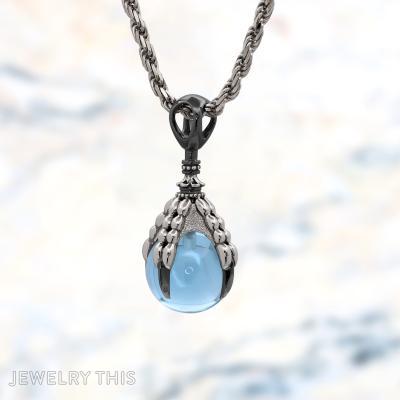
This pendant recreates a dragon’s claw gripping a round sky blue topaz orb, rebuilt after ...
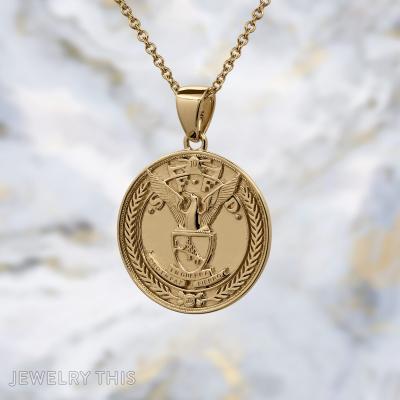
A daughter’s love for her father shines through this meaningful gift. This 1-inch pendant features ...

This pendant centers a heart-shaped amethyst — a February birthstone — inside a double-outlined heart ...

This elegant 14karat yellow gold pendant features the name of a loved one displayed in ...
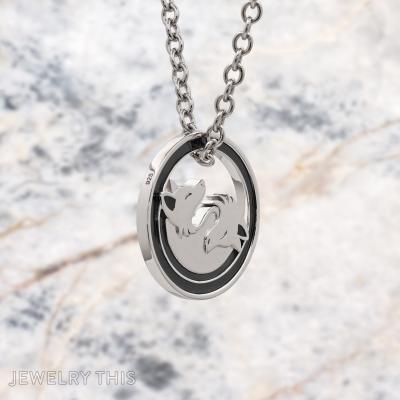
This sterling silver pendant reimagines the yin-yang symbol using two nose-to-tail foxes, cast identically on ...

This gold football pendant is a heartfelt gift from a father to his son. Measuring ...

Crafted in radiant 14k white gold, this custom pendant is a stunning replica of a ...



