


Engraved Sacred Seal Medallion Pendant in 14k Gold
$$$
14k yellow gold
K. came to us with a detailed reference image of a sacred-geometry talisman design and a clear goal: fit every symbol and name into a solid gold pendant without losing any of the detail. After the team explained that cutting the design through the metal wasn't feasible given how interconnected the elements were, K. trusted their judgment on how to render it instead. When the finished piece arrived, he wrote simply that it looked really nice.
'Hi Carrie the pendant looks great thanks and I happy for you to do what you think will give the best results.' — on seeing the first render
'Thank you it looks really nice.' — on delivery
Quick specs
Design type
Primary Metal
Primary Stone
Accent Stones
Design Complexity
Intent: Certainty
Size
Pendant approximately 7/8 inch (22mm) diameter. Chain width 4mm (client-provided).
How they made it distinctive
-
01
Precision machine engraving used instead of cast detail — chosen specifically because the design's density would not have come through cleanly from a mold
-
02
Pendant sized down from 1 inch to 7/8 inch at the client's request while preserving full legibility of the design
-
03
Fixed oval bail custom-sized to fit the client's own 4mm chain rather than a standard sourced chain
-
04
Design includes a full ring of lettering plus a layered star framework and central wheel motif, requiring careful sequencing of engraving after polishing
How you'd make it yours
Size: this piece is 7/8 inch — a new commission could go larger for easier legibility or smaller if the design is simplified
Metal: this piece is 14k yellow gold — the same engraved design language works in 18k gold or a white gold version
Engraving technique: this piece uses single-sided machine engraving — a new piece could explore two-sided engraving for additional detail
Chain compatibility: this piece was sized to a 4mm chain — a new commission can be sized to any chain width the client provides
One of a kind: this exact pendant was designed and engraved for one client and is not reproduced — a new commission is an original piece inspired by this one, not a copy
Design changes made
The pendant was brought down from 1 inch to 7/8 inch at the client's request after the initial size estimate, and the team shifted from casting the fine detail into the metal to precision machine engraving after casting, to keep the dense lettering and symbols clean and legible at the smaller size.
Who this is for
This piece is for someone who wants a design dense with meaning and detail rather than a single simple symbol — someone comfortable with intricate, layered imagery that rewards a closer look. It suits a person who already has a strong reference image in mind and wants a jeweler's technical judgment on how to translate it faithfully into solid gold.
How it's made
Once the design was finalized, the pendant body was modeled digitally and 3D printed in wax, then attached to a wax tree and invested in a flask. The flask was fired in a kiln to burn out the wax, leaving a hollow mold, and molten 14k yellow gold was cast into the mold under pressure. After cooling, the raw pendant was removed from the mold and prepared for finishing.
The cast disc was cleaned and polished to a bright finish before the detailed sacred-geometry design — the lettering, star framework, symbols, and central wheel motif — was applied using a precision engraving machine rather than being cast directly into the metal. This sequencing kept the dense, interconnected detail sharp and consistent across the full design, something that would have been difficult to achieve through casting alone. The oval bail was sized to fit the client's own 4mm chain.
Key note
The fine sacred-geometry detail was deliberately engraved by machine after casting, rather than cast directly into the metal, because the design's dense and interconnected elements would not have come out of the mold clean and consistent.
Pricing guidance
A complex engraved disc pendant like this sits in the mid range for custom gold pendant work. Most of the cost comes from the sheer density of detail — fitting that much lettering and symbolism legibly into a sub-one-inch pendant requires precision engraving work on top of standard casting and finishing. Gold weight and pendant diameter are the next biggest factors in the final cost.
Moves price up ↑
- ↑ Increasing the pendant diameter to fit even more detail or improve legibility
- ↑ Adding two-sided engraving instead of a single engraved face
- ↑ Upgrading from 14k to 18k gold for a richer color and higher gold content
- ↑ Requesting hand-finishing or hand-engraving instead of machine engraving
- ↑ Adding gemstone accents to the design
Moves price down ↓
- ↓ Reducing the pendant diameter and simplifying the design to fewer symbols
- ↓ Choosing a lower-karat gold or a gold-plated silver base
- ↓ Using a simpler, single-motif design rather than a dense multi-symbol layout
- ↓ Skipping a custom chain and using a standard sourced chain instead of client-supplied
Questions people ask
Yes, but there are real limits based on how much detail needs to fit legibly into the size. For a pendant under one inch with dense lettering and symbols, a precision engraving machine applied after casting produces much cleaner, more consistent results than trying to cast that level of detail directly into the metal. The size of the pendant may need to increase slightly to keep tiny elements readable. It's worth discussing the design with a jeweler before committing to a size, since text and symbols that look fine on paper can become illegible at small scale.
It depends on the design. Pierced or negative-space cutouts work best when there are clearly isolated sections that can be removed without compromising the structure or a consistent visual logic across the piece. For a design where symbols and lettering are tightly interconnected across the whole surface, piercing only some elements can look random rather than intentional, so it's often not recommended. A flat engraved surface can preserve the full detail without that risk.
Cast engraving means the design is built into the wax model and becomes part of the metal during the casting process itself, which can soften very fine or dense detail. Machine engraving is applied after the piece is cast and polished, cutting the design directly into the finished metal surface with a rotary or laser tool. For dense, detailed designs, machine engraving after casting generally produces cleaner, more legible results, especially at small scale. The tradeoff is an additional production step and corresponding time added to the build.
A complex engraved pendant in solid 14k gold, around seven-eighths of an inch, sits in the mid range for custom pendant work. The price is driven mainly by the density of engraving work required and the gold weight, which for a piece like this runs in the range of several grams before finishing. Simpler designs or smaller sizes bring the cost down, while larger sizes, two-sided engraving, or higher karat gold push it up. A jeweler can give a more precise estimate once the exact design and size are confirmed.
The design phase typically takes about a week, during which a 3D render is created and refined based on feedback. Once the design is approved, production usually takes two to three weeks, covering wax printing, casting, polishing, and the engraving step itself. More detailed designs or production backlogs can extend this timeline further. It's reasonable to ask for a timeline estimate specific to your design before paying a deposit.
Yes, most pendant commissions are designed to work with a chain the client already owns. The jeweler needs to know the chain's width in millimeters so the bail (the loop the chain passes through) can be sized correctly during the design phase. It's best to confirm this measurement before the 3D model is finalized, since the bail opening is built to that specific width and isn't easily adjusted afterward.
14k gold is a durable choice for daily wear and does not tarnish the way sterling silver can, though it will show fine surface scratches over time with regular use, which is normal for any gold jewelry. Polished gold surfaces can be restored with professional polishing if they become dull or scratched. For an engraved piece, gentle cleaning with a soft cloth is recommended rather than abrasive cleaners, which can wear down fine engraved lines over time. 14k gold is a good balance of durability and gold content compared to higher karats like 18k, which are softer.
It depends on how much detail the design contains. For a design with many small symbols and a full ring of lettering, going much below seven-eighths of an inch risks making individual elements too small to engrave cleanly or read clearly. A jeweler will typically advise on the minimum workable size once they've reviewed the full design, since legibility at scale is a technical constraint, not just a style preference.
Explore Similar Creations
Every masterpiece starts with a spark. Explore how our clients raw ideas - sketches, heirlooms, inspirations - were transformed into bespoke works of arts.
This pendant was designed to capture the essence of nature’s beauty. This one-inch round pendant ...

Inspired by his father’s work with NASA, this 1-inch fully 3D rocket ship pendant in ...

Celebrate religion with this two-tone 14kt yellow and white gold Reuleaux Cross pendant, measuring 0.75 ...

This exquisite pendant features intricately designed angel wings. Crafted with attention to detail, the wings ...

This rectangular pendant pairs a polished 10k yellow gold plaque with raised 10k white gold ...

Celebrating individuality and personal storytelling, this pendant is a heartfelt tribute to Joni Prado, whose ...
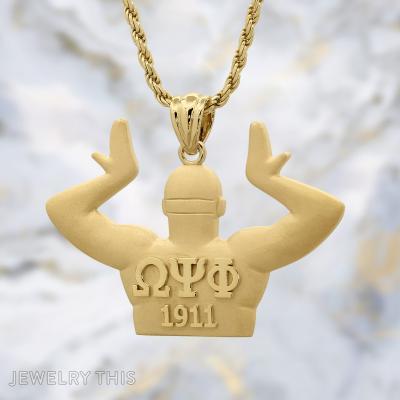
This pendant was designed around a fraternity emblem — a raised 3D figure in the ...

This exquisite Silver pendant takes the form of a majestic female lion, exuding regal grace ...

This sideways cross pendant is crafted in 14k white gold with a gentle upward curve ...

Immerse yourself in the ocean’s beauty with this custom pendant inspired by the coral emoji. ...

This round medallion pendant pairs a dimensional praying-hands relief on the front with the full ...

10k yellow gold cut out style pendant featuring client’s logo. Pendant: 1 inch in size. ...



