
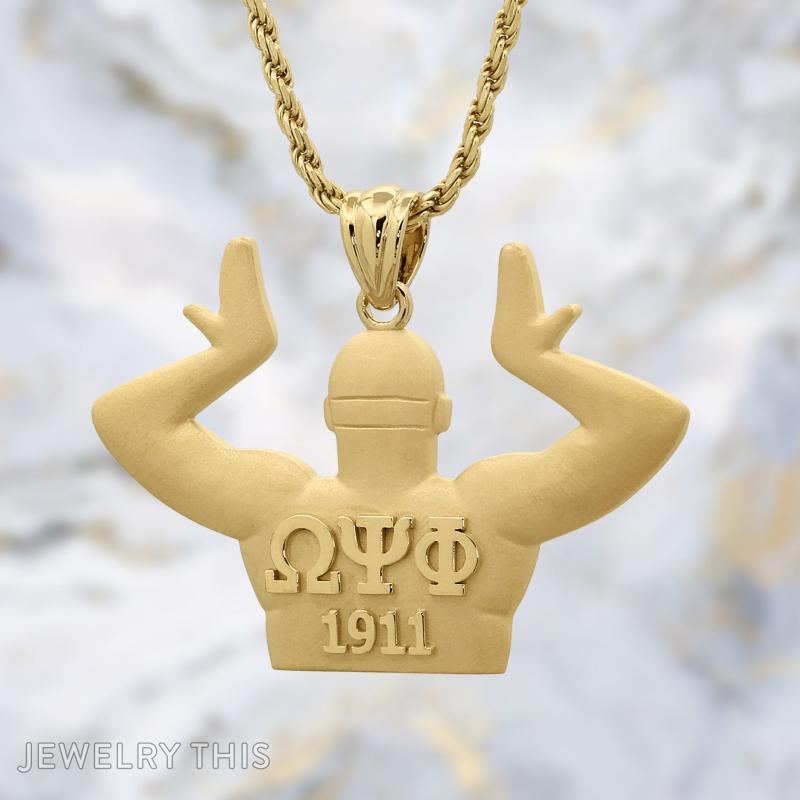
Fraternal Emblem Pendant — Raised Letters in Gold
$$
Gold-plated silver, 14k yellow gold double plating
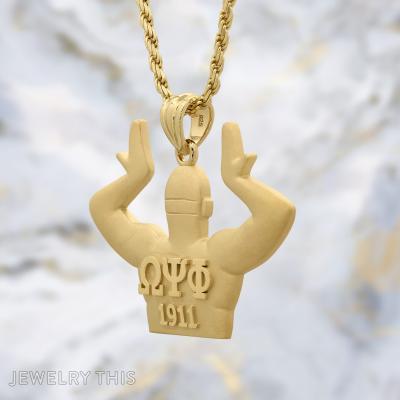
A wife set out to create a fraternity emblem pendant for her husband, a big-framed man she wanted the piece scaled to fit. The design went through several rounds of refinement — resizing, re-centering the lettering, and adjusting the finish — before she approved a 2-inch version with a personal date engraved on the back. When it arrived, she wrote that her husband absolutely loved it.
'It looks good! Just a few adjustment requests.' — on seeing the first render
'I just wanted you to know that my husband absolutely LOVED the piece!' — on delivery
Quick specs
Design type
Primary Metal
Primary Stone
Accent Stones
Style
Design Complexity
Intent: Certainty
Size
Pendant 2in wide x 1.5in high (not including bail). Double gold plating.
How they made it distinctive
-
01
Scaled up to 2 inches wide specifically to suit her husband's larger frame — most pendants of this style run closer to 1 inch
-
02
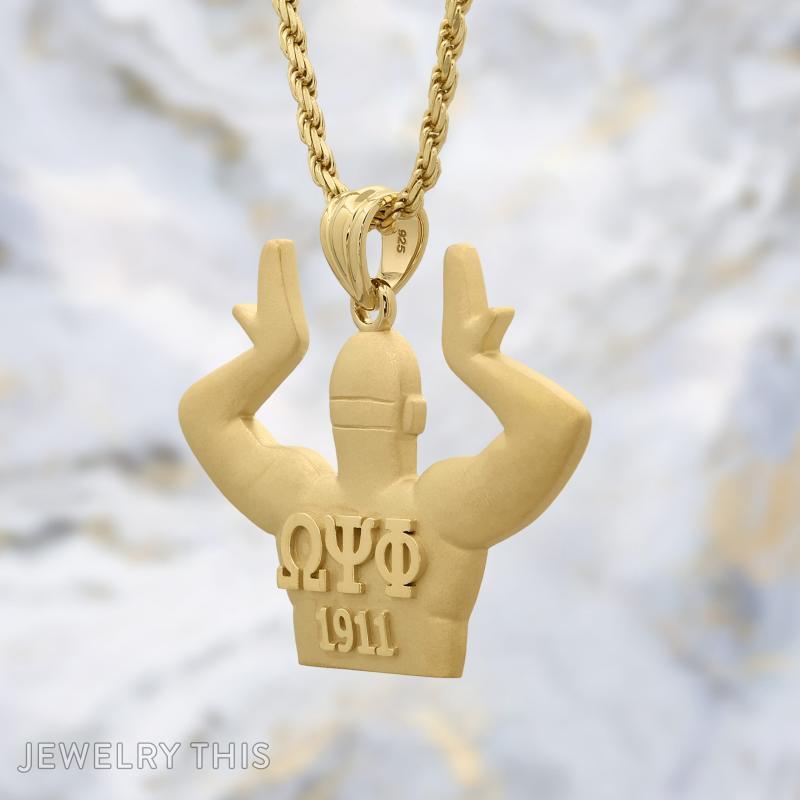
Matte-and-polish finish combination applied so the raised Greek letters and founding year stand out clearly against the textured body
-
03
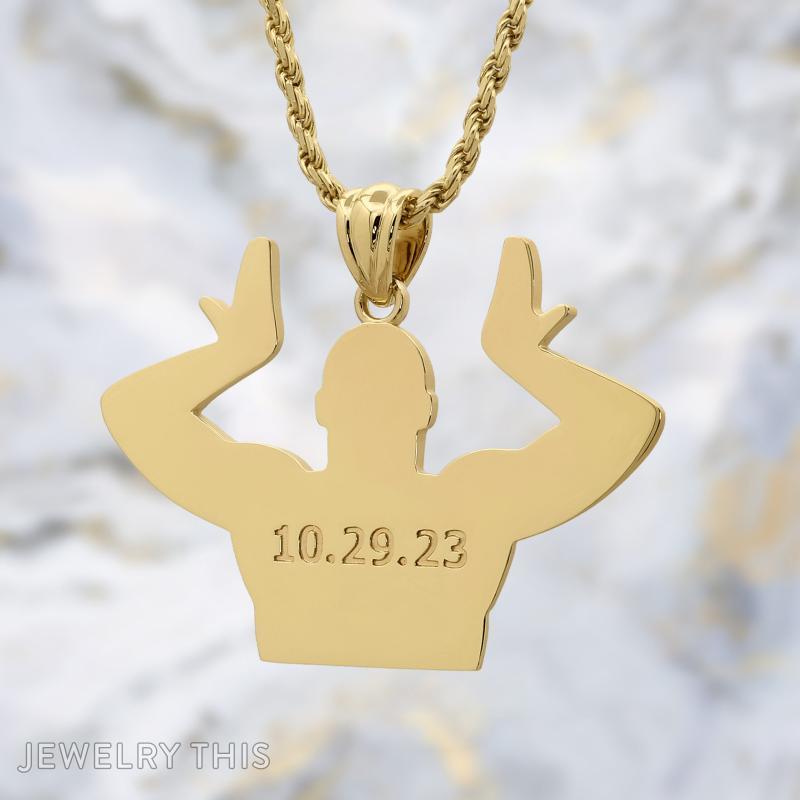
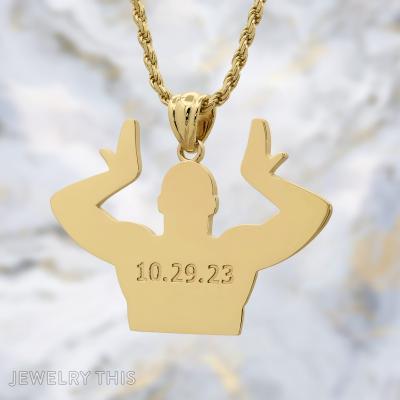
A personal date engraved on the back, adding a private meaning behind the public organizational symbol
-
04
Double gold plating chosen specifically for durability, since the piece is intended for near-daily wear
-
05
Lettering position was re-centered after the first render so the numerals aligned precisely with the figure's head
How you'd make it yours
Size: this piece is 2 inches wide — a new commission could be made closer to the standard 1-inch scale for a lighter, more subtle feel
Metal: this piece is gold-plated silver — the same design works in solid 10k or 14k gold for a client prioritizing permanence over plating
Finish: this piece combines matte body with polished lettering — a new piece could be fully polished or fully matte instead
Engraving: the back of this piece carries a private date — a new commission could carry different text, initials, or be left blank
Gemstones: this piece has no stones — a new commission could set small gems into the lettering for color, as was considered during this design
One of a kind: this exact pendant was designed and sized for one client's husband and is not reproduced — a new commission is an original piece inspired by this one, not a copy
Design changes made
The pendant was enlarged from the original render to 2 inches wide to better suit the wearer's larger frame, the lettering was re-centered and repositioned for better visual balance, and a matte finish was added to the body so the raised letters would stand out more clearly.
Who this is for
This piece is for someone who wants to give a big, unmistakable symbol of pride and belonging — not a subtle accent piece, but a statement made for someone with presence to match. It's especially right if the recipient has a strong connection to an organization or fraternity and you want the piece scaled to fit them, literally and figuratively.
How it's made
Once the design was finalized, a 3D digital model was created and printed as a resin model — the first physical version of the pendant, shared as a preview before casting. The resin was attached to a wax tree, invested in plaster, and fired in a kiln to burn out the wax and resin, leaving a hollow mold. Molten silver was then cast into the mold under pressure, producing the raw pendant, which was cleaned and prepared for finishing.
The body of the figure was given a hand-applied matte finish, while the Greek letters, founding year, and bail were left polished so the lettering reads clearly against the textured background. The piece was then double-plated in 14k yellow gold for extra durability, and the back was engraved with a personal date in a clean, simple font as the final finishing step.
Key note
The body was intentionally left matte while the lettering was kept polished, since the contrast between the two finishes — not color alone — is what makes the raised letters legible at a glance.
Pricing guidance
A large, 3D dimensional pendant like this one — with raised lettering, a sculptural figure, and back engraving — sits in the mid-to-upper range for custom pendants of this type. Most of the cost comes from the size and dimensional complexity of the casting rather than the metal choice alone. Plating versus solid metal, and the addition of gemstones, are the biggest variables from there.
Moves price up ↑
- ↑ Casting the piece in solid 10k or 14k gold instead of gold-plated silver
- ↑ Adding colored gemstones set into the letters or numerals
- ↑ Increasing the pendant size further, which increases metal weight and casting complexity
- ↑ Adding a two-sided finish treatment (matte and polish combinations) on both front and back
- ↑ Upgrading to a heavier-gauge chain sized to support the pendant's weight
Moves price down ↓
- ↓ Reducing the pendant size closer to a standard 1-inch scale
- ↓ Choosing a single plating layer instead of double plating
- ↓ Omitting the back engraving
- ↓ Skipping the matte hand-finishing step in favor of an all-polished surface
- ↓ Selecting a simpler, flatter design without raised 3D elements
Questions people ask
Gold plating durability depends heavily on how often the piece is worn and what it's exposed to — showering, lotions, and friction from clothing all speed up wear. A double-plated piece, which uses a thicker layer of gold over the base metal, generally holds up longer than standard single plating before it starts to show wear. Most people find plating lasts one to several years under regular daily wear before it needs attention. When it does start to fade, replating is a standard service most jewelers can perform without remaking the piece.
Not by adding more plating — converting a plated piece to solid gold requires remaking the piece entirely from solid metal, since plating is only a thin surface layer over a different base metal. If solid gold matters most, it's worth choosing that option from the start, even though it costs significantly more than a plated piece of the same design. For large, dimensional pendants like this one, the price difference between plated and solid gold can be substantial due to the amount of metal required.
A matte finish is created through hand-polishing techniques that leave a soft, non-reflective texture on the metal, while a polished finish is buffed to a mirror-like shine. Combining both on a single piece — matte on the body, polished on raised lettering, for example — creates contrast that makes design elements like text or numerals stand out more clearly than if the whole piece were one uniform finish. This kind of two-finish treatment is a deliberate design choice rather than a default, and it's commonly used on pieces where legibility of text or an emblem matters.
There's no hard limit, but pendants larger than about 1.5 inches start to swing more noticeably on a chain and carry more weight, which some wearers notice over a full day. A 2-inch pendant, like this one, is on the larger end and works best paired with a sturdy chain rated for the weight, plus a wide enough bail opening. It's worth cutting a paper template to the intended size and holding it up before finalizing, since photos and renders can be misleading about real-world scale.
A dimensional pendant in this size range, cast in gold-plated silver with raised lettering and back engraving, generally falls in the mid-to-upper range for custom pendant work. The primary cost driver is the complexity and size of the casting itself — a large, sculptural, three-dimensional design requires more metal and more finishing labor than a flat pendant of the same category. Material choice (plated versus solid gold) and any added gemstones are the next biggest factors affecting the final cost.
The design phase — creating and refining the 3D render until it's approved — typically takes about one week, though it can take longer if several rounds of revisions are needed. Once the design is approved and production begins, casting and finishing usually takes four to six weeks. Larger or more dimensionally complex pieces, like a raised 3D figure with double plating, can run toward the longer end of that window.
Yes, back engraving is a common addition to pendants that already have a design on the front — it's typically added as one of the final finishing steps after casting and plating. A short date or set of initials in a simple, clean font is the most common request, since intricate scripts can be harder to read at small scale. It's best to confirm exact wording and font style before the piece goes into production, since engraving happens after the metal work is complete.
Yes, organizational emblems — letters, symbols, founding dates, and mascot-style figures — translate well into pendant form, especially when rendered as a raised, dimensional design rather than a flat engraving. The process typically starts from a reference image or description, which is turned into a 3D digital model for review before anything is cast. Because these designs often carry raised text, a matte-and-polish finish combination is frequently used to keep the lettering legible against the textured background.
Explore Similar Creations
Every masterpiece starts with a spark. Explore how our clients raw ideas - sketches, heirlooms, inspirations - were transformed into bespoke works of arts.
This stunning custom sterling silver cross pendant showcases the beauty of Latin religious script and ...

A stunning replication of a business logo, rich in intricate detail. This 1.5-inch pendant, crafted ...

14k gold plated silver pendant featuring original artwork by the client. Detailed throughout with colorful ...

Celebrate love and symbolism with this exquisite custom pendant, crafted in sterling silver with a ...


Tattoo design on a silver heart shaped pendant. The details are engraved in color.

This gold-plated silver pendant showcases a unique family crest, crafted to honor personal heritage. Shaped ...

Inspired by the essence of enduring love and shared milestones. This pendant was designed and ...

10k white gold dolphin pendant featuring heart shaped blue topaz. Small lab grown diamonds set ...

Seeking to elevate a beloved piece, the client opted to replicate their cherished rose pendant ...
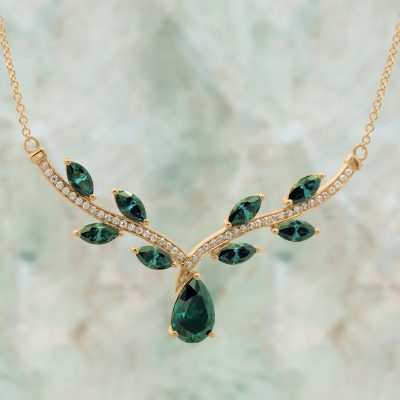
This stunning 14 karat yellow gold pendant features a unique vine-shaped design. At the center ...

Elegance meets symbolism in this 14k white gold custom pendant featuring the captivating number 444. ...



