

Double-Chain Birthstone Necklace — Recreated Family Design
$$$
14k white gold, lab-grown diamonds, peridot, garnet
A woman wanted to recreate a necklace her mother had worn for years — a double-chain design with a single diamond at the center — but swap that center stone for birthstones representing her family. The final design holds three marquise stones for three birthdays, with her mother's own birthstone set at the center. When it arrived, she wrote: 'It took her breath away and there were many tears of happiness. She loves it so much and wears it every day.'
'Honestly just did a dance of joy! I can't wait for it to arrive.' — on shipping
'The piece just arrived and OMG its amazing! It is exactly like I wanted and I am blown away.' — on delivery
Quick specs
Design type
Primary Metal
Shape / Cut
Primary Stone
Accent Stones
Style
Design Complexity
Intent: Certainty
Size
Pendant approx 0.5in x 0.25in; stones approx 5x3mm each (~0.25ct equivalent). Double chain necklace: 18in and 20in lengths, with bezel-set diamonds along the chains (7 stones on 18in, 6 stones on 20in) and a spacer connecting both chains at the back.
How they made it distinctive
-
01
Three marquise birthstones replace the single diamond of the original design, representing three family birthdays instead of one
-
02
Mother's own birthstone (garnet) placed at the center of the cluster, flanked by her children's birthstones
-
03
Double-chain structure with a connecting spacer recreated specifically to prevent tangling, matching a detail from the original piece
-
04
Small diamonds bezel-set individually along both 18-inch and 20-inch chains for a subtle sparkle without changing the chain's delicate profile
-
05
14k white gold chosen over sterling silver specifically for its durability, since the piece was expected to be worn daily
How you'd make it yours
Stone selection: this piece uses garnet, peridot, and lab diamond; a new commission could use any combination of birthstones for different family members
Stone count: this piece uses three stones; a new commission could use two, four, or more depending on family size
Metal: this piece is 14k white gold; the same design works in yellow or rose gold
Chain length: this piece uses 18-inch and 20-inch chains; a new piece is sized to its own wearer's preference
Diamond type: this piece uses lab-grown diamonds in the chain stations; a new commission could use natural diamonds for the same look at a higher cost
One of a kind: this exact necklace was designed to recreate one family's remembered piece and is not reproduced — a new commission is an original piece inspired by this one, not a copy
Design changes made
The original plan was two birthstones, but the client expanded it mid-design to include a third stone representing her mother's own birthday, placing that stone at the center of the cluster with the other two arranged around it.
Who this is for
This piece is for someone who wants to recreate a meaningful design from memory rather than start from a blank page, and who wants a family-birthstone piece that doesn't look literal or obvious. It's especially right if you're honoring more than one person in a single design and want each stone's placement to carry its own meaning.
How it's made
Once the 3D design was approved, the pendant was 3D-printed in wax and attached to a wax tree, which was invested in plaster and fired in a kiln to burn out the wax and leave a hollow mold. Molten 14k white gold was then cast into the mold under pressure to form the raw pendant and chain components. After cooling, the casting was cleaned, polished, and prepared for stone setting.
The three marquise center stones — peridot, garnet, and lab-grown diamond — were set by hand in a clustered arrangement, with the largest stone centered and the other two angled around it. Small round diamonds were bezel-set individually along both the 18-inch and 20-inch chains at intervals, and a small spacer link was added where the two chains meet at the back to keep them from tangling during wear.
Key note
The pendant required multiple recastings before a clean, defect-free casting was achieved — a reminder that fine stone-cluster settings depend on getting the metal foundation right before any gem is ever set.
Pricing guidance
A double-chain white gold necklace with a bezel-set diamond chain and a multi-stone birthstone cluster pendant sits in the mid range for custom pieces of this complexity. Much of the cost comes from the number of individually bezel-set diamonds along both chains, in addition to the center cluster. Stone choice — lab versus natural diamonds, and the specific colored gems used — is where the price moves most from there.
Moves price up ↑
- ↑ Using natural/mined diamonds instead of lab-grown diamonds along the chains and in the pendant
- ↑ Adding more bezel-set stones or increasing the number of chain stations
- ↑ Upgrading to 18k gold or platinum for the chains and pendant
- ↑ Increasing the size of the marquise center stones beyond the standard 5x3mm
- ↑ Adding a fourth or fifth birthstone to the cluster for additional family members
Moves price down ↓
- ↓ Using sterling silver in place of 14k white gold
- ↓ Reducing the number of bezel-set stones along the chains
- ↓ Choosing a single chain rather than a double-chain design
- ↓ Using smaller or fewer colored gemstones in the center cluster
- ↓ Selecting lab-grown diamonds throughout rather than natural stones
Questions people ask
Yes, recreation from photographs is a standard part of the custom design process. The team studies the images provided, works out proportions like chain length and stone placement, and builds a 3D render for approval before anything is cast. Details like exact metal purity or stone type in the original often cannot be confirmed from a photo alone, so those are discussed and chosen fresh for the new piece. Minor differences from the original are normal since the new piece is built from reference images rather than the physical item.
Lab-grown and natural diamonds are optically, chemically, and physically identical — the only real difference is origin and cost. Lab-grown diamonds typically cost less for the same size and quality, with no visible difference to the eye or in daily wear. Durability is the same, since the chemical structure is identical. For small bezel-set stones along a chain, choosing lab-grown is a common way to reduce cost without changing the look of the piece.
Yes, a cluster pendant design can be adapted to use birthstones in place of diamonds while keeping the same stone arrangement and setting style. Common substitutions include garnet for January, peridot for August, and amethyst for February, among others. The stones can be mixed sizes if one person's birthstone should be the visual focal point, or kept uniform in size for a more balanced look. This approach keeps the sentimental meaning of a birthstone piece while preserving a refined, non-literal design.
14k white gold is a durable choice for daily wear, more resistant to bending and wear than sterling silver over time. Bezel settings are considered one of the most secure and protective ways to set small stones along a chain, since the metal fully surrounds the stone's edge rather than relying on prongs. This makes bezel-set chains a good option for a piece intended to be worn every day. Occasional professional cleaning and inspection is recommended to keep both the metal and settings in good condition.
A double-chain necklace with bezel-set diamonds along both chains and a multi-stone cluster pendant generally falls in the mid range for custom jewelry of this complexity. The main cost drivers are the number of individually set diamonds along the chains and the choice between lab-grown and natural stones. Opting for lab-grown diamonds and keeping the stone count consistent with the design shown here keeps the cost from climbing further. Request a quote for your specific stone and chain preferences to get an accurate estimate.
The design phase for a piece like this typically takes about one week, during which a 3D render is produced and refined based on feedback before anything is cast. Once the design is approved, production generally takes three to four weeks, covering casting, cleanup, and hand-setting of all the stones. Complex pieces with casting difficulties or multiple stone settings can take longer, so it's worth building in extra time when there's a specific delivery deadline. Rush requests should be discussed with the design team as early as possible.
Yes, a small spacer link between two chains is a functional design element that can be added to most double-chain necklace designs. It's used to keep the two chains from tangling or sliding over each other during wear, typically positioned where the chains meet at the back of the neck or at the shoulder line. It can be designed to be discreet and nearly invisible, matching the chain's finish. This is a common detail requested by clients recreating a remembered design where tangling was an issue.
Explore Similar Creations
Every masterpiece starts with a spark. Explore how our clients raw ideas - sketches, heirlooms, inspirations - were transformed into bespoke works of arts.
This exquisite white gold pendant is a faithful recreation of a cherished family piece. The ...

Show off your Raider Nation pride with this stunning gold-plated silver pendant. The 2-inch pendant ...
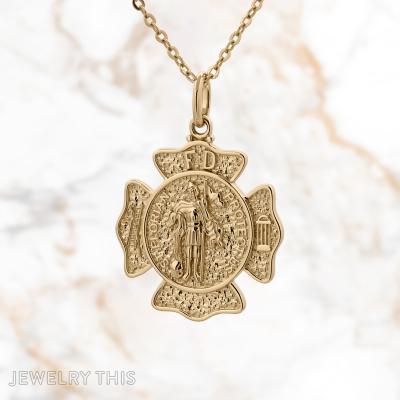
This exquisite custom gold religious fire fighter pendant honors the bravery and dedication of firefighters ...

Inspired by the essence of enduring love and shared milestones. This pendant was designed and ...

This pendant takes the shape of the African continent, rendered with a polished raised edge ...


This custom-designed pendant is inspired by the client’s company logo. Crafted in sterling silver the ...

This coin-style pendant was built around a tattoo design, reimagined for metal rather than skin. ...

Introducing this striking 1-inch unicursal hexagram cut out pendant, crafted with precision in silver and ...

This pendant recreates a ballroom dance shoe in miniature, cast in 14k yellow gold and ...

This pendant reproduces a Scottish clan crest — a circular badge bearing a rampant cat ...

A stunning 14k white gold pendant featuring a beautiful Mugunghwa Flower design on a matte ...