
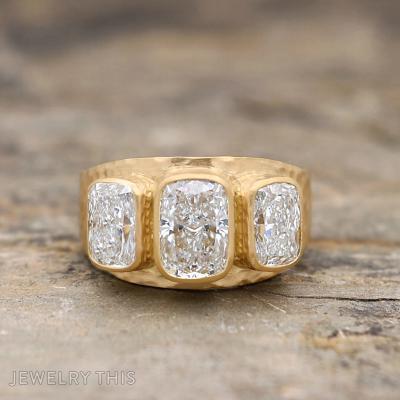
Three-Stone Hammered Yellow Gold Anniversary Ring
$$$
18k yellow gold, lab diamonds
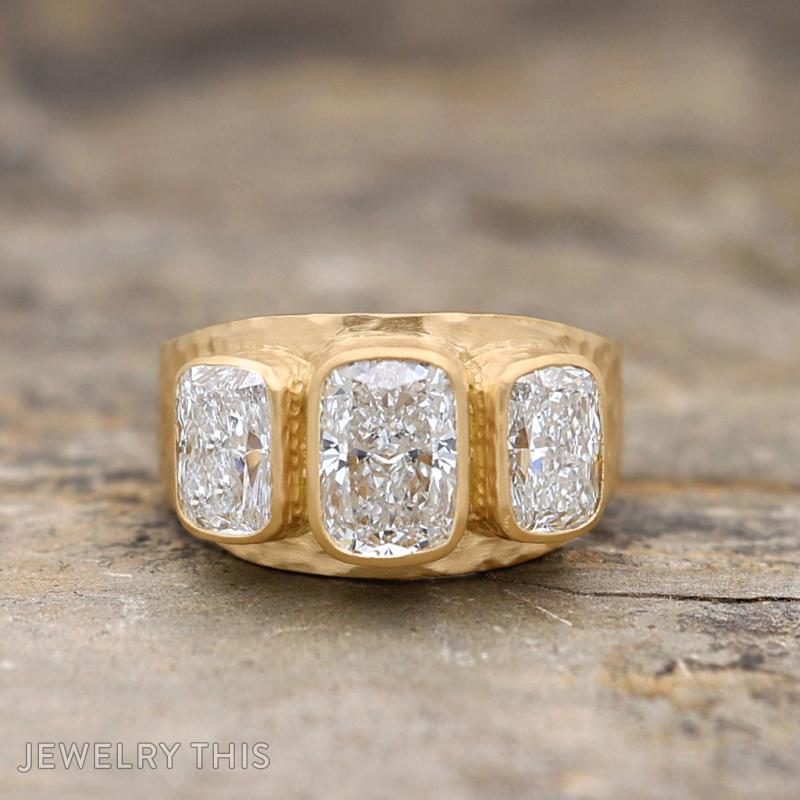
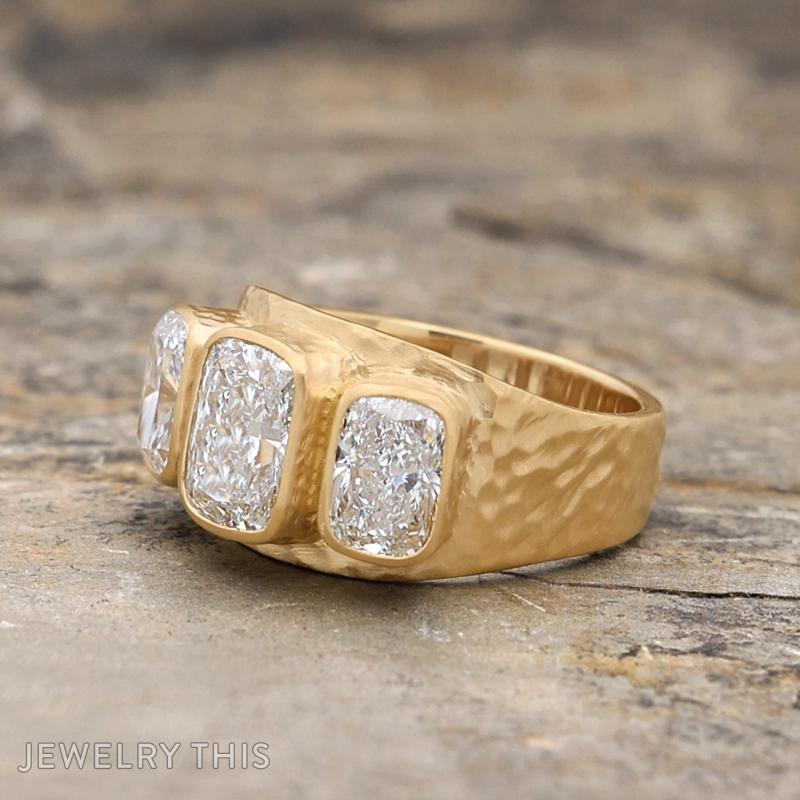
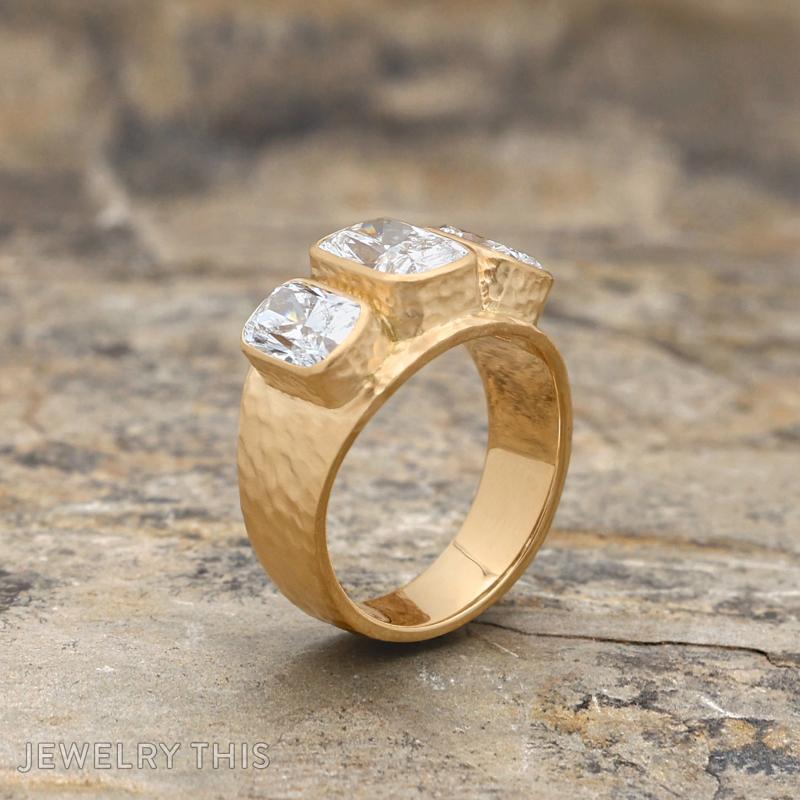
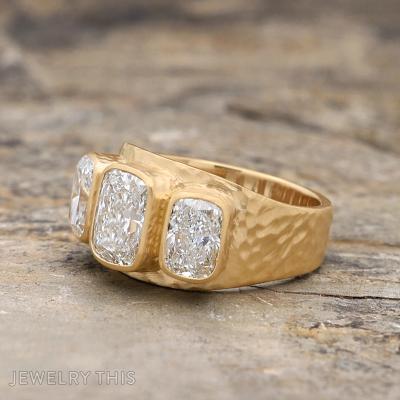
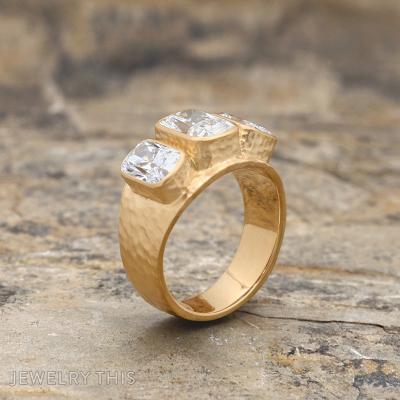
A husband wanted a three-stone ring to mark 30 years of marriage, and he was closely involved in shaping every detail of the design himself, sketching and revising the band shape and stone setting repeatedly until it matched a very specific vision in his head. He pushed for a wider, thinner-walled band with the stones sitting up on top like little chimneys rather than sinking into a traditional setting. When it arrived just before their anniversary, he wrote: "It came out amazing and A. loves it!"
'It came out amazing and A. loves it!' — on delivery
Quick specs
Design type
Primary Metal
Shape / Cut
Primary Stone
Accent Stones
Style
Design Complexity
Intent: Certainty
Size
Ring size 8.5 US. Center stone approximately 9mm x 6.5mm; side stones approximately 7.7mm x 5.5mm each. Wall thickness approximately 2mm; band width approximately 13mm at top, under 5mm at back.
How they made it distinctive
-
01
Bezel walls shaped with sharp, chimney-like transitions rather than rounded shoulders \u2014 a deliberate, client-driven departure from a standard blended bezel profile
-
02
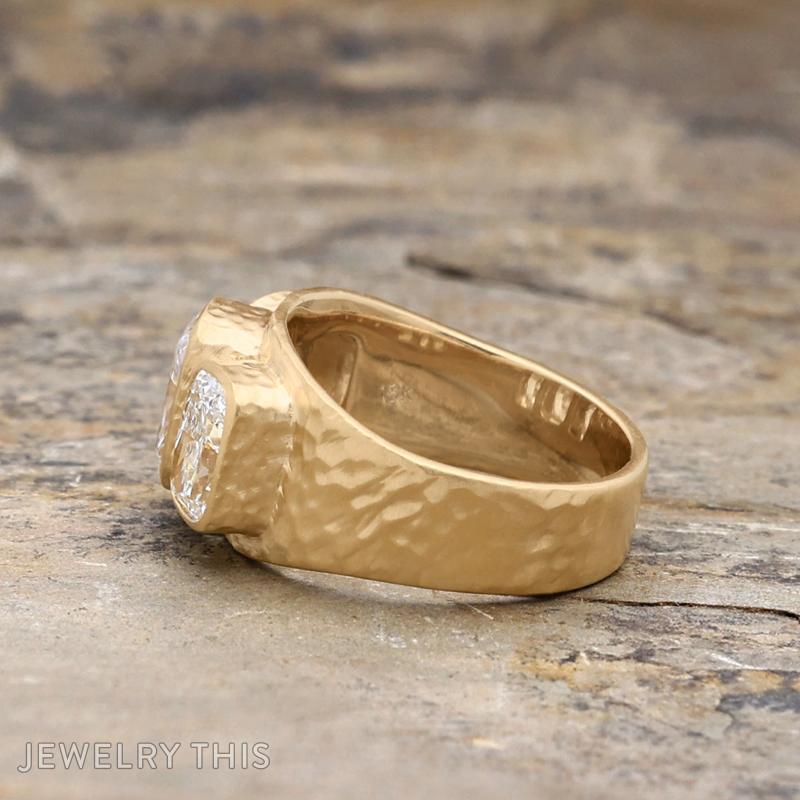
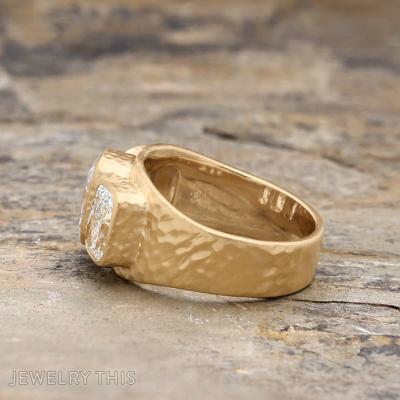
Wide, funnel-shaped band designed specifically so the three diamonds appear to sit on top of the metal rather than sink into it
-
03
Center stone sized roughly a third larger than the two side stones to create a graduated top line without traditional prongs
-
04
Wall thickness brought close to the structural minimum at the client's request to reduce visual and physical bulk
-
05
Hand-hammered texture on the top surface paired with a smooth, polished interior for comfort
How you'd make it yours
Stone shape: this piece uses elongated cushion cuts; a new commission could use oval or emerald cut stones for a similar elongated top line
Stone type: this piece uses lab diamonds; a new commission could use natural diamonds or moissanite for a different look or budget
Metal: this piece is 18k yellow gold; the same wide bezel-wrap design works in 14k yellow gold or a white gold version
Finish: this piece has a hammered top with a polished interior; a new piece could be fully polished or fully matte
Band profile: this piece has a pronounced funnel taper; a new commission could use a more uniform width throughout
One of a kind: this exact ring was designed through months of back-and-forth for one client and is not reproduced \u2014 a new commission is an original piece inspired by this one, not a copy
Design changes made
The band shape went through several rounds of revision at the client's request \u2014 from a thicker, more rounded setting to a wider, thinner-walled band with sharper, chimney-like transitions where the bezels meet the shank, so the diamonds appear to sit on top of the band rather than blend into it. The final wall thickness was brought down close to the structural minimum to keep the ring from feeling heavy.
Who this is for
This piece is for someone who knows exactly what they want and is willing to go through real back-and-forth to get the proportions right \u2014 someone who cares as much about how a ring sits on the hand as how it looks in a photo. It's especially right for a milestone anniversary where a classic three-stone ring feels too expected and a bolder, more architectural silhouette feels more honest to the moment.
How it's made
Once the design was approved, a 3D CAD model was built and a resin proof was printed and shipped to the client so he could confirm scale and proportion on the hand before any metal was committed. After several rounds of adjustment to the band width, wall thickness, and bezel shape, a revised model was built around the actual diamonds once they arrived from the cutter, and a new resin was produced to confirm fit. The final model was then cast in 18k yellow gold using the lost-wax casting method.
After casting, the wide top surface of the band was hand-hammered to create a textured, handmade finish, while the inner band was left smooth and polished for comfort against the skin. The three elongated cushion-cut lab diamonds were then bezel-set with the metal walls hammered down over the stones' edges to hold them mechanically in place, with the bezel edges pressed smooth rather than left sharp.
Key note
The bezel walls are intentionally shaped with sharp, chimney-like transitions into the band rather than rounded shoulders, a deliberate departure from the more common blended bezel-to-shank profile.
Pricing guidance
A wide, hammered three-stone lab diamond ring in 18k gold with a non-standard bezel-wrap setting sits toward the higher end of custom ring pricing due to the gold content and the hand-finishing the bezel and hammered texture require. Stone size and metal karat are the two biggest cost drivers on a piece like this, followed by the amount of hand-fabrication needed to achieve a non-traditional silhouette. Multiple rounds of design revision add labor time but not material cost.
Moves price up ↑
- ↑ Increasing the center stone carat weight beyond approximately 2 carats
- ↑ Choosing 18k gold over 14k for a richer color and higher gold content
- ↑ Adding a wider band with more surface area to hand-hammer and finish
- ↑ Using natural diamonds instead of lab-grown for the same carat weights
- ↑ Requesting additional rounds of custom bezel reshaping beyond standard revisions
Moves price down ↓
- ↓ Reducing the center stone size and scaling the side stones down proportionally
- ↓ Choosing 14k gold instead of 18k
- ↓ Simplifying the bezel shape to a standard rounded profile rather than a custom chimney profile
- ↓ Leaving the band surface polished rather than hand-hammered
- ↓ Using moissanite in place of lab diamonds for the three stones
Questions people ask
A bezel setting is one of the most secure and durable ways to hold a stone because a continuous wall of metal surrounds the stone's edge rather than relying on a few thin prongs. This makes it a strong choice for daily wear since there is nothing raised to catch on clothing or hair. The tradeoff is that a bezel covers slightly more of the stone's profile from the side compared to a prong setting. For a wide three-stone design like this, the bezel also lets the stones sit visually on top of the band rather than being framed by metal claws.
Lab-grown and natural diamonds are chemically and optically identical \u2014 both are pure carbon crystallized into the same structure, and both are graded on the same cut, color, clarity, and carat scale. The difference is entirely in origin: one forms in the earth over billions of years, the other is grown in a controlled lab environment over a matter of weeks. Lab-grown diamonds typically cost significantly less than natural diamonds of the same size and quality. For a three-stone ring using larger stones, choosing lab-grown keeps the overall cost more manageable without changing the appearance.
A wider band spreads the metal's structural support across more surface area, so it can sometimes be made slightly thinner in cross-section while still holding its shape under daily wear. There is a practical limit, though \u2014 jewelers generally will not go below about 2mm of wall thickness on a ring shank regardless of width, because thinner metal becomes prone to bending or cracking over time. Widening the band also changes the overall visual weight of the ring, making it read as bolder even if the actual wall is thin. This tradeoff between width and thickness is a common conversation in custom ring design.
A three-stone ring with a substantial center stone and two side stones in 18k gold, with hand-hammered detailing and a custom bezel profile, falls toward the higher end of custom ring pricing. The biggest cost drivers are the total carat weight across all three stones and the gold karat and quantity used in a wide band design. Hand-finishing steps like hammering the surface texture and shaping custom bezel walls add labor cost beyond a simple polished band. Choosing lab-grown stones over natural ones keeps the stone cost more contained relative to the metal and labor cost.
A standard custom ring typically takes five to six weeks from approved design to delivery, but a design with multiple rounds of revision, like adjusting band width, wall thickness, and bezel shape, can extend that timeline. Sourcing well-matched diamonds in specific sizes from a cutter can also add time, particularly when the design needs to be finalized around the stones' exact measurements. A resin proof stage, where a 3D-printed model is shipped to the client to check scale and fit before casting, is a normal part of this process and adds roughly a week. Once the design and stones are finalized, casting and finishing generally take a few weeks.
Once a ring is cast, the wall thickness is essentially fixed \u2014 it is not something that gets adjusted afterward the way a ring size can be. This is why wall thickness and band width are finalized carefully during the design and resin-proof stage, before any metal is committed. Jewelers typically will not cast a shank thinner than about 2mm regardless of the band's width, since thinner metal is prone to bending or cracking with daily wear. If a finished ring needs to be less bulky, that generally has to be addressed in a new design rather than as a modification to the existing piece.
Yes, a wide bezel-wrap three-stone design like this can accommodate a range of stone shapes, though elongated shapes like cushion, oval, or emerald cut tend to suit the wide, low profile of this band style particularly well. A rounder stone shape like a round brilliant would change the proportions of the top line and may look more clustered rather than elongated. The bezel setting method works well with most stone shapes since it simply needs to follow the stone's outer edge. Stone shape is one of the easier elements to adjust early in the design process before the model is finalized.
Check what our clients say about us

o y
12 months ago
Thank you Carrie for your incredible dedication and guidance throughout this entire process. Your attention to every detail, from sourcing the perfect diamonds to translating my vision into thoughtful sketches, 3D models, and photorealistic render made all the difference in bringing this special ring to life. I appreciated how you patiently walked through design adjustments, explained technical considerations, and ensured the final piece perfectly matched what I had in mind for our anniversary. You made the experience enjoyable and memorable, and the end result is simply stunning! my wife loves her one-of-a-kind ring!
Explore Similar Creations
Every masterpiece starts with a spark. Explore how our clients raw ideas - sketches, heirlooms, inspirations - were transformed into bespoke works of arts.
This 18karat yellow gold engagement ring exudes elegance and vintage charm. At the heart of ...

This exquisite gold ring commands attention with its wide, luxurious width. The top portion of ...
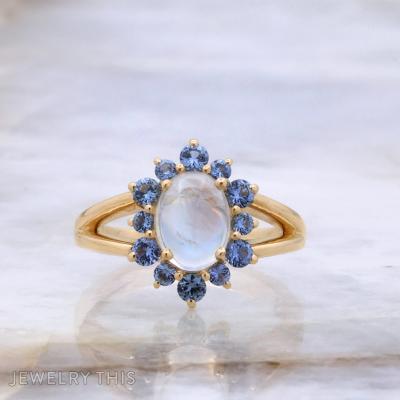
This ring centers an oval cabochon moonstone inside a sunburst-style halo of twelve round sapphires ...

This 14k yellow gold ring reinterprets the traditional Claddagh design — hands cradling a crowned ...

This remarkable ring was crafted based on images provided by the client, faithfully recreating the ...

This yellow gold band is a loving tribute, meticulously crafted to replicate the original wedding ...

This white gold ring features a symphony of fall colors. The exquisite ring presents a ...

Exuding understated elegance, this delicate ring is a testament to refined simplicity. Its slender band, ...

Celebrate everlasting love with this custom wedding set in luminous 14k white gold. The engagement ...

This stunning ring showcases three princess-cut green tourmaline stones set in the center, creating a ...
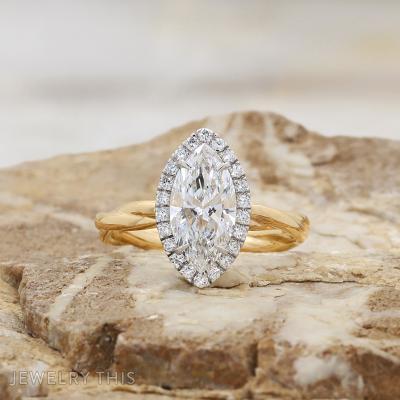
This elegant two-tone engagement ring beautifully combines modern brilliance with timeless design. At its heart, ...

This Platinum ring stands as a testament to timeless craftsmanship. The band showcases a double-row ...



