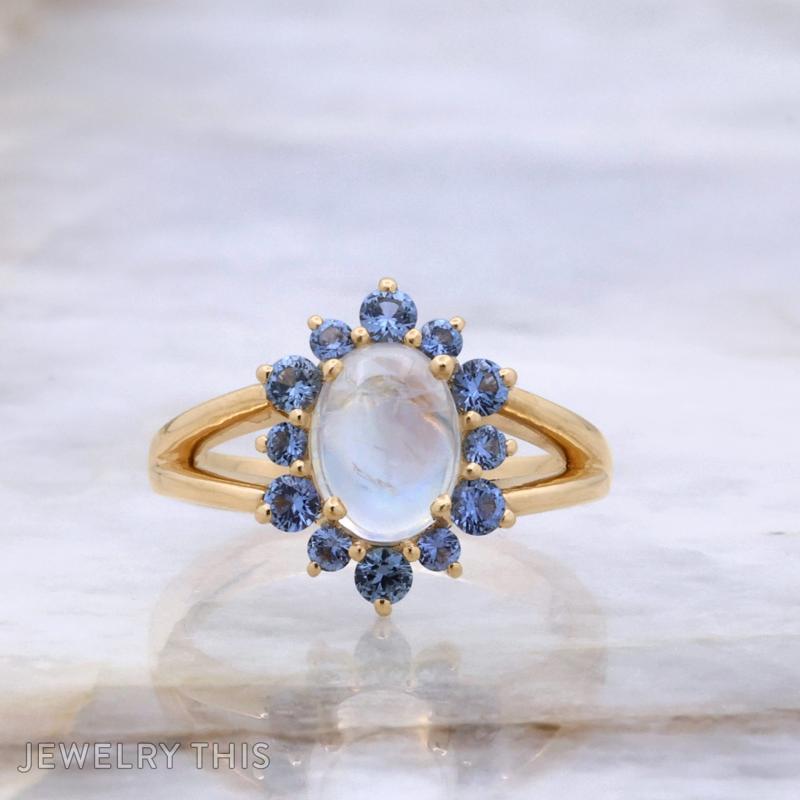
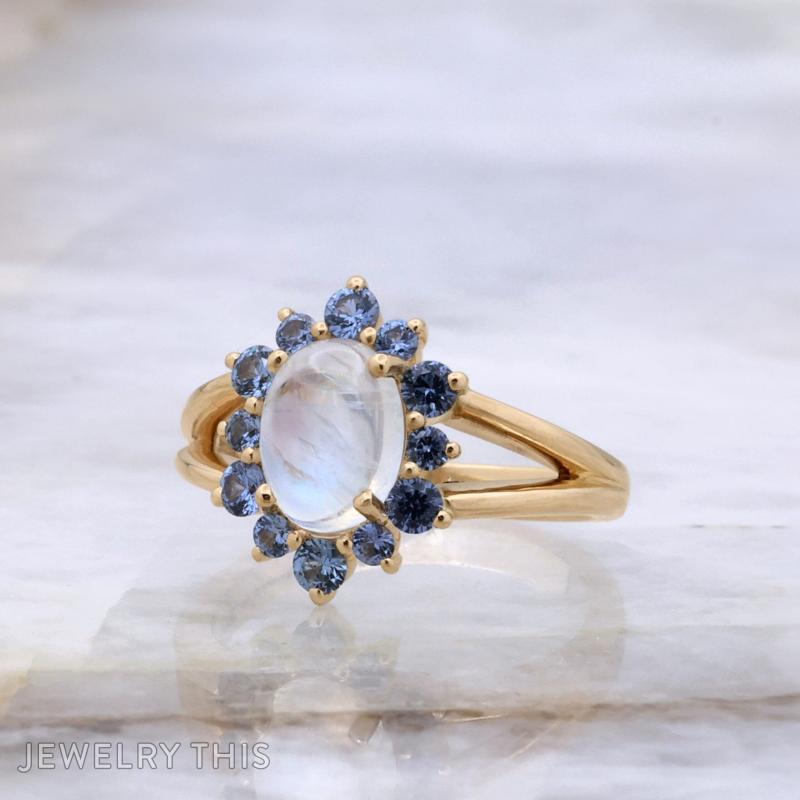
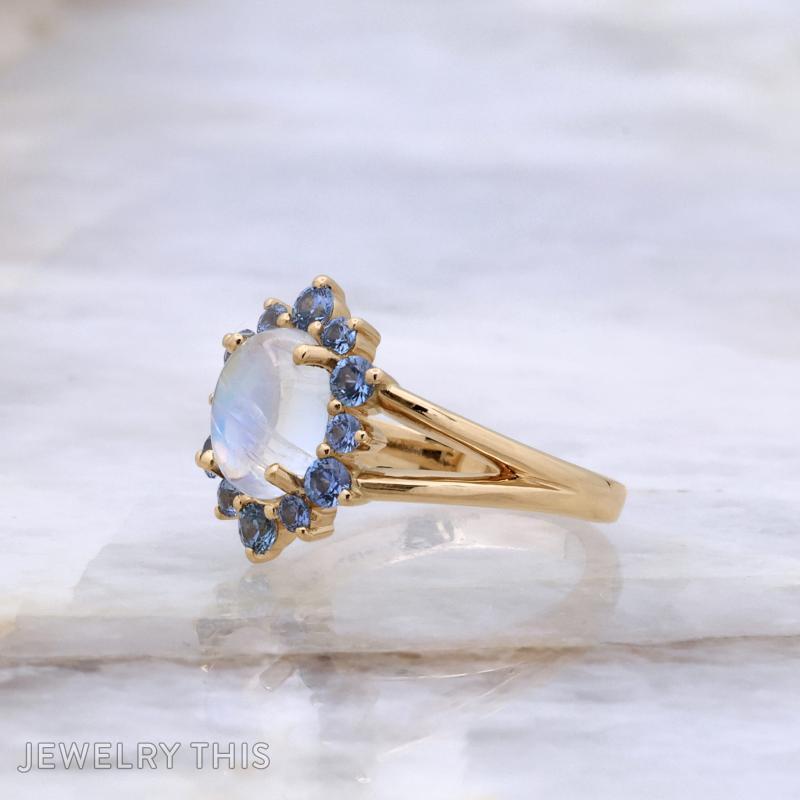
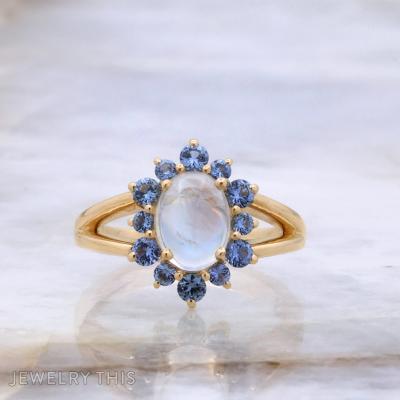
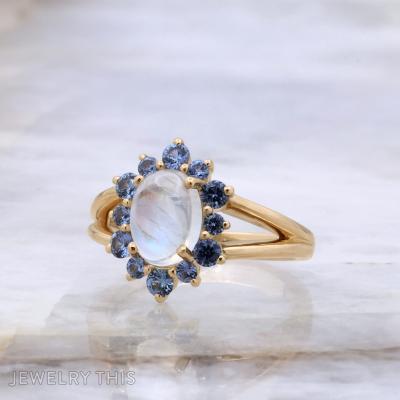
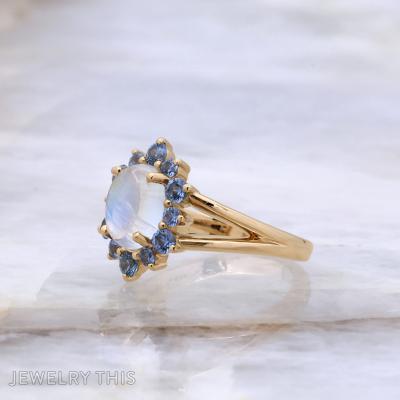
Moonstone Ring with Sapphire Sunburst Halo
$$$
14k yellow gold, moonstone, sapphires
A. came to us ready to replace a dainty ring she had worn nearly every day for years and which was finally reaching the end of its life. She wanted an oval moonstone center framed by a sunburst halo of alternating sapphires, modeled after a ring she had found and loved. After comparing two versions of the halo stone sizing, she chose the one closer to her original inspiration, and when it arrived she wrote: 'It fits perfect, it looks even better than the finished photo... it's everything and more.'
'Oh it's so beautiful! ... I love it!' — on seeing the first render
'It fits perfect, it looks even better than the finished photo... it's everything and more. Thank you SO much.' — on delivery
Quick specs
Design type
Primary Metal
Shape / Cut
Primary Stone
Accent Stones
Style
Design Complexity
Intent: Certainty
Size
Ring size 5 US (15.7mm). Center moonstone approximately 8.5x6.5mm oval. 12 round sapphires alternating large/small around the halo.
How they made it distinctive
-
01
Alternating large and small sapphires around the halo instead of a uniform stone size, creating a dynamic sunburst rather than a flat ring of matched stones
-
02
Four-prong setting built to a taller height specifically to clear the moonstone's domed cabochon profile
-
03
Sapphires sourced with a deliberate pale, periwinkle-leaning blue tone to complement the moonstone's natural undertones rather than using standard commercial blue
-
04
Split-shank band chosen to echo the exact silhouette of the client's original inspiration photo
-
05
Center stone size deliberately kept smaller than the inspiration photo's stone to avoid a bulky feel on a smaller hand
How you'd make it yours
Stone type: this piece uses a moonstone center — a new commission could use a different cabochon stone like labradorite or a faceted stone like aquamarine for a different look
Halo stone color: this piece uses pale periwinkle-blue sapphires — a new commission could use a single uniform color or alternate two different colors
Metal: this piece is 14k yellow gold — the same halo design works in white or rose gold
Halo stone count: this piece uses twelve alternating stones — a new commission could use a different count depending on the center stone's proportions
Band style: this piece uses a split V-shaped shank — a straight single-strip band would also suit this halo design
One of a kind: this exact ring was designed for one client's hand and proportions and is not reproduced — a new commission is an original piece inspired by this one, not a copy
Design changes made
The halo was rebuilt with a different stone-size combination after the client felt the first sapphire set looked more dramatic than her original inspiration photo; the rep sourced a second set of sapphires closer to the original proportions, which the client preferred.
Who this is for
This piece is for someone replacing a ring they've worn daily for years and are ready to upgrade into something meant to last. It suits someone drawn to moonstone's soft glow but who wants more presence and detail than a plain solitaire, especially if a uniform row of matched stones feels too static compared to a dynamic, alternating halo.
How it's made
Once the design was approved through a photorealistic render, the piece moved into a 3D CAD model that mapped the exact proportions of the split shank, prong heights, and halo layout before any metal was committed. From that model, a wax pattern was cast in 14k yellow gold using the lost-wax casting method, producing the raw ring in its rough form ready for finishing.
After casting, the ring was polished to its final gold finish before stone setting began. The oval moonstone cabochon was set first into its four-prong mounting, sized to accommodate the stone's domed profile and secure its girdle. The twelve round sapphires were then hand-set around the moonstone in their alternating large-and-small sunburst arrangement, followed by a final polish and quality check before shipping.
Key note
The four prongs holding the moonstone were built to a specific height to clear the stone's domed cabochon profile, rather than the flatter prong height typical of a faceted stone setting.
Pricing guidance
A moonstone halo ring with a split-shank band and alternating accent stones sits in the mid range for custom rings of moderate complexity. Colored stone sourcing and the labor of hand-setting twelve individually sized halo stones account for most of the cost, more so than the metal itself. Adjustments to stone count, size, or metal karat are what move the price from there.
Moves price up ↑
- ↑ Increasing the halo to a larger stone count or larger individual stone sizes
- ↑ Upgrading from sapphires to natural fine-color sapphires with certification
- ↑ Using 18k gold instead of 14k for the band
- ↑ Adding a matching wedding band designed to nest against the split shank
- ↑ Custom-cutting the moonstone to an exact carat target rather than sourcing a close match
Moves price down ↓
- ↓ Reducing the halo to a uniform stone size instead of alternating large and small
- ↓ Using a smaller center moonstone
- ↓ Choosing a simpler, non-split band profile
- ↓ Substituting lab-created blue spinel or synthetic sapphire for natural sapphire
- ↓ Reducing the halo stone count
Questions people ask
Moonstone rates about 6 to 6.5 on the Mohs hardness scale, which is softer than sapphire or diamond, so it can scratch or chip more easily with hard daily impact. It's still commonly worn as an everyday ring, especially in a protected setting with prongs sized to its dome, but it benefits from being taken off during heavy manual work or contact sports. Cleaning is simple — warm water and a soft cloth, avoiding ultrasonic cleaners which can damage the stone's internal structure. Most wearers find it holds up well with normal daily use and occasional care.
The blue sheen in moonstone, called adularescence, comes from light scattering between thin layers of feldspar inside the stone. It's not a coating or treatment — it's a natural optical effect caused by the stone's internal structure. The strength and color of the glow varies from stone to stone, with some showing more blue and others more of a silvery-white shimmer. Higher-quality moonstones typically show a stronger, more consistent blue flash across the dome.
Yes. Sapphires occur naturally across a wide range of blue tones, from very pale icy blue to deep navy, and some show a slight violet or periwinkle undertone depending on their origin and trace mineral content. Sourcing lighter or periwinkle-leaning sapphires typically takes some extra searching through a cutter's inventory since the exact tone can vary stone to stone. This flexibility in color is one advantage colored gemstones have over diamonds, where color grading is much more standardized.
A moonstone center with a full sunburst halo of alternating sapphires, set in 14k gold with a split-shank band, falls in the mid range for custom rings of this complexity. Most of the cost comes from labor — hand-setting twelve individually placed stones takes considerably more time than a simple three-stone or solitaire setting. Stone sourcing, particularly for a specific pale blue sapphire shade, also adds to the cost compared to using standard commercial-grade stones.
The design phase — sketch, 3D model, and photorealistic render for approval — typically takes about a week, though sourcing a specific stone color or size can add extra time if adjustments are requested. Once the design is approved and production begins, casting, polishing, and hand stone-setting generally take about four to five weeks. A ring involving a stone-sourcing back-and-forth, like finding the right sapphire tone, may run slightly longer than a standard timeline while a jeweler tracks down suitable options.
Yes. Because colored gemstones aren't bound by strict carat-weight standardization the way diamonds are, the number and size of halo stones can flex based on what looks proportional around the center stone. A jeweler will typically aim for a target number but adjust based on the actual dimensions of the sourced stones so the finished halo looks balanced rather than forcing an exact count that might crowd or gap the setting.
Either works. A single consistent accent color, like the pale blue sapphires used here, creates a cohesive sunburst look, while alternating two colors around the halo gives a more varied, layered appearance. The choice comes down to preference — some people want the halo to read as one unified frame around the center stone, while others like the visual interest of alternating tones.
A split-shank band divides into two separate strips of metal as it approaches the setting, creating a V-shaped gap on either side of the stone before merging back into a single band at the back of the finger. It's chosen largely for its look — it adds visual interest and can make a center stone appear more elevated or featured compared to a plain single-strip band. Structurally, it functions the same as a standard band once it merges at the back, so it doesn't add or reduce durability significantly.
Check what our clients say about us

Lize
10 months ago
Carrie was the perfect person to help me design my forever ring. It was such a seamless process and fairly quick! I truly will be telling everyone about Jewelry This!
Explore Similar Creations
Every masterpiece starts with a spark. Explore how our clients raw ideas - sketches, heirlooms, inspirations - were transformed into bespoke works of arts.
This white gold ring draws you in immediately with the captivating 9 carat rose cut ...

This elegant white gold band is a heartwarming tribute to a beloved child, beautifully showcasing ...

This silver birthstone ring features an oval amethyst, oval garnet, round emerald, and ruby, each ...


This sterling silver ring makes a bold and meaningful statement with its striking design and ...

This custom yellow gold swirl infinity ring is crafted from high-polished yellow gold. This round ...

This custom engagement ring is the perfect mix of modern and classic. The 14k white ...

This exquisite Yellow gold ring is a loving homage to a family ring featuring a ...
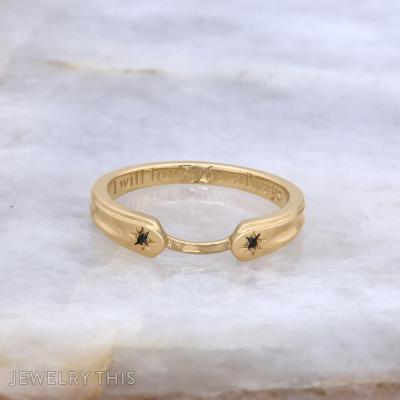
This custom yellow gold wedding band was designed to perfectly complement and fit against the ...
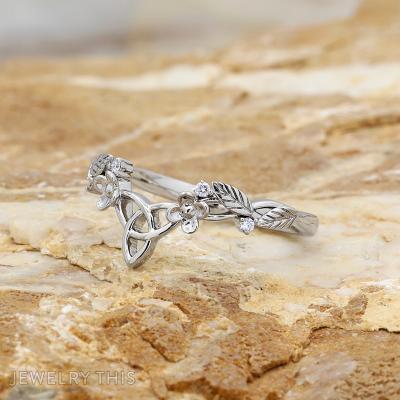
This custom platinum wedding band was thoughtfully designed to complement an existing engagement ring while ...

This white gold ring captures the essence of timeless beauty. At its heart lies a ...

This pair of sterling silver wedding bands are a symbol of the unbreakable bond between ...