


Three-Finger Initial Ring in Sterling Silver with Rubies
$$$
Sterling silver, natural rubies
A wife set out to build her husband a three-finger ring with his initials spelled out in rubies — a style he had in mind and was excited about from the start. The design went through several rounds of adjustment, from letter spacing to a wider top bar sized from a wax model he tried on himself, with a personal three-line engraving added inside each band. When it arrived, she wrote: "We love it! It is perfect."
'We love it! It is perfect. Thank you so much!' — on delivery
Quick specs
Primary Metal
Shape / Cut
Primary Stone
Accent Stones
Design Complexity
Intent: Certainty
Size
Three connected rings, sized to pinky 7.5 US, ring finger 8.5 US, middle finger 10.5 US. Top bar width 14mm (increased from initial 11mm). Engraved inside each band.
How they made it distinctive
-
01
Built as a single rigid three-finger piece rather than three separate rings, designed to be worn as one unit
-
02
Letters set flush with round rubies rather than raised, chosen specifically because square stones couldn't be cut small enough to follow the curved letterforms
-
03
Top bar widened by roughly 25% after a wax model fitting, giving the monogram more visual presence on the hand
-
04
Three separate lines of script engraving hidden inside the bands, each carrying part of a personal phrase
-
05
A wax resin model was shipped directly to the wearer to confirm width and fit before any metal was cast, since multi-band rings are very difficult to resize
How you'd make it yours
Stone type: this piece uses natural rubies — a new commission could use lab-grown diamonds for a similar look at a different cost, or other colored stones
Metal: this piece is sterling silver — the same design language could be built in yellow gold or white gold, though weight increases significantly
Letter arrangement: this piece groups the letters tightly at center — a new piece could space letters out to align with each finger instead
Width: this piece measures 14mm across the top bar — a new commission could be made narrower or wider depending on preference
Engraving: the inside of each band can carry a new personal phrase or set of initials
One of a kind: this exact ring was designed and sized for one wearer's three fingers and is not reproduced — a new commission is an original piece inspired by this one, not a copy
Design changes made
After trying on a wax resin model, the wearer asked for the top bar to be sized up substantially for more presence, and a three-line script engraving was added inside the bands partway through the design process. The letter arrangement was also adjusted from a spaced-out layout to a grouped, flush-set block format after a few rounds of feedback.
Who this is for
This piece is for someone who wants a bold, statement-making ring that reads immediately as personal rather than decorative. It's especially right for a wearer who likes a hip-hop-inspired silhouette and wants initials or a monogram to be the clear focal point of the design, with a private message hidden on the inside only they know about.
How it's made
The approved design was first produced as a 3D-printed wax model, which was shipped to the client so her husband could try the piece on and confirm fit and width before any metal was committed — a step that led to the top bar being resized wider. Once the width was finalized, the model was attached to a wax tree, invested in plaster, and fired in a kiln to burn out the wax. Molten sterling silver was then cast into the resulting mold, producing the raw three-finger piece.
After casting, the piece was cleaned, polished, and finished across its rigid connected-band structure. The top surface was finished flat and flush so the forty-eight small round rubies could be set directly into the block letterforms without raised prongs catching on the hand. The script engraving was then applied to the inside of each of the three bands as a separate finishing step.
Key note
The curved letterforms meant the rubies had to be cut small enough to follow the shape of each letter by hand — a constraint that ruled out square-cut stones entirely for this design.
Pricing guidance
A multi-band statement ring with flush-set colored stones across a wide custom bar sits in the mid-to-upper range for sterling silver custom work. Most of the baseline cost comes from the stone count and the labor to flush-set dozens of small stones into precise letterforms, not the metal itself. Stone choice is the single biggest lever on price for a design like this.
Moves price up ↑
- ↑ Upgrading from rubies to mined diamonds or other precious colored stones at the same stone count
- ↑ Casting the piece in yellow gold or platinum instead of sterling silver, which increases both material weight and cost
- ↑ Increasing the width of the top bar beyond 14mm, which requires larger stones and more metal
- ↑ Adding engraving across all three interior bands rather than a single line
- ↑ Increasing the stone count for a longer monogram or additional decorative elements
Moves price down ↓
- ↓ Switching from natural rubies to lab-grown diamonds, which run notably less than rubies at the same size and count
- ↓ Reducing the top bar width back toward 11mm, requiring smaller stones
- ↓ Spacing the letters out across the full bar instead of a dense grouped block, which can reduce total stone count
- ↓ Omitting the interior engraving
- ↓ Choosing a two-finger rather than three-finger format to reduce overall material and stone count
Questions people ask
Yes, a three-finger ring like this is built as one solid connected piece spanning three finger openings, with a flat top bar wide enough to carry a monogram. The letters are typically formed using small stones set flush into the metal surface so nothing raised catches on the hand. Because the three bands are joined into a single rigid structure, finger sizing has to be confirmed in advance since this style is very difficult to resize later. A wax model is often shipped to the wearer first to confirm fit and width before the final metal version is cast.
Square-cut stones aren't available in sizes small enough to fit tightly within curved letterforms like a C or an O. Letters that include curves require stones that can follow that curvature, which rules out hard-edged square cuts at a small scale. Round stones can be packed closely together to outline both straight and curved letter shapes cleanly. This is a practical setting constraint rather than a stylistic preference.
A three-finger ring in sterling silver with dozens of small flush-set rubies sits in the mid-to-upper range for custom silver work, largely because of the stone count and the hand-labor required to set each one precisely into a letterform. The metal itself is a smaller portion of the total cost compared to the stone-setting labor. Widening the design or increasing stone count raises the price further, while switching to a different stone type can bring it down significantly. Getting an exact figure generally requires a finalized width and stone count.
Yes, in this case lab-grown diamonds came in at a lower overall price than natural rubies at the same stone count and ring design. Lab-grown diamonds are optically, chemically, and physically identical to mined diamonds — the difference is origin and cost, not appearance. Rubies, sapphires, and emeralds tend to be priced higher than diamonds of comparable size because they are rarer in fine small calibrated cuts. The choice between stone types is often more about personal meaning than durability, since both options hold up well in daily wear.
Once a design is fully approved and the balance is substantially paid, production of a piece like this typically takes about three to four weeks. Before that, the design phase includes a 3D render for approval and often a wax model shipped to the wearer to confirm fit, which can add one to two additional weeks. Multi-band rings with inset stonework take longer than a simple single band because of the flush stone-setting labor. The full process from deposit to delivery commonly runs six to eight weeks or more depending on how many design revisions are requested.
Multi-band rings like this are extremely difficult to resize, and in some cases it isn't possible at all once the piece is cast as a single rigid structure. This is why a wax model is strongly recommended before casting, so the wearer can try the piece on and confirm both finger sizing and the width feel in advance. Because the bands are joined together rather than separate, adjusting one finger size can affect the fit of the others. Getting accurate finger measurements up front is the most important step in the whole process.
Yes, each connected band in a three-finger ring can carry its own engraving on the inside, since the bands are wide enough to hold a short line of text each. Script or block lettering are both options, and the content is typically confirmed before the final width adjustment is made so the engraving can be finalized at the same time. A three-band ring like this can carry three separate lines, which works well for a phrase split across the piece. The engraving is applied as a separate finishing step after the main casting and stone-setting is complete.
Sterling silver is a more affordable base metal that still provides a bright white look well-suited to a stone-set monogram design like this one. White gold costs more per gram and would raise the total price of a piece with this much metal and stone-setting labor. Both metals can be flush-set with small stones in the same way, so the visual result is similar; the main differences are cost, weight, and long-term maintenance. Sterling silver can tarnish over time with exposure to air and moisture, while white gold holds its finish longer but requires occasional rhodium replating.
Explore Similar Creations
Every masterpiece starts with a spark. Explore how our clients raw ideas - sketches, heirlooms, inspirations - were transformed into bespoke works of arts.
Personalized signet ring featuring enamel filled symbol inlayed into the top of the ring which ...

Bold and refined, this sterling silver signet ring features a striking 15 mm round top ...


This 14k yellow gold signet ring centers on a custom family crest: a raised dragon ...
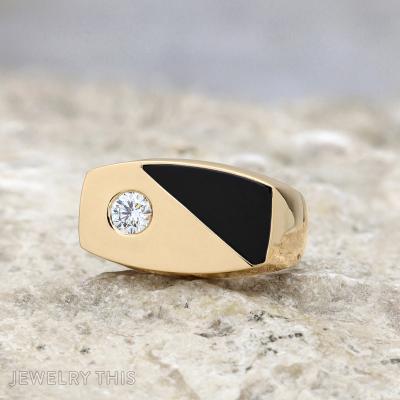
This ring reimagines a family piece in a trimmed, more wearable scale. An asymmetrical top ...

This ring harmoniously blends bold design with personalized symbolism. Crafted from black rhodium plated silver, ...

This oval-faced ring was rebuilt in sterling silver with white rhodium plating, recreating a vintage ...

This signet-style logo ring combines classic elegance with modern design. The ring features a round ...

This custom 14k yellow gold signet style ring is a beautiful replica of an original ...

Custom made sterling silver ring featuring a family name, symbolic detailing and colored enamel.

This sterling silver signet ring was customized to perfection. The top surface of the ring ...

Sterling silver men’s ring featuring an emblem logo of a firefighter as well as motorcycle ...



