
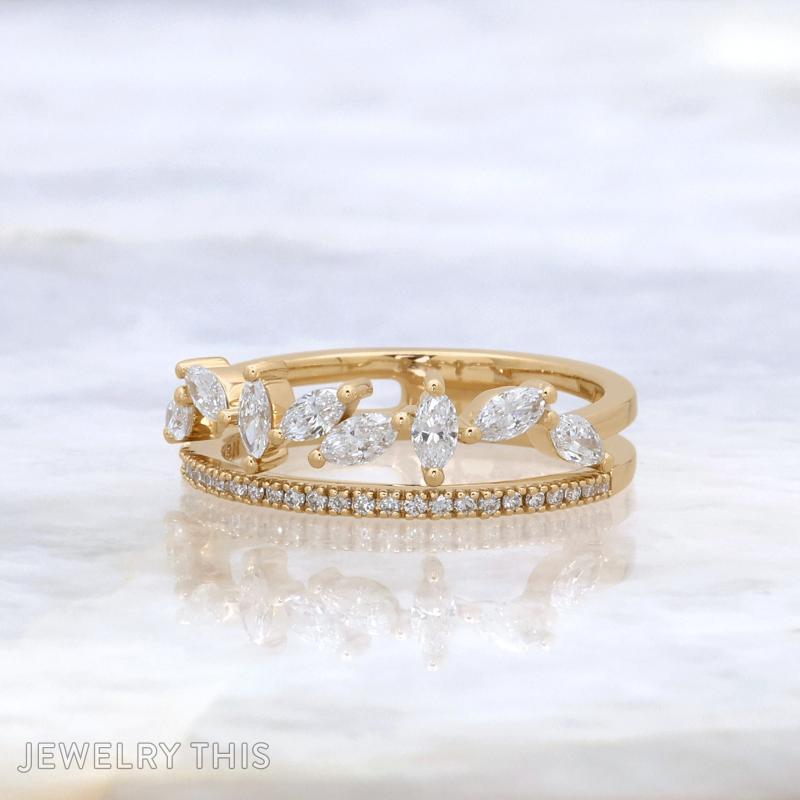


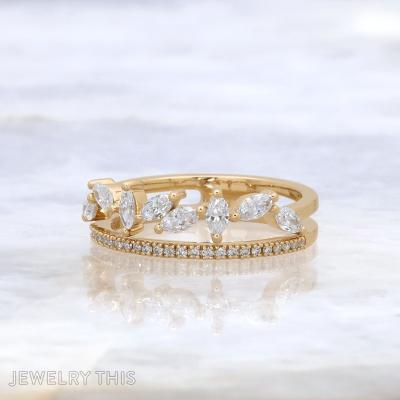


Marquise Diamond Double-Band Ring in 14k Gold
$$$
14k yellow gold, lab-created diamonds
A client wanted to recreate a ring his wife already owned and loved, remaking it in solid gold with real diamonds instead of the original's lower-quality materials. He supplied measurements and photos against a ruler to get the proportions right, and asked to see the design on an actual hand before moving forward, so the team printed a resin model and photographed it worn for scale. Once approved, he added hidden initials inside the band as a personal touch, positioned so a future resize would never disturb them.
'In the rendering, is it possible to show a finger through it? ... From a design standpoint, it looks really close to what I provided. No comments there.' — on seeing the first render
'Thanks. Looks good' — on seeing the resin fit photo
Quick specs
Design type
Primary Metal
Shape / Cut
Primary Stone
Accent Stones
Style
Design Complexity
Intent: Certainty
Size
Ring size 7 US (17.2mm). Two-band design; individual band width on the slim/petite side.
How they made it distinctive
-
01
Two-band open design recreated from a lower-cost original, rebuilt in 14k gold and lab diamonds for lasting quality
-
02
Marquise diamonds set at scattered heights and angles across the upper band to mimic the original's organic cluster look
-
03
A resin model was printed and photographed worn on an actual hand so scale could be confirmed before casting
-
04
Hidden initials engraved inside the band at the split seam specifically so a future resize will not disturb them
-
05
Lower band fully pave-set with round diamonds for continuous sparkle beneath the marquise cluster
How you'd make it yours
Stone type: this piece uses lab diamonds; a new commission could use natural diamonds for the same look or moissanite for a lower-cost alternative
Metal: this piece is 14k yellow gold; the same two-band design works in 18k gold, white gold, or rose gold
Stone arrangement: the marquise cluster density and placement can be adjusted for a sparser or fuller look on a new piece
Engraving: a new piece can carry its own hidden inscription placed at a resize-safe location
One of a kind: this exact ring was designed to recreate one client's existing piece and is not reproduced — a new commission is an original piece inspired by this one, not a copy
Design changes made
Design matched the initial brief without major changes. The one addition was a set of engraved initials inside the band, placed at the split seam specifically so future resizing would not affect the engraving.
Who this is for
This piece is for someone who already found a design they love and just wants it made to last — in real gold, with real stones, built to hold up to daily wear. It's especially right if you have a piece you're not comfortable trusting your everyday hand to, and want the exact same look without the durability tradeoff.
How it's made
Once the design was approved, a 3D digital model was built and printed in resin so the client could confirm proportions against an actual hand before any metal was committed. That resin model was then used to produce a wax version, which was attached to a tree and invested in plaster; the mold was fired in a kiln to burn out the wax, leaving a hollow cavity. Molten 14k yellow gold was cast into that cavity under heat, then cooled and separated from the tree.
After casting, the piece was cleaned up and polished to a mirror finish across both bands. The lower band's round diamonds were pave-set in a continuous line, while the upper band's marquise diamonds were individually prong-set at varying heights to create the scattered cluster look. The initials were engraved last, placed on the inside of the band at the split seam so they remain protected through any future resizing.
Key note
The engraving was deliberately placed at the band's split seam — the point most likely to be altered during a future resize — so a personal touch can survive a service the ring may eventually need.
Pricing guidance
A two-band yellow gold ring with a pave lower band and a marquise diamond cluster upper band sits in the mid range for custom stacked-ring designs. Much of the cost comes from the number of individually set stones — over 30 here — since setting labor scales with stone count regardless of overall ring size. Diamond type and total carat weight are the next biggest levers on price.
Moves price up ↑
- ↑ Switching from lab-created to natural diamonds for the same stone count and sizes
- ↑ Increasing the size of the marquise stones or adding more of them to the cluster
- ↑ Upgrading from 14k to 18k gold
- ↑ Adding pave diamonds to the upper band as well as the lower one
- ↑ Setting the round diamonds in a wider or double row for more sparkle
Moves price down ↓
- ↓ Reducing the round diamond count in the pave band
- ↓ Using fewer marquise stones in the cluster arrangement
- ↓ Choosing moissanite in place of lab diamonds
- ↓ Narrowing the band width to reduce metal and setting surface
- ↓ Simplifying to a single band rather than the two-band design
Questions people ask
Yes, this is a common request — someone owns an inexpensive ring they love the look of and wants a version made in solid gold with genuine stones. The process starts with photos and measurements of the original piece, ideally against a ruler or measuring tape for accurate scale. A 3D render is built from those references and shared for approval before any metal is used. The finished piece keeps the same design and proportions but is built to last with quality materials.
Lab-created and natural diamonds are chemically and optically identical — both are real diamonds, just with different origins. Lab diamonds are grown in a controlled environment rather than mined from the earth, which typically makes them significantly less costly for the same size and quality. For a design with many small stones, like a cluster or pave band, lab diamonds are a common choice because they keep the total cost more reasonable without changing how the piece looks. There is no visual difference to the naked eye.
The full process typically runs about four to six weeks from deposit to delivery. The design phase — sketch, 3D model, and rendered preview — usually takes about a week, during which you can request changes. Once the design is approved, production takes another three to four weeks, covering casting, stone setting, polishing, and any engraving. Rush timelines are sometimes possible depending on the piece's complexity.
Yes. Before casting in metal, a resin 3D print of the design can be made and photographed on a hand for scale, which is especially useful if you're trying to confirm proportions against a reference piece. This step does not typically add cost and takes a few extra days. It's a useful gut-check between the digital render and the final metal piece, since renders can sometimes be hard to judge for true-to-life scale.
Yes. The safest placement for engraving is away from the seam or point where a jeweler would cut and add or remove metal during a resize. On a two-band ring with a split design, the inside of the band near the split — rather than directly at the connection point — is a good location because it keeps the engraving intact if the ring needs to be resized later. This is worth discussing with your jeweler before the design is finalized.
A two-band design with a full pave row and a marquise diamond cluster sits in the mid price range for custom rings, largely because of the number of individually set stones involved. Setting labor is the primary cost driver here, since each stone — round or marquise — is set by hand. Choosing lab diamonds over natural ones, and 14k over 18k gold, are the two most effective ways to manage cost without changing the design.
Yes, natural diamonds can be used in place of lab-created diamonds in the same cut, size, and arrangement. The visual result is identical, since the two are optically indistinguishable to the eye. The main consideration is cost, as natural diamonds of comparable size and quality typically run higher than lab-created equivalents, which matters more on a design like this with a higher total stone count.
Very closely, yes — though a full recreation from photos alone involves some interpretation, particularly around band width and stone proportions if exact measurements aren't available. Providing photos with a measuring tape or ruler in frame significantly improves accuracy. The 3D render and, if needed, a resin test print are both opportunities to compare the design against the original before committing to final production.
Explore Similar Creations
Every masterpiece starts with a spark. Explore how our clients raw ideas - sketches, heirlooms, inspirations - were transformed into bespoke works of arts.
This white gold engagement ring is an exquisite blend of elegance and brilliance, featuring a ...

This beautiful garnet ring is a loving recreation of an antique costume piece, brought to ...

This extraordinary Yellow gold ring features a breathtaking 1 carat Round Moissanite stone set at ...

This custom wedding set exudes romance and sophistication. The engagement ring, inspired by the classic ...

This yellow gold wedding band combines modern design with classic elegance. Crafted with a flat ...

Three rings interlock to create one unique four leaf clover. This ring set is made ...

Reimagining a sentimental piece, this custom 14k white gold wedding band is a resilient symbol ...

This custom jewelry ring showcases the natural beauty of Lake Tahoe. Crafted in luxurious 14k ...
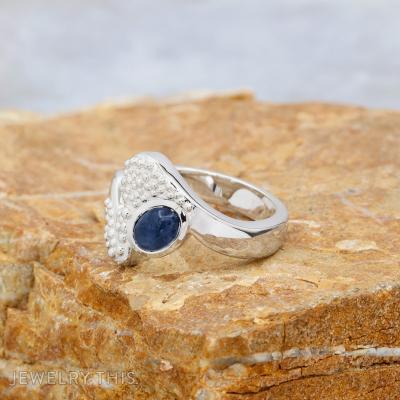
This sterling silver ring reimagines a beloved grandmother’s ring using only memory and a handful ...

This striking white gold engagement ring showcases a captivating marquise-shaped black diamond at its center, ...
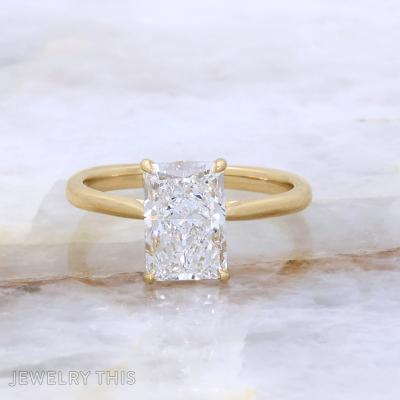
This engagement ring centers a 2-carat elongated radiant-cut lab diamond in a classic four-prong solitaire ...

This enchanting platinum engagement ring showcases a striking hexagonal-shaped teal sapphire at its center, chosen ...



