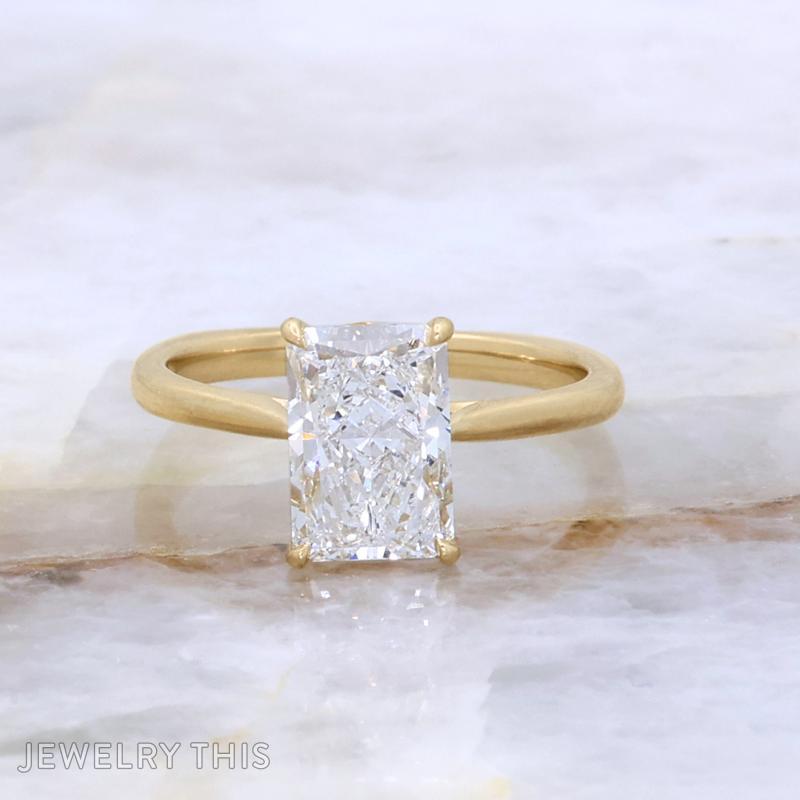
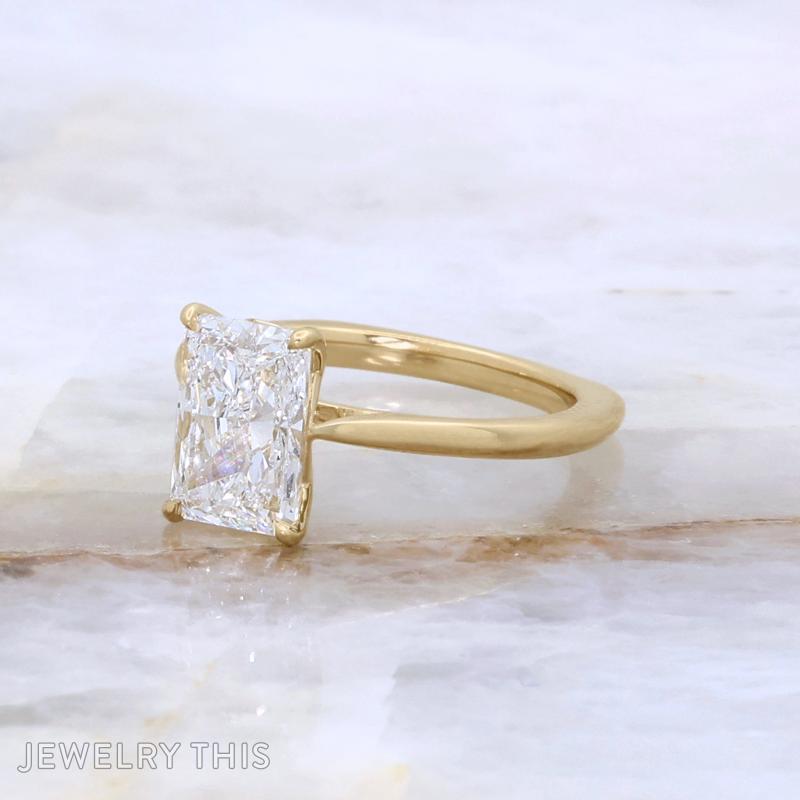
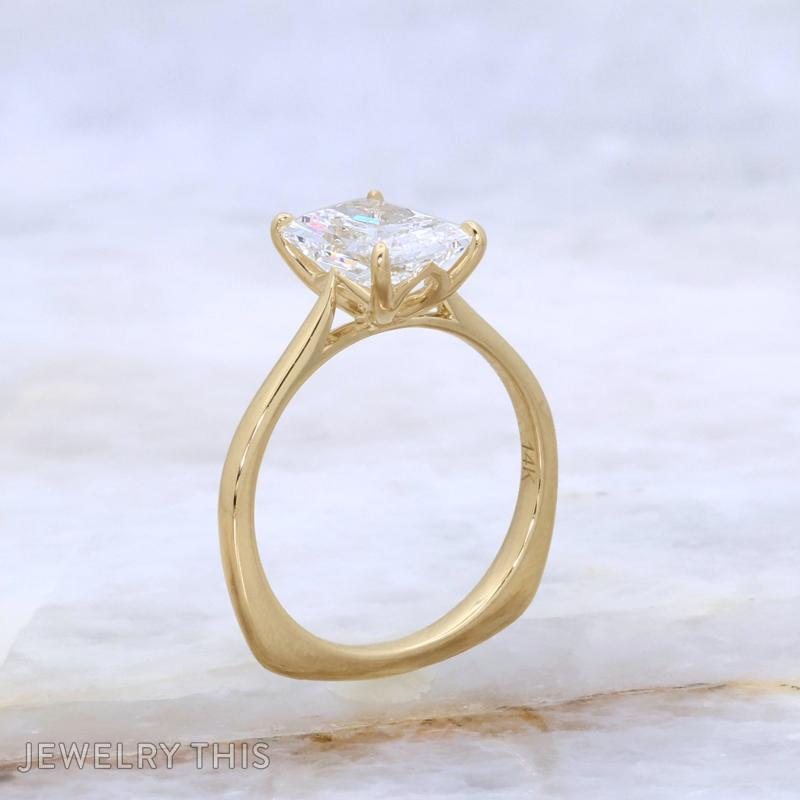
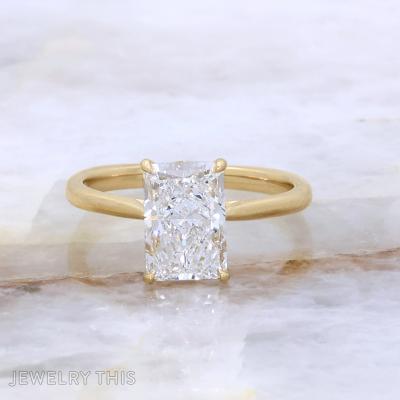
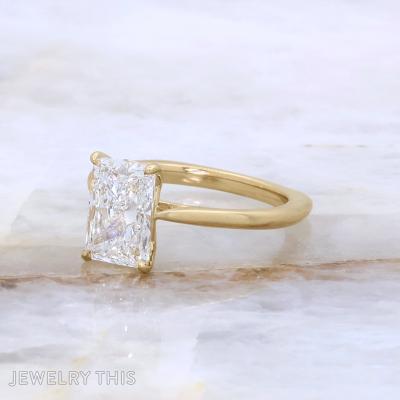
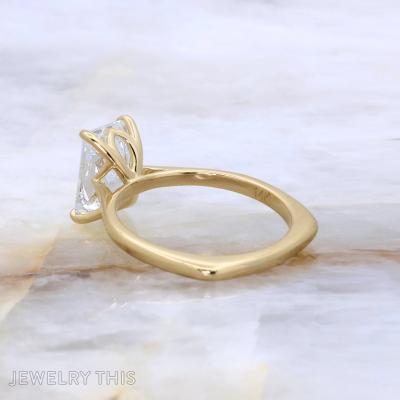
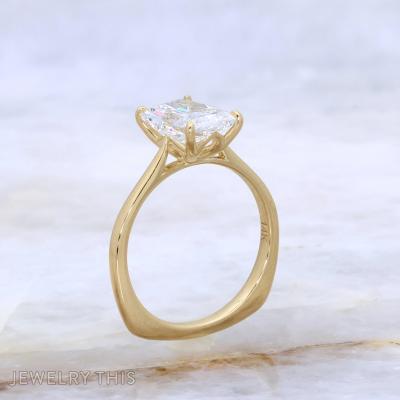
Elongated Radiant Solitaire Engagement Ring in Yellow Gold
$$$
14k yellow gold, lab diamond
M. wanted to propose to his partner of two and a half years and came in with a design board she had put together herself while they shopped around for styles together — giving him a rare, precise map of exactly what she loved. He pushed through a few rounds of technical back-and-forth to get a sculpted connection between the basket and band just right, all while avoiding a split-shank look she disliked. When it arrived, he wrote that it looked amazing in person — and even better on her finger.
'It looks wonderful! Quite literally exactly how I imagined it.' — on seeing the finished ring photos
'The ring looks amazing in person, and is now looking even better on Becca's finger.' — on delivery
Quick specs
Design type
Primary Metal
Shape / Cut
Primary Stone
Accent Stones
Style
Design Complexity
Intent: Certainty
Size
Ring size 5.25 US (15.9mm). Elongated radiant center stone, approximately 2.00 carats.
How they made it distinctive
-
01
Design built directly from a board the recipient created herself while shopping for styles, giving an unusually precise map of her preferences
-
02
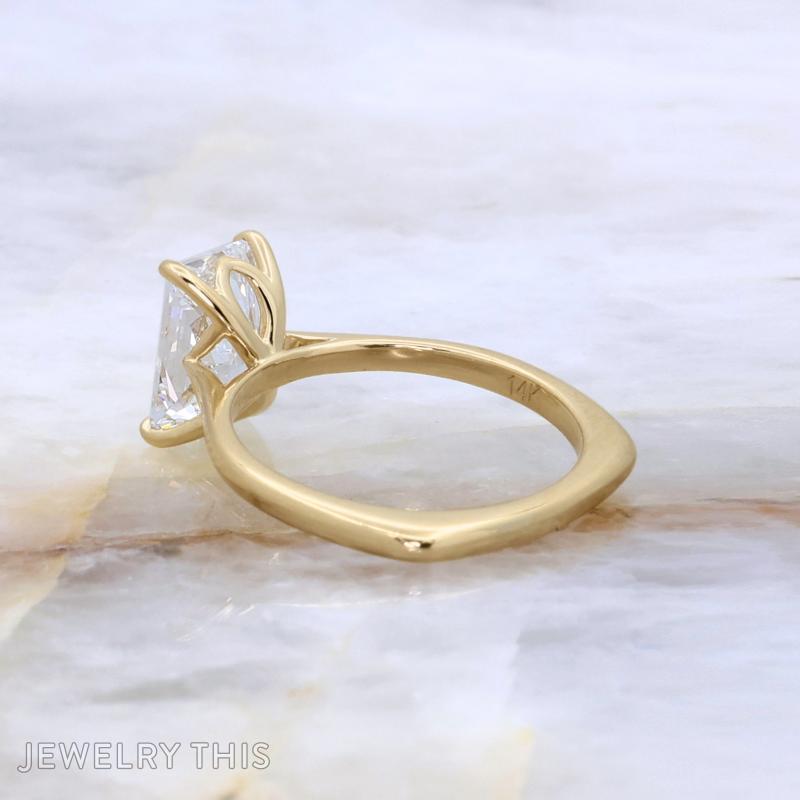
Basket sculpted into a fluid connection with the band, leaving open negative space behind the stone rather than a traditional floating basket
-
03
Split-shank look deliberately avoided at the recipient's request, shaping how the basket-to-band connection was finalized
-
04
Pointed claw prongs shaped only after the diamond was set, protecting the stone during earlier finishing stages
-
05
Elongated radiant cut chosen specifically for its rectangular silhouette and larger visual footprint across the finger
How you'd make it yours
Stone type: this piece uses a lab-grown diamond — a new commission could use a natural diamond for the same look at a higher cost
Diamond color/clarity: this piece uses D color, VVS2 clarity — a new commission could use a different grade combination depending on budget
Metal: this piece is 14k yellow gold — the same solitaire language works in white gold, rose gold, or platinum
Basket-to-band connection: this piece uses a sculpted connected basket — a new commission could use a traditional floating basket or a different connective element
One of a kind: this exact ring was designed around one recipient's own style board and is not reproduced — a new commission is an original piece inspired by this one, not a copy
Design changes made
The client asked for the basket to connect into the band with a smoothed, fluid transition and open space behind the stone, rather than the more traditional floating basket in the first sketch. An alternate version of this idea was ruled out because it would have created a visible split-shank look from the top, which the recipient specifically disliked, so the design was finalized using the subtler connected-basket approach instead.
Who this is for
This piece is for someone proposing to a partner who already knows exactly what they love — someone willing to go through a few rounds of technical back-and-forth to get small structural details right rather than settling for a standard setting. It's especially right for a partner who wants a solitaire with real presence but has specific opinions about shank shape and setting style that a store-bought ring can't accommodate.
How it's made
Once the final design was approved, the piece moved through a design quality check to confirm the diamond would fit the setting precisely, then a resin (wax) model was 3D printed as the first physical preview of the ring. The wax model was attached to a wax tree and invested in plaster, which was fired in a kiln to burn out the wax and leave a hollow mold. Molten 14k yellow gold was then cast into that mold to form the raw ring.
After casting, the ring was cleaned up and polished to a mirror finish across the band and basket. The prongs were left slightly fuller through casting and finished into their final pointed claw shape only after the center diamond was set, protecting the stone during the earlier finishing stages. The sculpted basket-to-band connection was hand-finished to keep the open negative space behind the stone clean and fully polished despite its tight geometry.
Key note
The pointed claw prongs are intentionally shaped after the diamond is set, not before, so the stone is fully protected during the earlier casting and polishing stages.
Pricing guidance
A solitaire engagement ring with a 2-carat lab-grown center stone and a custom sculptural band detail sits toward the higher end of the mid range for custom engagement rings. Most of the cost comes from the diamond itself at this carat weight, with the custom basket-to-band connection adding modest labor on top of a standard solitaire build. Metal karat and diamond grade are the next biggest levers on price.
Moves price up ↑
- ↑ Increasing the center diamond size beyond 2 carats
- ↑ Choosing a natural diamond instead of a lab-grown diamond at the same carat and grade
- ↑ Upgrading to 18k gold or platinum instead of 14k yellow gold
- ↑ Adding pave or milgrain detail along the band or basket
- ↑ Requesting the sculpted basket-to-band connection be cast as a separate hand-finished piece rather than a simplified version
Moves price down ↓
- ↓ Reducing the center diamond to a smaller carat weight
- ↓ Choosing a lower diamond clarity grade (e.g. VS2 instead of VVS2)
- ↓ Simplifying the basket-to-band connection to a standard floating basket
- ↓ Selecting 10k gold instead of 14k
- ↓ Choosing a more common diamond shape that requires less custom stone-cutting lead time
Questions people ask
Yes. Lab-grown and natural diamonds are chemically and optically identical, both rating a 10 on the Mohs hardness scale, so there is no difference in durability or daily wear resistance. The only differences are origin and price, with lab-grown diamonds typically costing significantly less than a natural diamond of the same carat weight, color, and clarity. Lab-grown diamonds also show the same fire and brilliance as natural diamonds under normal lighting. Neither type requires different care routines.
A 2-carat radiant-cut solitaire with a lab-grown diamond typically falls toward the higher end of the mid range for custom engagement rings, since carat weight is the single biggest driver of diamond cost. A natural diamond of the same size, color, and clarity would cost substantially more than the lab-grown equivalent. Metal choice, diamond color and clarity grade, and any additional design details on the band all shift the final price from there. Custom sculptural details, even small ones, add modest labor cost on top of a standard solitaire build.
D and E are both in the colorless range on the diamond color scale, with D being the highest possible grade and E just one step below it. The difference between them is essentially invisible to the naked eye, even to a trained eye in most lighting conditions. Some buyers choose D specifically because color is the diamond characteristic most visible without magnification, so going as high as the budget allows can feel worthwhile. Either grade will appear bright white and colorless when set in a ring.
The full process typically takes 4 to 6 weeks from design approval to delivery. The design phase, including a technical sketch, 3D model, and photorealistic render for approval, usually takes about one week. Once the design is approved and production begins, casting, stone setting, and finishing take approximately 4 weeks. Custom elements, like a sculpted band detail, are built into that timeline rather than adding significant extra time in most cases.
Yes, prong shape is a customizable detail on a radiant cut solitaire setting. This ring uses a pointed claw prong, which is shaped into its final form only after the diamond is set, keeping the stone protected during the earlier casting and polishing stages. Other common options include flat or rounded prong tips, which give a slightly different look at the corners of an elongated stone. The choice is largely aesthetic and does not affect how securely the stone is held.
Yes, though it depends on the specific geometry involved. A subtle sculpted connection between the basket and band, like the one on this ring, can usually be achieved without significantly increasing cost or production time. More elaborate versions with very tight open spaces can be harder to polish as a single cast piece and may need to be made and finished as a separate component, which adds labor. It's worth discussing the specific look you want early in the design process so the setting style (split shank vs. connected basket, for example) is accounted for from the start.
Lab-grown diamonds are less expensive primarily because of how they are produced. They are grown in controlled lab environments over a period of weeks rather than mined from the earth, which removes the extensive extraction, sorting, and supply chain costs associated with natural diamonds. Since lab-grown and natural diamonds are chemically identical, there is no difference in how they look, sparkle, or wear over time. The price gap mainly reflects supply and production economics rather than any difference in quality.
Yes, radiant cut diamonds are a popular engagement ring choice because they combine the brilliance of a round cut with a more elongated, rectangular silhouette. The cut's trimmed corners make it more durable against chipping compared to sharp-cornered shapes like emerald or asscher cuts. An elongated radiant cut, like the one used here, can also create the visual effect of a larger stone across the finger. It pairs well with a simple solitaire setting when the goal is to let the diamond's proportions stand out.
Explore Similar Creations
Every masterpiece starts with a spark. Explore how our clients raw ideas - sketches, heirlooms, inspirations - were transformed into bespoke works of arts.
This black rhodium plated white gold wedding set is a bold and distinctive expression of ...

This white gold engagement ring celebrates timeless love and exquisite design. At its heart lies ...

This exquisite Platinum Moissanite And Sapphire Wedding Set. A harmonious blend of elegance and sophistication. ...

This vintage-style 14 karat yellow gold engagement ring showcases a horizontally set oval emerald nestled ...

This stunning 10k yellow gold engagement ring is a masterpiece in recreation and continuity. At ...

Introducing our captivating twist on a classic style, the 2.13 carat Emerald Cut Lab Created ...

This custom wedding band is a sentimental recreation of the original ring, bringing back cherished ...

This elegant white gold engagement ring showcases a radiant-cut diamond at its center, exuding brilliance. ...
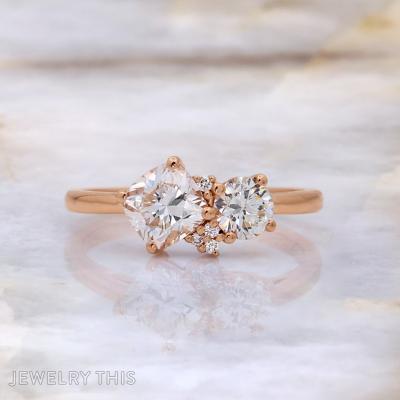
This ring reimagines two heirloom stones into a single two-stone, or toi et moi, design ...

This captivating yellow gold engagement ring features a stunning pear-shaped diamond as its centerpiece. The ...

This wedding set is made sterling silver and set with a center round moonstone with ...

Inspired by the enchanting tale of The Little Prince, this yellow gold wedding band is ...