
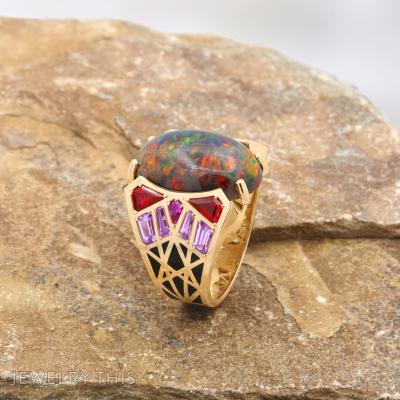
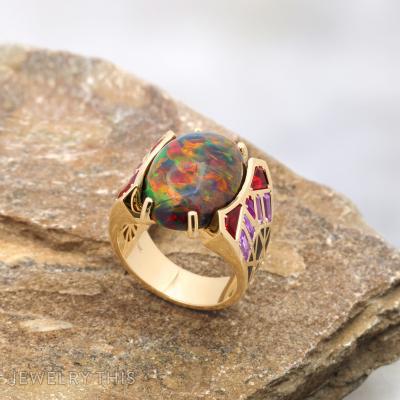
Art Deco Black Opal Ring with Custom-Cut Ruby & Sapphire
$$$
14k yellow gold, black enamel, natural boulder opal, lab-grown ruby, lab-grown purple sapphire
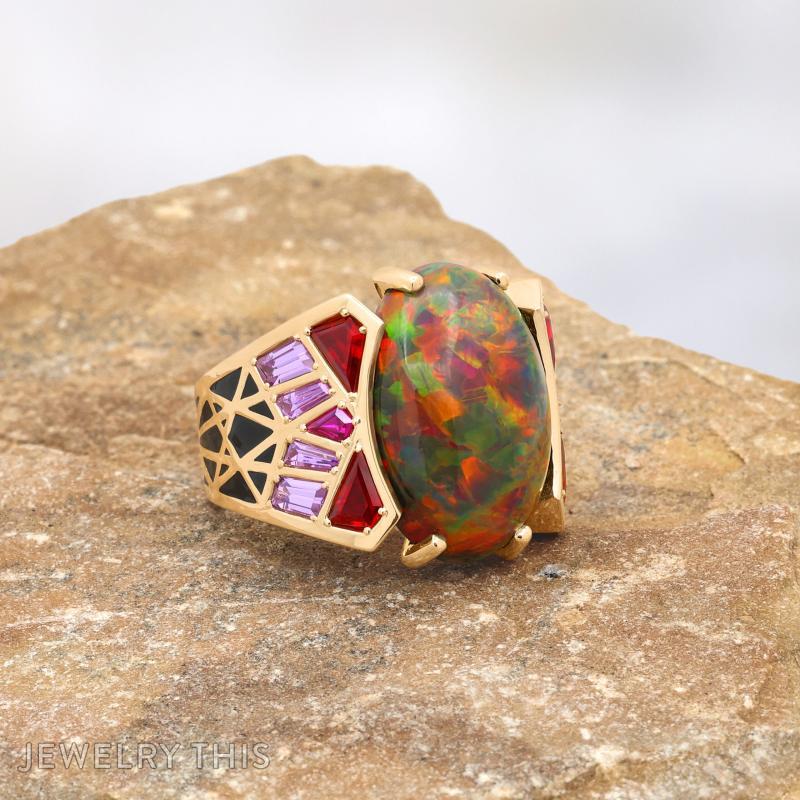
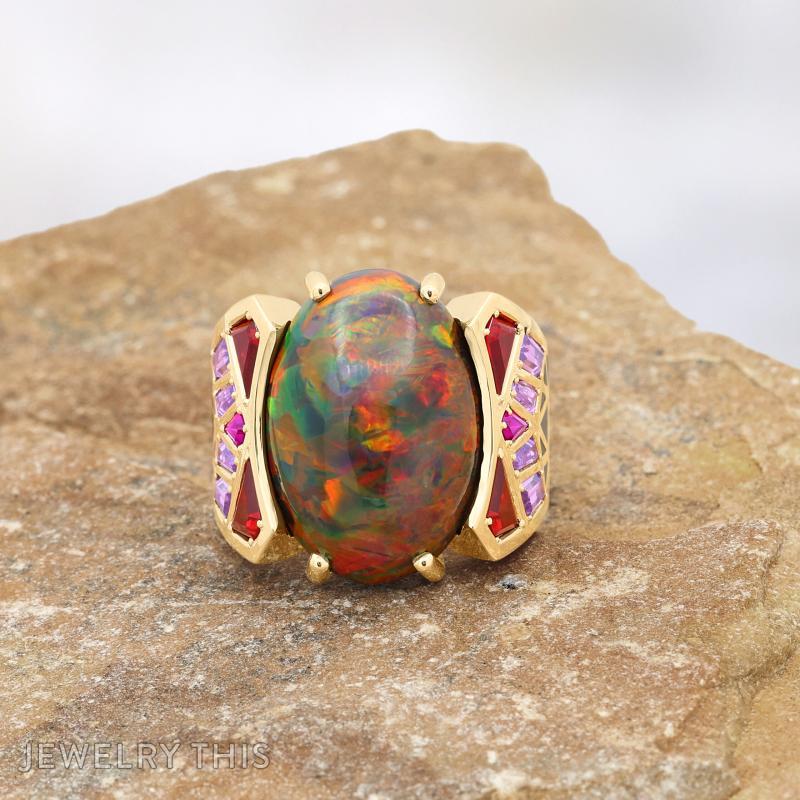
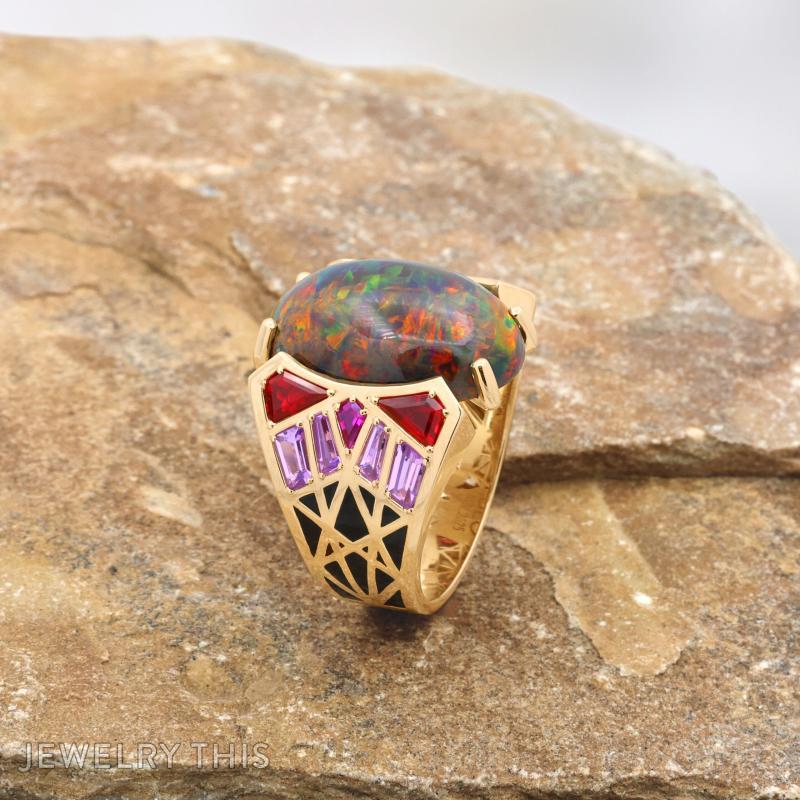
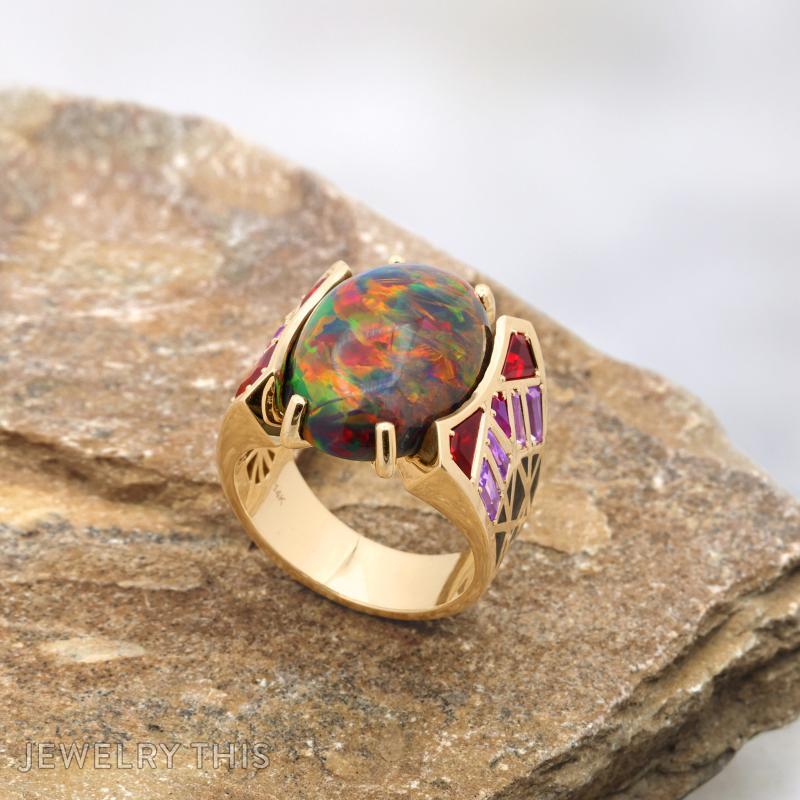
A client came to us with a fully realized Art Deco design in mind — a boulder opal centerpiece framed by radiating rows of ruby and purple sapphire that step down in size along custom-cut geometric linework. He supplied his own opal and worked through months of design refinement, from stone-cutting challenges to prong styling to an interior lattice grille, before the ring was finally cast and set. When it arrived, he wrote: 'I just got my ring and it is beautiful!!! This one was my brainchild since 2018-ish, so it's quite surreal.'
'I just got my ring and it is beautiful!!! Thank you so much for working with me on this project!' — on delivery
Quick specs
Design type
Primary Metal
Shape / Cut
Primary Stone
Style
Design Complexity
Intent: Certainty
Size
Ring size 11 US (20.6mm). Center opal approximately 22x15x8mm as sourced. Finished ring weight approximately 20 grams.
How they made it distinctive
-
01
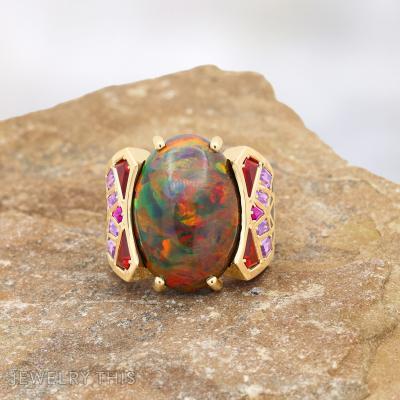
Center boulder opal client-sourced and set in a raised double-prong bezel designed to protect its soft, brittle edges
-
02
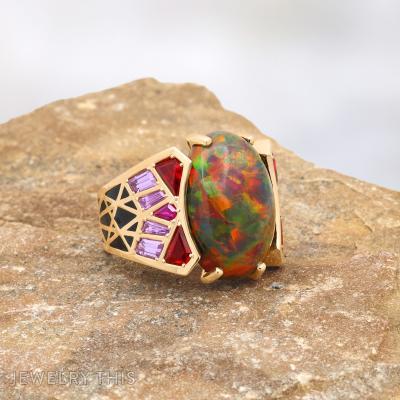
Twelve ruby and purple sapphire accent stones custom-cut to precise angular geometry, requiring a hand-built specialty cutting tool
-
03
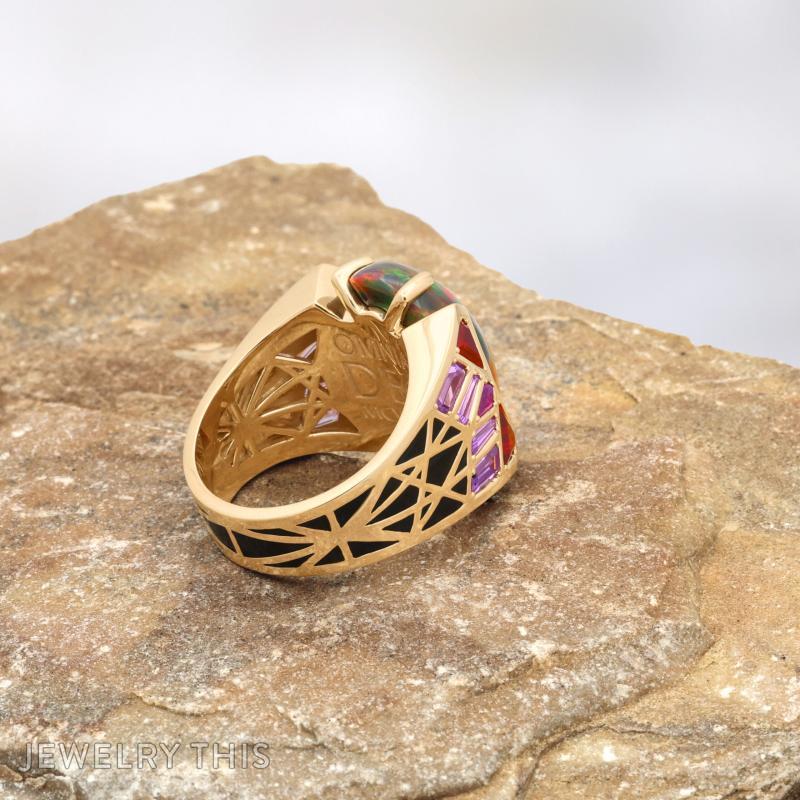
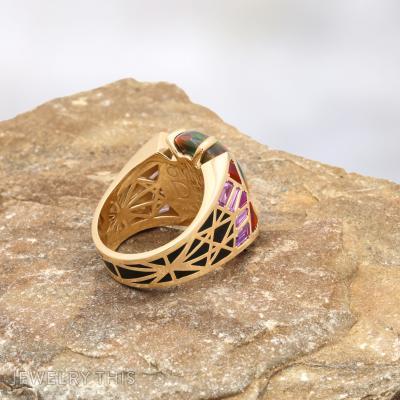
Radiating Art Deco linework pattern filled with black enamel for contrast against polished 14k yellow gold
-
04
Pierced interior lattice grille on the inside of the shank, echoing the exterior pattern while aiding casting quality
-
05
Two-line interior engraving oriented to run along the length of the center stone rather than around the band's circumference
-
06
Stones set entirely by hand due to the opal's softness, with a small stabilizing bead of clear epoxy added beneath the stone
How you'd make it yours
Center stone: this piece uses a client-supplied boulder opal; a new commission could use a sourced boulder opal or a harder alternative stone for more setting flexibility
Accent stones: this piece uses custom-cut ruby and lab-grown purple sapphire; a new commission could use sourced round or square stones to reduce custom-cutting time
Metal: this piece is 14k yellow gold; the same Art Deco linework works in 18k yellow gold or a two-tone treatment
Enamel color: this piece uses black enamel in the recessed channels; a new commission could use a different enamel color or leave the metal polished
Engraving: the interior of the band can carry a new inscription oriented along the band or the center stone on a fresh commission
One of a kind: this exact ring was designed by and for one client over an extended collaborative process and is not reproduced — a new commission is an original piece inspired by this one, not a copy
Design changes made
The original vision called for elongated, sharp-pointed kite-shaped accent stones set tightly into an intricate linework pattern, but ruby and sapphire's cutting limits meant the geometry was simplified to angular but sourceable shapes, and amethyst was swapped for lab-grown purple sapphire for durability. Later in the design phase, the double-prong opal setting was refined for a lower profile, the interior hollow was replaced with a pierced lattice grille, and black enamel was added to the recessed geometric channels for contrast.
Who this is for
This piece is for someone who already has a strong, specific design vision and wants a team willing to work through the technical constraints to realize it faithfully. It's especially right for a client who thinks like a designer themselves, who wants to be closely involved in every stage of stone cutting, setting style, and finish decisions rather than choosing from existing options.
How it's made
Once the design was finalized in CAD, a resin model was shipped to the client to confirm fit, and a resin was also sent to the stone cutter as a physical reference for cutting the ruby and purple sapphire accents to the exact angles the pattern required. The finished 14k yellow gold ring was then cast from the approved model, with a pierced interior grille cast open to reduce metal thickness and aid casting quality while echoing the band's exterior pattern.
After casting, the ring was cleaned up and polished, with the recessed geometric channels prepared to receive black enamel fill for contrast against the polished gold. The boulder opal was set last in a raised double-prong bezel, secured entirely by hand since the stone's softness ruled out mechanical pressure; a small bead of clear epoxy was later added beneath the stone to stabilize it without affecting its appearance. The graduated ruby and purple sapphire accents were set into the radiating linework in sequence from largest to smallest.
Key note
The ruby and purple sapphire accents required a custom hand-built cutting tool made specifically for this project, because the angular geometry of the pattern didn't match any standard cutting guide.
Pricing guidance
A sculptural Art Deco ring with this level of custom stone cutting and a large center opal sits at the higher end of custom ring work. Most of the cost comes from the labor of custom-cutting a dozen small angular accent stones to precise, non-standard geometry and hand-setting a soft opal without mechanical pressure. Metal weight and the complexity of the pierced interior grille add to that baseline.
Moves price up ↑
- ↑ Increasing the number of custom-cut accent stones or using more complex angular shapes
- ↑ Choosing a larger or higher-grade boulder/black opal with more vivid color play
- ↑ Adding a fully pierced interior grille pattern rather than a simple hollow shank
- ↑ Requesting hand engraving or enamel fill across a larger surface area
- ↑ Upgrading from lab-grown to natural ruby and sapphire accents
Moves price down ↓
- ↓ Using rounds or simple square-cut accent stones that can be sourced rather than custom cut
- ↓ Reducing the number of accent stones or simplifying the radiating pattern
- ↓ Choosing a smaller center stone that requires less material and setting time
- ↓ Omitting the interior lattice grille in favor of a standard hollowed or solid shank
- ↓ Skipping the black enamel fill and leaving the recessed channels as polished metal
Questions people ask
Not easily. Black and boulder opals are cut as cabochons with smooth, curved surfaces because the material is too soft and brittle to hold sharp faceted points without a high risk of chipping. A bezel setting can be shaped with sharp corners around a softer-edged stone to create the visual illusion of a pointed shape while the stone itself stays safely rounded. Faceted opals do exist, mostly using more affordable, plentiful material where cutting loss is less of a financial risk.
Opal sits around 5.5-6.5 on the Mohs hardness scale, which is soft compared to sapphire or ruby, so it can scratch or chip more easily than harder gemstones. A raised bezel or protective prong setting reduces the risk by shielding the stone's edges from impact. Many opal rings are set with a slightly looser fit intentionally, since applying heavy pressure to snug the stone tight can crack it, and a small dot of clear epoxy under the stone is a common way to add stability without changing its appearance. With a protective setting and reasonable care, an opal ring can be worn regularly, though it's not as impact-resistant as a diamond or sapphire ring.
Natural and lab-grown sapphire are chemically and structurally identical, with the same hardness and durability, so there's no visible or practical difference once set. The main difference is that lab-grown material is more available in consistent color and size, which matters a great deal when a dozen or more accent stones need to match closely. For small custom-cut geometric shapes, lab-grown stones are often the more practical sourcing choice specifically because a cutter can get matching rough material more reliably.
A ring with this level of custom stone cutting and a large center opal sits at the higher end of custom ring pricing, mainly because of labor. Cutting a dozen small stones to precise angular shapes is significantly more time-consuming than sourcing standard round or square stones, and hand-setting a soft center stone adds further time. Metal weight also factors in, since a dense, dimensional design like this uses noticeably more gold than a simple band. The center stone itself, if client-supplied or independently sourced, is priced separately from the setting.
It varies significantly and can take considerably longer than a standard custom ring, especially if the accent stones need to be recut for accuracy. Custom stone cutting for small, precisely angled shapes alone can take several weeks, and if a cutter needs to build or adjust a specialized tool to achieve the right geometry, that adds more time. The ring setting itself, once stones are in hand, still requires CAD design, casting, finishing, and hand-setting. Clients working on highly custom designs like this should expect a process that unfolds over months rather than weeks.
Yes, this is achievable and serves both a functional and aesthetic purpose. A solid, thick section of metal can actually cause casting problems, since molten metal flows and sets more reliably through narrower channels, so a pierced interior pattern can improve casting quality while echoing the exterior design language. It also lets light reach the underside of colored stones. The tradeoff is added labor to model and finish the pierced detail cleanly.
It depends on how narrow the recessed area is. Wider recessed channels, like those found in a geometric pattern along a ring's shank, can usually be filled with enamel for contrast. Very fine engraved lines, like small interior text engraving, are often too narrow for enamel to be applied reliably, since the groove needs enough width and depth to hold the fill material securely.
Hand-set prongs on a fully custom piece can vary slightly from one another since each is shaped individually rather than machine-formed, and it's worth having a jeweler examine anything that looks notably different or missing. If a prong is confirmed damaged or insufficient, it can be rebuilt and secured without remaking the entire piece. It's generally recommended to have this kind of repair done by the same team that built the setting, since they understand the specific stone and setting geometry involved.
Explore Similar Creations
Every masterpiece starts with a spark. Explore how our clients raw ideas - sketches, heirlooms, inspirations - were transformed into bespoke works of arts.

This enchanting engagement ring features a captivating pear-shaped purple sapphire at its center. The sapphire ...

This unique custom jewelry ring is handcrafted in 14k yellow gold. This stunning piece showcases ...
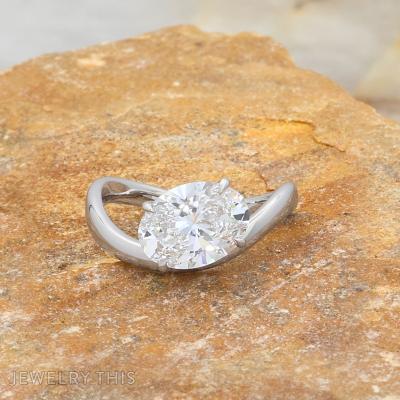
This engagement-style solitaire was built around a client-provided 2.89ct oval lab diamond, set in a ...

Crafted in 14k yellow gold, the custom vintage style ring showcases a stunning dark blue ...

This 14karat rose gold ring was a remake of the client’s original costume version. At ...

This signet ring is filled with sentiment and symbolism. The top surface features a flying ...

This yellow gold ring features a captivating oval rose cut diamond at its center, delicately ...
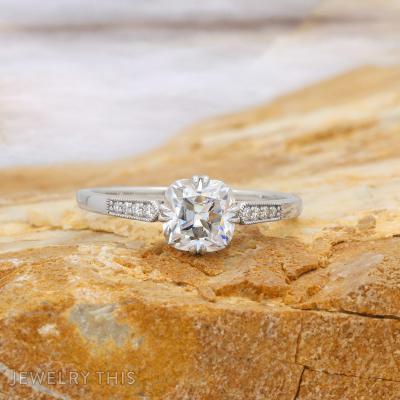
Rooted in Victorian elegance, this white gold ring captures the romance of a bygone era. ...

This beautiful 14karat Yellow gold wedding set is a stunning recreation of the original. The ...
This striking engagement ring presents a magnificent display of brilliance and color. Elevated at the ...

This band features an intricate design that allows a thriving squash plant to come to ...



