


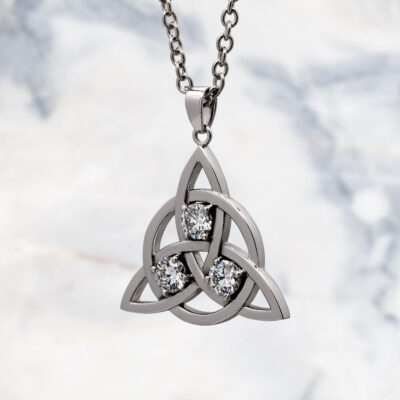
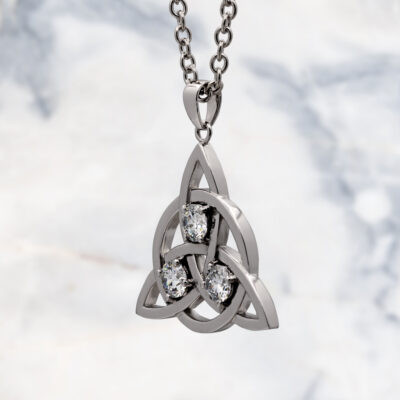
Trinity Knot Pendant — Three Diamonds, 14k White Gold
$$$
14k white gold, sterling silver chain, lab diamonds
D. wanted to mark 33 years of marriage with a piece that tied together three things at once: his wife, their three children, and his family's Irish heritage. He chose a Trinity knot design and placed a diamond at each of its three points to represent their children, working through the exact proportions with the design team until the size felt right for his wife's frame. When it arrived in time for the anniversary, he wrote that it looked very nice.
'I received the necklace and it looks very nice! Thank you for the "rush" delivery.' — on delivery
Quick specs
Design type
Primary Metal
Secondary Metal
Shape / Cut
Primary Stone
Accent Stones
Design Complexity
Intent: Certainty
Size
Pendant approximately 26mm (1 inch) top to base. Three round lab diamonds, approximately 0.47ct each. Chain: sterling silver, 18 inch.
How they made it distinctive
-
01
Three round diamonds placed at the knot's inner points rather than the center — a placement the client specifically requested after researching other Trinity designs
-
02
Pendant size increased slightly from the original concept so the diamonds could be cut larger without crowding the knot
-
03
Open Trinity knotwork left unembellished elsewhere, keeping the focus on the three stones rather than added metalwork
-
04
Lab-created VS1 diamonds chosen to maximize stone size and clarity within the client's budget
-
05
Sterling silver chain paired with a 14k white gold pendant to keep the piece wearable without added cost
How you'd make it yours
Stone: this piece uses lab-created diamonds — a new commission could use mined diamonds, moissanite, or colored gemstones such as sapphires
Metal: this piece is 14k white gold — the same Trinity knot design works equally well in sterling silver or platinum
Size: this piece was sized at roughly 1 inch for its wearer — a new piece is sized to its own wearer and may run smaller or larger
Chain: this piece pairs with a sterling silver chain — a new commission could use a 14k gold chain instead
One of a kind: this exact pendant was designed for one client's family and is not reproduced — a new commission is an original piece inspired by this one, not a copy
Design changes made
The pendant was enlarged slightly from the original 1-inch concept after the design team found the initial proportions ran a bit small; the diamond size was adjusted to 0.47 carats each to suit the larger size. The core design — Trinity knot shape with three diamonds at the inner points — matched the client's brief from the start.
Who this is for
This piece is for someone who wants a symbol that means something specific, not just something decorative. It's especially right if you're marking a long relationship or a family milestone and want that meaning built into the design itself, rather than added as an afterthought.
How it's made
Once the design was approved, the 3D model was printed in wax and attached to a tree inside a casting flask. The flask was fired in a kiln to burn out the wax, leaving a hollow mold, and molten 14k white gold was cast into that mold under pressure to form the raw pendant. After cooling, the piece was removed from the mold and prepared for the finishing stages.
The open knotwork band was cleaned up and polished to a bright, reflective finish throughout, since the design has no contrasting matte or textured zones. The three round lab diamonds were then set by hand into the inner points of the knot using prong settings sized to hold each stone securely while keeping the open, airy look of the Trinity knot intact.
Key note
The pendant's final size was adjusted upward from the original 1-inch plan specifically so the diamonds could be cut larger (0.47 carat each) while keeping the Trinity knot's proportions balanced.
Pricing guidance
A Trinity knot pendant with three round diamonds set at the knot's inner points sits in the mid range for pendants of moderate complexity. Open knotwork designs require careful hand-finishing to keep the metal thin and consistent throughout, and the diamond setting adds labor on top of the casting. Metal choice and diamond type are what move the price most from there.
Moves price up ↑
- ↑ Upgrading from lab-created to natural mined diamonds of the same size and clarity
- ↑ Choosing platinum instead of 14k white gold for the pendant body
- ↑ Increasing each diamond beyond roughly a third to a half carat
- ↑ Adding a matching 14k gold chain instead of the complimentary sterling silver option
- ↑ Requesting a larger overall pendant size with proportionally larger stones
Moves price down ↓
- ↓ Switching the pendant metal to sterling silver instead of 14k white gold
- ↓ Reducing diamond size to the smaller 4mm/0.23 carat option
- ↓ Using moissanite in place of lab-created diamonds
- ↓ Choosing a smaller overall pendant size (0.75 inch instead of 1 inch)
- ↓ Omitting the diamonds and leaving the knotwork polished metal only
Questions people ask
The Trinity knot, also called a triquetra, is a traditional Celtic symbol made of three interlocking arcs with no clear beginning or end. It's commonly associated with Irish heritage and is also used to represent other groupings of three, such as three children or three decades of marriage. The symbol doesn't require any specific cultural background to wear — many people choose it simply for its symbolism of connection or completeness. In this design, the three points of the knot were each set with a diamond to layer in an additional personal meaning.
Lab-created diamonds have the same chemical composition, hardness, and optical properties as mined diamonds — they are both pure crystallized carbon and score a 10 on the Mohs hardness scale. The visual difference between a lab-created and mined diamond of the same cut, color, and clarity grade is not detectable to the naked eye. Lab-created diamonds are typically available at a lower cost than mined diamonds of equivalent quality, which allows for a larger or higher-grade stone at the same budget. A VS1 clarity grade, as used in this piece, means the diamond has only minor inclusions that are difficult to see even under magnification.
14k white gold is a durable choice for daily wear, containing about 58% pure gold alloyed with harder metals for strength. White gold pieces are typically rhodium-plated to achieve their bright white finish, and that plating can wear thin over years of contact with skin and clothing, gradually revealing a slightly warmer tone underneath. Re-plating is a simple, inexpensive service most jewelers offer to restore the original brightness. For an open knotwork design like this one, the main durability consideration is avoiding snagging the thin metal arcs on clothing or hair rather than the metal's inherent strength.
A pendant of this size and complexity — an open knotwork design with three round diamonds — typically falls in the mid range for custom diamond pendants. The price is driven primarily by the diamond type and size chosen, with metal choice as a secondary factor. Opting for lab-created diamonds instead of mined, or sterling silver instead of gold, meaningfully changes the total versus keeping all of those choices at the higher end. Chain selection is usually priced separately from the pendant itself.
A custom pendant like this typically takes about one week for the design phase, where the 3D model is created and refined based on feedback, followed by three to four weeks of production once the design is approved. Production includes 3D-printing a wax model, casting it in metal, and hand-finishing and stone-setting the piece. Rush timelines are sometimes possible for a firm deadline like an anniversary, though they generally involve starting production immediately after design approval rather than waiting for the full standard schedule. Shipping typically adds a few additional days once the piece is complete.
Yes, a Trinity knot pendant like this can be designed with colored gemstones such as sapphires, emeralds, or birthstones in place of diamonds, since the prong settings at each knot point can accommodate most round stones of a similar size. This is a common choice for clients who want to represent specific birth months or a particular color preference rather than a traditional diamond look. Changing to a colored stone would not require any change to the open knotwork structure itself. It's worth discussing stone hardness with the design team, since softer stones may need a slightly more protective setting for daily wear.
A value summary document is typically provided after the piece ships, which is sufficient for most homeowners' or renters' insurance policies to add a jewelry rider. This is different from a full independent gemological appraisal, which involves a third-party appraiser physically examining the piece and is usually obtained separately if required by a specific insurer. If a full appraisal is needed, most clients arrange this locally after receiving the piece. It's worth checking with your specific insurance provider about what documentation they require before assuming either option is sufficient.
Explore Similar Creations
Every masterpiece starts with a spark. Explore how our clients raw ideas - sketches, heirlooms, inspirations - were transformed into bespoke works of arts.
This striking pendant is a unique and personalized logo. Measuring 19mm, it features the letters ...
This platinum cross pendant was rebuilt from photographs and appraisal notes describing an Edwardian original ...

14k yellow gold pendant featuring mama bear and her two cubs. Custom engraved on the ...
This exquisite pendant features a delicate floral design crafted in luminous 14k rose gold, measuring ...

This pendant spells out the number 444 in three connected numerals, each one fully covered ...

This custom pendant was crafted to replicate a tantalizing slice of pepperoni pizza. Crafted with ...

Celebrate corporate identity with our 1-inch double H pendant, a business logo in resplendent 14kt ...

This elegant custom pendant features a sculptural sterling silver fox with stag antlers wrapping upwards ...

This exquisite sterling silver heart logo pendant holds deep meaning. This 1-inch tall pendant is ...

This custom pendant is a sentimental piece of jewelry recreated for a client to replace ...

This pendant takes the shape of a clenched fist rendered in polished sterling silver, with ...

This custom pendant is a stunning representation of a personal logo crafted from high-quality sterling ...



