

Lettered Olive Shell Pendant in Yellow Gold
$
14k yellow gold plated sterling silver
A client sent in a photo of a shell that mattered to them and asked for it recreated as a pendant — first hoping for a 3D version, then choosing the 2D option to fit their budget. The design still captured the ridges and curve of the original shell closely enough to satisfy. When it arrived, the client wrote simply: 'It turned out great! Thank you so much!'
'It turned out great! Thank you so much!' — on delivery
Quick specs
Design type
Primary Metal
Primary Stone
Accent Stones
Style
Design Complexity
Intent: Certainty
Size
Pendant approximately 19-25mm (0.75-1in) long. Chain 1.8mm width, gold plated cable style.
How they made it distinctive
-
01
Designed directly from the client's own photograph of a specific shell, not a generic nature motif
-
02
Produced as a 2D profile to fit the client's budget while still preserving the ridged, layered texture of the original shell
-
03
No stone used — the entire visual interest comes from the sculpted metal surface and polish
-
04
Compact scale (0.75-1 inch) chosen specifically so the pendant would not feel oversized
-
05
Paired with a thin 1.8mm matching chain selected to keep the overall look delicate
How you'd make it yours
Dimension: this piece is a 2D profile — a new commission could be rendered fully in 3D for a more sculptural look
Metal: this piece is gold-plated sterling silver — the same design works in solid 14k gold or plain sterling silver
Size: this piece is 0.75-1 inch — a new piece can be scaled larger or smaller to its own wearer's preference
Stone: this piece has no stone — a new commission could add a small accent stone if desired
Chain: this piece uses a 1.8mm cable chain — a new piece could pair with a wider or different chain style
One of a kind: this exact pendant was modeled from one client's own shell photograph and is not reproduced — a new commission is an original piece inspired by this one, not a copy
Design changes made
The piece shifted from the client's preferred 3D rendering to a 2D design after learning the 3D option would cost more than their budget allowed. A thin 1.8mm gold cable chain was added to match the pendant, chosen specifically for its narrow width per the client's request.
Who this is for
This piece is for someone who has a specific natural object they love — not nature in general, but one particular shell, leaf, or found thing — and wants it carried with them in a wearable form. It's especially right for someone on a tighter budget who still wants a piece that is genuinely theirs, not a catalog design, and who prefers a quiet, polished look over anything flashy.
How it's made
Once the 2D design was finalized and the bail added, a wax model of the pendant was printed using a 3D printer and attached to a wax tree inside a flask. The flask was placed in a kiln to burn out the wax, leaving a hollow mold, and molten metal was cast into that mold to form the raw pendant in 14k yellow gold plated sterling silver.
After the piece cooled and was removed from the mold, it went through cleaning, polishing, and finishing to achieve the high-shine surface seen in the final piece. The ridged, overlapping shell-like detailing was refined during finishing to preserve the texture and depth of the original photographed shell, and the matching 1.8mm gold-plated cable chain was paired with the finished pendant before shipping.
Key note
Although specified as a 2D design to meet budget, the finishing process preserved enough surface ridging and layered contour that the piece reads with real dimension rather than a flat engraved profile.
Pricing guidance
A sculpted nature-inspired pendant like this, cast in gold-plated silver with no stone, sits toward the lower end of the price range for custom pendants. Most of the cost comes from the 3D modeling work required to translate a photographed object into a wearable metal form, rather than from materials. Choosing a fully 3D rendering instead of a 2D profile would move the price up noticeably.
Moves price up ↑
- ↑ Upgrading from a 2D profile to a fully 3D rendered pendant
- ↑ Using solid 14k gold instead of gold-plated sterling silver
- ↑ Increasing the pendant size beyond the current 0.75-1 inch length
- ↑ Adding a stone accent or inlay to the design
- ↑ Requesting a thicker or more elaborate chain style
Moves price down ↓
- ↓ Reducing the pendant to a smaller, simpler silhouette
- ↓ Choosing a plain sterling silver finish without gold plating
- ↓ Simplifying the ridged detailing to a smoother surface
- ↓ Omitting the matching chain and using an existing one instead
Questions people ask
Yes, a photo of almost any object can be used as design reference for a custom pendant, whether in a flat 2D profile or a fully dimensional 3D form. The design team studies the reference photo and builds a digital model that captures its key shape and texture details. A 3D rendering is shared for approval before anything is cast, so adjustments can be made if the proportions or details need refining. The level of realism achievable depends partly on the photo's clarity and the object's natural complexity.
A 2D pendant is essentially a flat profile or relief design, with detail created through surface engraving and shallow depth variations on a single plane. A 3D pendant is fully dimensional and sculpted in the round, which captures more realistic depth and shape but requires significantly more modeling and casting work. Because of the added labor, 3D pendants generally cost more than their 2D counterparts. Many clients choose 2D as a way to capture the essence of a design within a smaller budget.
Gold-plated sterling silver has a solid sterling silver base with a layer of gold plating over the surface, and the plating itself will gradually wear with regular contact and exposure to moisture or lotions. Most wearers get one to two years of good color retention before the plating starts to show thinning on high-contact areas like the back of a pendant. Re-plating is a standard, widely available jewelry service when that happens. For someone wearing the piece daily, choosing a slightly thicker plating layer or limiting water exposure can extend how long it looks fresh.
A pendant like this, cast in gold-plated silver with no stone and moderate sculptural detail, typically falls at the lower end of the price range for custom pendant work. The main cost driver is the 3D modeling time needed to translate a reference photo into an accurate wearable design, not the base metal itself. Choosing solid gold instead of plating, or upgrading to a fully 3D sculptural form, would raise the price from there.
The design phase for a pendant like this typically takes about a week, during which a 3D render is produced and refined based on client feedback. Once the design is approved, production generally takes another two to three weeks to complete, covering wax printing, casting, and finishing. In total, most clients can expect their finished pendant in roughly three to four weeks from deposit to shipping. Delays can occur if additional design revisions are requested.
Yes, chain width and style are typically customizable to match the client's preference and the scale of the pendant. A thinner chain, such as 1.5 to 2mm, works well with a smaller, lightweight pendant and keeps the overall look delicate. Wider or chunkier chain styles are also available for clients who prefer a bolder look or have a larger pendant. Matching the chain's metal tone to the pendant is standard practice for a cohesive finished piece.
Yes, a stone-free pendant relies entirely on its sculpted metal surface, texture, and silhouette for visual interest rather than a gemstone centerpiece. This approach works particularly well for nature-inspired or object-based designs where the shape itself is the main feature. It also tends to keep costs lower since there's no stone sourcing or setting involved. The finishing process, including polishing and texture refinement, becomes especially important in a stone-free design since it carries the entire visual impact.
Explore Similar Creations
Every masterpiece starts with a spark. Explore how our clients raw ideas - sketches, heirlooms, inspirations - were transformed into bespoke works of arts.
This exquisite custom pendant is a remarkable piece that beautifully captures the love and connection ...

This inverted cross pendant was designed around a specific devotional symbol — the St. Peter’s ...

Embrace your rebellious spirit with this unique custom heart-shaped pendant. Crafted in sterling silver, the ...
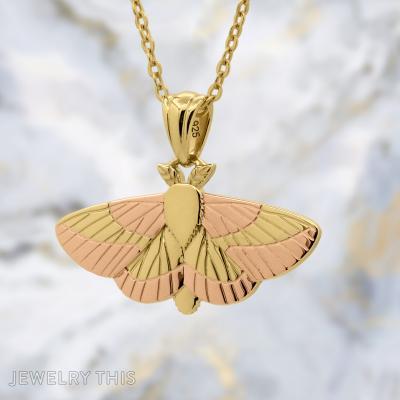
A delicate moth pendant symbolizing transformation and light. Crafted in silver with 14kt yellow and ...

14k yellow gold gazebo pendant featuring starfish accents. Pendant: .75inches tall. Hangs on 14k yellow ...

This is an exceptional custom jewelry cross pendant, that beautifully reflects faith and personal style. ...

This bold gold plated silver pendant showcases a detailed image of Santa Muerte in the ...

This custom pendant intricately captures the silhouette of Africa serving as a tribute to its ...

This pendant translates a black belt logo into a wearable, dimensional piece rather than a ...

This pendant reimagines a favorite low-cost design in sterling silver — a fully three-dimensional skeleton ...

Silver pendant & Gold pendant each with enamel. Client’s unique logo turned into a wearable ...

This 10k yellow gold pendant was built around a client-provided image, translated into a raised, ...



