

Family Tree Pendant With 16 Birthstones in Gold
$$$
14k yellow gold, rhodium-plated leaves, sapphire, mixed natural and lab-created birthstones
A grandfather wanted to map his entire family — himself, his wife, their three children's families, and extended relatives — onto a single pendant, working from a tree of life design he had originally created for his own cane. Over several rounds of sketches he placed each birthstone by hand, leaving a few leaves blank for grandchildren not yet born and tucking two particular stones into the upper branches for a foster daughter he described as someone who "got stuck in the branches" of the family. When it arrived in time for his wife's 60th birthday, he wrote simply: "WOW gorgeous."
'WOW gorgeous, where do I leave reviews' — on delivery
Quick specs
Design type
Primary Metal
Secondary Metal
Shape / Cut
Primary Stone
Accent Stones
Design Complexity
Intent: Certainty
Size
Pendant diameter approximately 40mm (1.5in). Chain 16in anchor style, end-to-end measurement.
How they made it distinctive
-
01
Two intertwined trunks at the base represent the couple at the center of the family, mirroring a tree of life design the client had made for his own cane
-
02
Three main branches each carry a cluster of birthstones for one of the three children's families, grouped by household rather than scattered individually
-
03
Several leaves were deliberately left unset to reserve space for grandchildren not yet born
-
04
Two birthstones were placed together higher in the branches, set apart from the family groupings, to represent a foster daughter the client described as someone who belongs to the family in her own way
-
05
Cut-out detailing lets light through the tree rather than setting it against a solid background, echoing an inspiration image the client specifically chose
-
06
Leaves finished in white rhodium plating against a yellow gold tree, creating contrast without the cost of fully separate white gold castings
How you'd make it yours
Stone type: this piece uses a mix of natural and lab-created birthstones — a new commission could use entirely lab-created stones for a uniform look
Metal: this piece is 14k yellow gold with rhodium-plated leaves — the same tree structure works in white gold throughout or a two-tone rose and yellow combination
Size: this piece is sized at roughly 40mm to fit its full stone count — a new piece is sized to however many family members it needs to represent
Branch structure: the three-branch layout reflects this family's structure — a new commission could use a different number of branches or roots
Chain: this piece uses a 16-inch anchor chain — a new commission could use a different length or chain style
One of a kind: this exact pendant was designed to map one specific family and is not reproduced — a new commission is an original piece inspired by this one, not a copy
Design changes made
The design moved from a medallion-style tree to a true pendant with cut-out detailing after the client favored an inspiration photo that blended engraving and open space. Birthstones were ultimately set into the leaves themselves rather than placed separately on the branches, since the leaf-setting allowed for larger, more visible stones within the available space.
Who this is for
This piece is for someone who wants to hold an entire family — not just one relationship — in a single wearable object. It's especially right if your family doesn't fit a simple mold: blended families, extended relatives, and people who aren't related by blood but belong anyway all have a place in a design like this.
How it's made
Once the layered sketch and stone placement were approved, the design moved into a 3D model, which was printed in wax using a 3D printer and attached to a wax tree inside a casting flask. The flask was fired in a kiln to burn out the wax, leaving a hollow mold, and molten 14k yellow gold was cast into that mold under pressure to form the raw pendant. The client was shown a resin print of the model before casting, so he could see the final form in physical scale before it took shape in metal.
After casting, the piece was cleaned and polished, and the leaves were finished with white rhodium plating to create a contrast against the yellow gold trunk and branches. Each birthstone was then hand-set into its leaf using prongs — a mix of natural stones and lab-created alexandrite, ruby, emerald, and sapphire — with several leaves deliberately left unset to reserve space for future additions to the family.
Key note
Several leaves were cast and finished exactly like the others but left permanently unset, reserving physical space in the metal itself for family members not yet born.
Pricing guidance
A complex cut-out pendant with this many individually set stones sits toward the higher end of custom pendant work. Most of the added cost comes from the sheer number of prong settings required — each leaf is its own small setting — plus the two-tone finishing work needed to plate the leaves separately from the gold tree. Overall size and metal weight are the next biggest factors once the stone count is fixed.
Moves price up ↑
- ↑ Increasing the number of individually set birthstones beyond what's needed for the family size
- ↑ Choosing solid white gold leaves instead of rhodium-plated gold leaves
- ↑ Upgrading the chain to a heavier gauge or longer length
- ↑ Using all-natural stones instead of a mix of natural and lab-created options
- ↑ Increasing the pendant diameter to accommodate more branches or detail
Moves price down ↓
- ↓ Reducing the pendant size, which lowers both metal weight and the number of stones that fit
- ↓ Using lab-created versions of stones where available instead of natural
- ↓ Simplifying the branch structure to fewer main branches
- ↓ Choosing a single metal tone throughout rather than two-tone plating
- ↓ Leaving more leaves unset for future additions rather than setting them all now
Questions people ask
Yes, but it requires careful planning around size. A pendant with a dozen or more individually set stones typically needs to be sized closer to an inch and a half across rather than a standard inch, simply to leave enough room for each setting without overcrowding the leaves. The design usually goes through a sketch and stone-placement phase first, specifically to work out how many stones can realistically fit before moving to a 3D render. Leaving a few spaces unset is also a common solution when the family is still growing.
Lab-created and natural stones of the same type are chemically identical and look the same to the eye — the difference is origin and, usually, cost. Some stones, like amethyst, garnet, topaz, and peridot, are really only available in natural form, while others, like alexandrite, ruby, emerald, and sapphire, are commonly available lab-created. Mixing natural and lab-created stones within one piece is standard practice and does not create a visible inconsistency. The choice is usually driven by availability and budget rather than appearance.
Rhodium plating a gold leaf gives it a bright white-gold appearance at a fraction of the cost and complexity of casting each leaf separately in solid white gold. For a design with many small individual leaves, casting each one in a different metal would significantly increase both the manufacturing difficulty and the price. Plating does wear over time with daily contact, particularly in high-friction areas, and can be refreshed by a jeweler when it starts to dull. It's a standard, well-understood finishing technique for two-tone pieces like this.
A piece this detailed typically takes longer than a standard pendant because of the sketch-and-revision phase needed to finalize stone placement before the 3D design even begins. Once the design is approved, casting and stone-setting production usually takes about four weeks. Sourcing a large number of different birthstones, especially a mix of natural and lab-created varieties, can add time before casting starts. Altogether, a piece like this can take six to ten weeks from first sketch to shipping.
Yes, this is a common request for family-representation pieces. Leaves or settings can be cast and finished exactly like the rest of the piece but left without a stone, so a jeweler can set a birthstone in that spot later without remaking the piece. It does mean the empty leaf will look slightly different until it's filled, but many clients prefer that over leaving a family member out of the design permanently.
Quality birthstone pieces use prong settings, not glue. Prongs are small metal claws that are bent over the edge of the stone to hold it securely in place, and they are the standard setting method for fine jewelry because they hold up to years of daily wear. Glued-in stones are typical of costume jewelry and tend to loosen or fall out over time, especially with any friction or moisture. On a piece with a dozen or more stones, prong setting also lets each stone be individually inspected and re-secured later if needed.
14k yellow gold is a common base for the tree structure because it holds fine cut-out detail well and provides a strong color contrast against white rhodium-plated leaves. The karat affects durability and cost but not the overall look once plated. Sterling silver with rhodium plating is a lower-cost alternative that achieves a similar white-and-yellow contrast using gold plating on the trunk instead of solid gold. The right choice usually comes down to budget and how much metal weight the final size requires.
Check what our clients say about us

David Haberman
3 years ago
All I can say is how impressed I am. From conception to final piece. This was a complicated design. The team at jewelryThis did an amazing job delivering exactly what I pictured.
Explore Similar Creations
Every masterpiece starts with a spark. Explore how our clients raw ideas - sketches, heirlooms, inspirations - were transformed into bespoke works of arts.
This 18k yellow gold pendant depicts a specific desert mountain formation in raised relief at ...

Introducing our innovative 1-inch round Cuban flag pendant in 14kt yellow gold plated silver, showcasing ...

This custom pendant was created in honor of the dedicated service of the Johnson County ...

14k yellow gold pendant featuring mama bear and her two cubs. Custom engraved on the ...

This key-shaped pendant is crafted in 14k white gold and centers on a heart-cut red ...

14k yellow gold pendant featuring name in cutout design. Pendant: .75inches in size. Pendant hangs ...

This 2-inch medallion pendant combines a yellow gold-plated circular frame with a white gold-plated triangle ...

This pendant takes the shape of a mirrored pair of antlers, meeting at a center ...

This exquisite 14k yellow gold pendant is a true expression of faith and devotion. The ...

Sterling Silver chain featuring a pair of Sea Turtles with fins connected. Turtles each: 1/2 ...

This oval-shaped marvel commemorates the journey of engagement. At its core lies a captivating tableau: ...
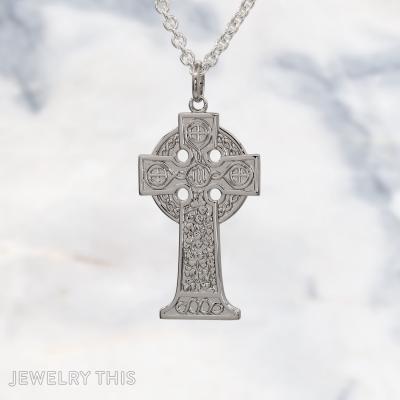
This stunning Celtic cross pendant is a meaningful symbol of faith and heritage, beautifully crafted ...



