Doe and Crescent Moon Pendant — Silver Anniversary Gift
$
Sterling silver
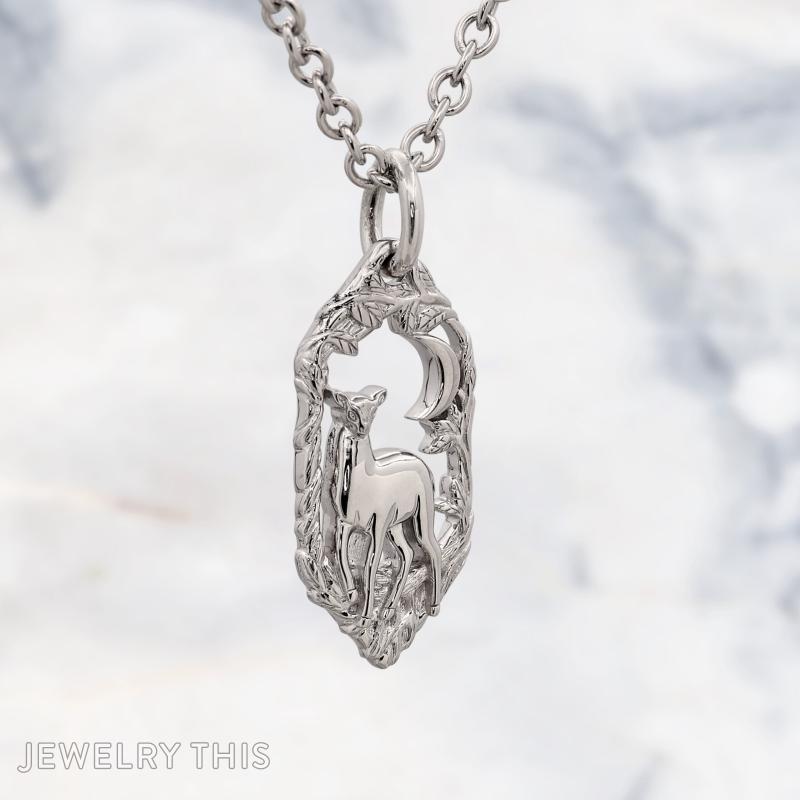
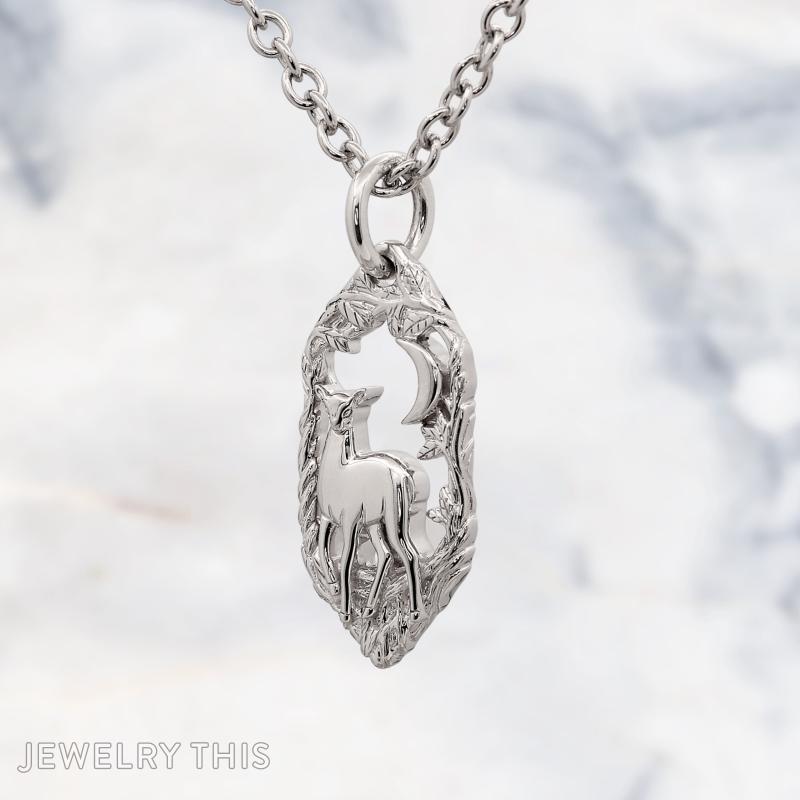
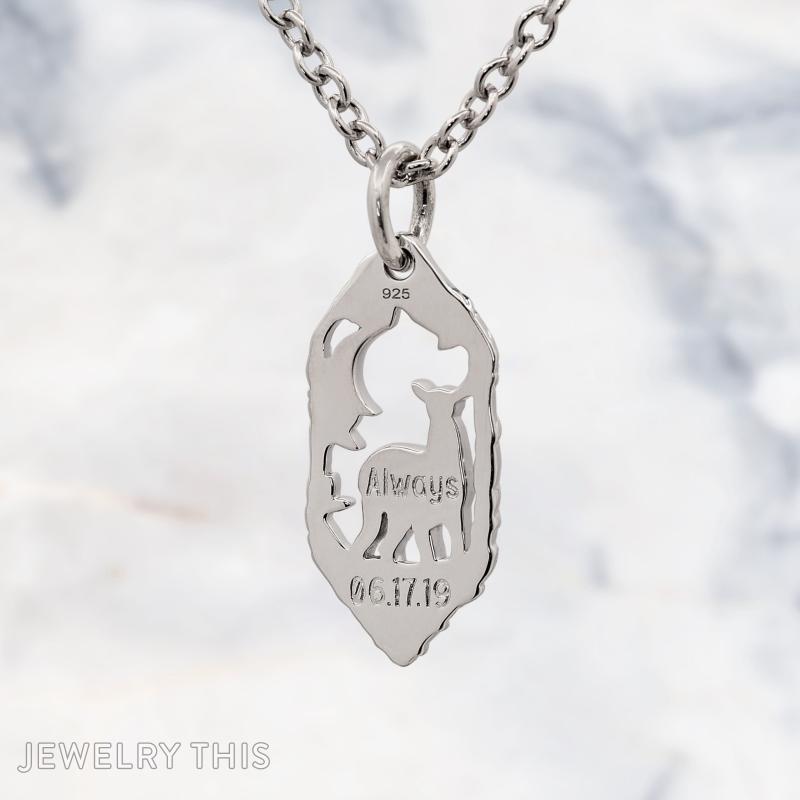
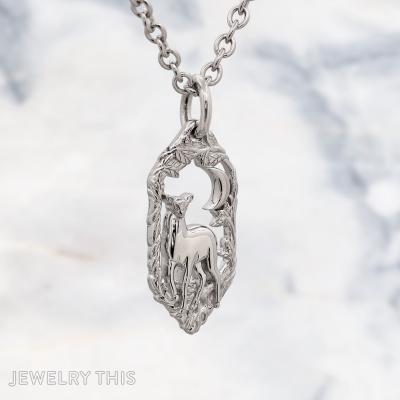
A client wanted an anniversary pendant that captured his wife's love of a particular tragic character from her favorite book series, translated into a doe standing beneath the moon in a small nature scene. The design went through two rounds of revision — removing antlers to keep the doe female, opening up the silhouette so the branches became the frame instead of a solid background — before he approved a version he said was exactly how he'd imagined it. He wrote after delivery: 'It looks wonderful, thank you. I know my wife will love the pendant.'
'This is awesome, I love it! It is exactly how I was imagining, and I'm absolutely ready to take this design to the next step!' — on design approval
'It looks wonderful Tricia, thank you! I know my wife will love the pendant.' — on delivery
Quick specs
Design type
Primary Metal
Primary Stone
Accent Stones
Design Complexity
Intent: Certainty
Size
Pendant approximately 1in (25.4mm) tall. Chain 18in cable chain, sterling silver. Engraved text approximately 2mm tall.
How they made it distinctive
-
01
Antlers were removed from the initial sketch specifically to keep the figure recognizable as a doe rather than a buck
-
02
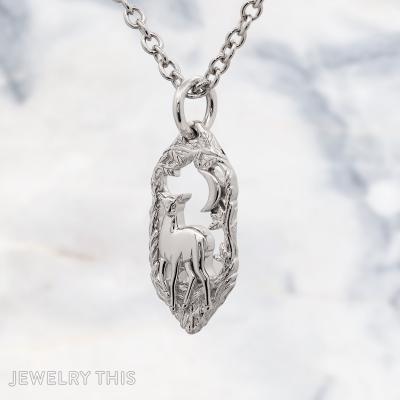
Branch frame opened into a cut-out silhouette rather than a solid backdrop, so the 3D doe and moon read as floating within a nature scene
-
03
Moon positioned to attach directly to a branch rather than floating separately, tying the two elements together structurally
-
04
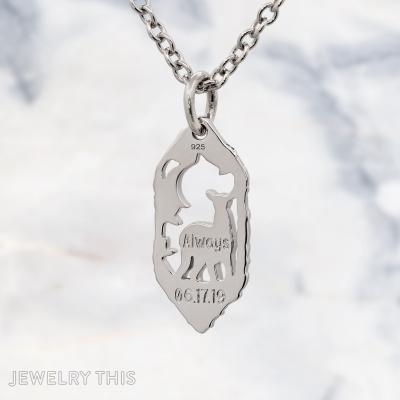
Back engraving intentionally shrunk and repositioned after the front design changed, keeping a personal inscription without disrupting the new open silhouette
-
05
Gemstone eye-setting was explored and deliberately dropped once measurements showed the area was too small to set safely
How you'd make it yours
Stone accents: this piece has none — a new commission could add small gemstones along the border or base where there's enough material to set them securely
Metal: this piece is sterling silver — the same open cut-out design works in 14k or 18k white gold for more durability
Engraving: the back currently carries a short word and date — a new piece could carry a different phrase, name, or symbol
Animal figure: this piece uses a doe — a new commission could use a different animal silhouette within the same branch-frame concept
One of a kind: this exact pendant was designed for one client's anniversary gift and is not reproduced — a new commission is an original piece inspired by this one, not a copy
Design changes made
The doe was changed to remove antlers, the branch background was opened into a cut-out frame so the 3D doe and moon would stand out rather than sit against a solid backdrop, and the engraving was shrunk and moved to fit the new design. Small center stones for the doe's eyes were explored but dropped once the eye area proved too small to set safely.
Who this is for
This piece is for someone who wants a nature-inspired pendant with real dimension, not a flat engraved disc, and who likes the idea of a meaningful detail tucked away on the back rather than displayed up front. It fits someone giving a gift tied to a specific shared reference or memory, where the design itself carries the sentiment more than an obvious inscription does.
How it's made
Once the final render was approved, a wax model of the pendant was 3D printed and attached to a wax tree inside a flask. The flask was placed in a kiln to burn out the wax, leaving a hollow mold, and molten sterling silver was cast into that mold. After cooling, the piece was extracted from the mold and cleaned in preparation for finishing.
Because the design relies on an open, cut-out frame rather than a solid background, the branch edges and leaf detailing were carefully cleaned and refined by hand so the negative space read cleanly rather than looking rough. The doe and moon were finished to a high polish to stand out dimensionally against the more textured branch frame, and the back was engraved last with the short inscription and date, sized down to stay legible within the smaller available space.
Key note
The branch frame was deliberately cast as an open silhouette rather than a solid backdrop, which is why the doe and moon appear to float in negative space rather than sit against a filled background.
Pricing guidance
An openwork 3D pendant with this level of cut-out detail and hand-finishing sits toward the lower end of the mid-range for custom pendant work. Most of the cost comes from the labor of cleaning and refining an open silhouette design after casting, since there's more edge and negative-space finishing than on a solid pendant. Metal choice and chain selection are what move the price most from there.
Moves price up ↑
- ↑ Upgrading from sterling silver to 14k or 18k white gold
- ↑ Adding gemstone accents such as small emeralds or peridot, which requires a larger setting area than this design allowed
- ↑ Choosing a heavier-gauge chain or a longer chain length
- ↑ Adding a second engraved line or a longer inscription requiring more careful hand engraving
Moves price down ↓
- ↓ Simplifying the branch frame to a partial cut-out rather than a fully open silhouette
- ↓ Reducing the pendant size below one inch, which reduces material and finishing time
- ↓ Omitting the back engraving entirely
- ↓ Choosing a lighter-gauge basic chain instead of a cable chain
Questions people ask
Yes, an open or cut-out silhouette is achievable in cast sterling silver or gold, but it requires more hand-finishing than a solid-backed pendant because every edge of the negative space has to be cleaned and refined after casting. The design in this piece uses branch-like edges as a frame around a dimensional figure, which is a good example of how open space can be used deliberately rather than as an afterthought. The tradeoff is that more open designs take somewhat longer to finish by hand compared to a flat or solid-backed pendant of the same size.
Sterling silver is .925 fine silver alloyed with other metals for strength, and it holds up well for regular wear, though it can tarnish over time with air exposure and will need occasional polishing to keep its shine. It's softer than 14k or 18k gold, so very fine cut-out details can be slightly more prone to bending under rough handling than the same design in gold. For a pendant that isn't subjected to constant friction or impact, sterling silver is a reliable and lower-cost option compared to precious gold alloys.
A dimensional, cut-out pendant of this complexity in sterling silver sits toward the lower end of the mid-range for custom pendant work, with 14k or 18k gold versions costing meaningfully more due to material cost alone. The main cost driver is labor — hand-finishing an open silhouette design takes more time than a flat or solid pendant of similar size. Adding a chain, gemstones, or additional engraving will move the price up from the base pendant cost.
It depends entirely on the physical size of the area being considered — in this design, the doe's eye area measured under half a millimeter, which is too small to safely seat even a very small gemstone. When an area is that constrained, the alternative is usually to place accent stones elsewhere in the design, such as along a border or base, rather than force a setting into an area that can't structurally support it. This is something best confirmed once the 3D model is complete, since exact measurements aren't visible until that stage.
The full process from approved design to a finished, shipped pendant typically runs five to six weeks on a standard timeline: about one week for the design phase (sketch, revisions, and 3D render approval), followed by four to five weeks for casting, hand-finishing, and engraving. Design revisions before approval can extend the front end of that timeline if multiple rounds of changes are needed. Once the design is locked in, the production timeline is fairly predictable.
Yes, but the available space depends heavily on the pendant's design — in this case, opening up the front design into a cut-out frame reduced the flat back area available for engraving, which meant the text had to be shrunk to roughly 2mm tall to fit legibly. Cursive or script fonts can still read clearly at that size if kept short, but very long inscriptions may need to be trimmed or reduced to fit. It's worth discussing engraving space early in the design process, since design changes to the front can directly affect what's available on the back.
Sterling silver and 14k white gold can look very similar in color, but they differ in cost, durability, and maintenance — white gold is more durable, resists tarnish better, and costs significantly more due to the gold content. For a dimensional, detailed design like this one, both metals can hold the fine branch and figure details well, so the choice mostly comes down to budget and long-term maintenance preference rather than what the design can support. Sterling silver will need more frequent polishing to maintain its shine compared to white gold.
Yes, this exact pendant was ultimately made without gemstones after the doe's eye area was found to be too small to set safely, and the design reads as a complete piece without them. Cut-out and dimensional details can carry a lot of visual interest on their own, especially when a design uses open negative space and a high-polish finish to create contrast against a more textured frame. Gemstones are a nice addition when the design supports them, but they aren't required for a piece like this to feel finished.
Explore Similar Creations
Every masterpiece starts with a spark. Explore how our clients raw ideas - sketches, heirlooms, inspirations - were transformed into bespoke works of arts.
This gorgeous pendant is a graceful interpretation of a logo, carefully designed to reflect both ...

This stunning circular pendant features a raised border framing the center which is adorned with ...


Exuding luxury and sophistication, this custom pendant is a masterpiece crafted in radiant 14k yellow ...

Fans of the movie Saw will quickly notice this 3D silver pendant inspired by the ...

This Silver pendant is a recreation of a beloved lost treasure. This pendant captures the ...


This distinctive yellow gold pendant captures the mystique of the lunar cycle. Shaped as a ...

This pendant reimagines the sand dollar as a wearable keepsake, cast in sterling silver with ...

This pendant is created in gold-plated sterling silver and is inspired by the American Association ...

This striking custom pendant, measuring 2.5 inches, is a symbol of strength and individuality. It ...

Sterling silver circular pendant featuring silver logo in the center. Background of pendant filled with ...