


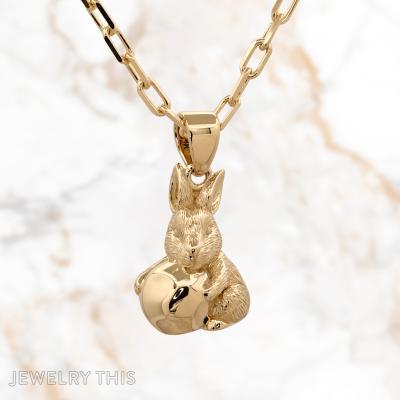


3D Gold Bunny and Pea Pendant — Kids' Nicknames Necklace
$$$
14k yellow gold
A father wanted a single piece that could hold both of his nearly-grown children in one wearable design — a bunny for the son once nicknamed "Bunny," nuzzled against a small uneven pea for the daughter once called "Little Pea." He pushed for a fully dimensional sculpture rather than a flatter, more affordable relief, wanting his wife to be able to hold and turn the piece in her hands. When it arrived just in time for her birthday, he wrote: "arrived, love it!" and confirmed days later, "Presented. And she loves it."
'I think you rocked it! No notes. So much cuter than my concept.' — on design approval
'arrived, love it!' — on delivery
Quick specs
Design type
Primary Metal
Primary Stone
Accent Stones
Design Complexity
Intent: Certainty
Size
Pendant approximately 5/8 inch (16mm) tall. Chain: 18-inch diamond-cut cable chain, 5.04 grams.
How they made it distinctive
-
01
Fully three-dimensional sculpture rather than a flat or half-relief pendant, giving it a tactile, in-the-round quality
-
02
Combines two separate symbols — a bunny and a pea — into one interacting figure instead of two pendants that could tangle
-
03
The pea was deliberately left uneven and lopsided rather than a perfect sphere, so it wouldn't read as a ball
-
04
Cast in multiple gold components and hand-assembled because the fully dimensional shape could not be cast as one piece
-
05
Proportions were adjusted between the two figures so neither child's symbol reads as more prominent than the other
How you'd make it yours
Dimensionality: this piece is fully 3D front and back; a new commission could use a half-3D relief for a similar look at a lower cost
Subject matter: this piece combines a bunny and a pea; a new commission could use any two meaningful symbols or figures
Metal: this piece is 14k yellow gold; the same sculptural style works in 18k yellow gold or white gold
Finish: this piece is high polish; a new commission could use a satin or matte finish to highlight surface texture
Chain: this piece uses an 18-inch diamond-cut cable chain; a new commission could use a different length or link style
One of a kind: this exact pendant was sculpted for one family's two children and is not reproduced — a new commission is an original piece inspired by this one, not a copy
Design changes made
The design shifted from two separate pendants to one combined sculpture of a bunny cuddled against a pea, and from a half-dimensional relief to a fully three-dimensional piece cast in multiple parts and assembled. After the first render, the bunny's muzzle was brought in tighter against the pea and the back leg contours were given more definition to match the original sketch.
Who this is for
This piece is for someone who wants a single object that quietly holds two people they love, rather than two separate pieces of jewelry. It's especially right if you're drawn to sculptural, tactile jewelry that feels like a tiny object to hold and turn over, not just something flat to glance at from across the room.
How it's made
Once the fully three-dimensional design was approved, it was built as a 3D digital model and printed in resin — a physical preview shared with the client before any metal was involved. Because the piece is dimensional on both front and back, it could not be cast as a single shape; it was produced in multiple wax components, each invested in plaster and burned out in a kiln, then cast individually in 14k yellow gold and joined by hand.
After casting, the separate gold components were assembled and cleaned up at the seams so the figure reads as one continuous form. The bunny's fur was carved into the surface for texture, while the pea was left with a smooth, slightly irregular finish to contrast against the textured fur. The entire piece was then finished to a high polish gloss, and the fixed bail was set to balance the pendant so it hangs face-forward on its chain.
Key note
Because the design is fully dimensional rather than a flat relief, the bunny and pea were cast as separate gold components and joined by hand — a more labor-intensive process than a single-cast pendant, but the reason the piece can be held and turned in the hand like a tiny figurine.
Pricing guidance
A fully three-dimensional gold pendant like this sits toward the higher end for custom pendant work, since sculptural, in-the-round pieces require significantly more modeling and casting labor than a flat or half-dimensional design. Most of the added cost comes from producing and assembling multiple cast components rather than a single piece. Metal weight and finish complexity are the next biggest factors after the dimensional construction itself.
Moves price up ↑
- ↑ Making the piece fully 3D on both front and back rather than a flat or half-dimensional relief
- ↑ Increasing the overall size, which adds gold weight and casting complexity
- ↑ Adding gemstone eyes or other stone accents to the figure
- ↑ Choosing 18k gold instead of 14k for a higher gold content
- ↑ Adding a more elaborate chain style or a longer, wider chain
Moves price down ↓
- ↓ Designing the piece as a flat or half-dimensional relief instead of fully 3D
- ↓ Reducing the pendant to a single figure rather than a combined two-figure design
- ↓ Choosing a smaller overall size to reduce gold weight
- ↓ Using a simpler chain style at a shorter length
- ↓ Selecting a satin or matte finish, which can reduce some hand-finishing time compared to high polish
Questions people ask
The gold weight depends on the size and how dimensional the design is — a fully three-dimensional figure uses noticeably more metal than a flat pendant of the same height because it has volume on both the front and back. For a piece around 5/8 inch tall in 14k gold, the pendant itself typically weighs a few grams, with the chain adding additional weight depending on its length and link style. A jeweler can provide an exact weight in grams once the piece is finished, which is useful for insurance documentation.
A flat or half-dimensional pendant can usually be cast as a single piece, but a fully three-dimensional design — detailed on both the front and back — often has to be built and cast in separate components and then assembled by hand. That assembly step, plus the additional modeling time needed to sculpt a believable back side, adds meaningful labor on top of the extra gold required for the added volume. From the front, a well-made half-dimensional piece can look very similar, which is why it's a common way to reduce cost while keeping the same overall design.
14k gold does not tarnish the way sterling silver can, because it contains enough pure gold to resist the surface oxidation that causes discoloration. It is mixed with other metals for durability, which means it can develop very fine surface scratches with daily wear, but it will not turn black or greenish like lower-karat alloys or plated pieces might. A light polish every so often will keep a high-gloss finish looking bright. This makes 14k gold a reliable choice for a piece meant to be worn for years.
Yes, a hand-drawn sketch is a completely workable starting point — it just needs interpretation from a 3D designer who can translate the proportions, gesture, and details into a digital model. The process usually goes through a few rounds of a preview render, since the translation from a 2D drawing to a fully dimensional shape can shift small details like facial expression or limb definition. Clients typically give feedback on a first render and get an updated version before final approval. The end result is often described as capturing the spirit of the sketch rather than a literal copy of it.
On a standard timeline, the design phase — sketch, 3D model, and rendered preview for approval — typically takes about a week, sometimes longer if multiple rounds of revisions are needed. Once the design is approved and production begins, casting and finishing usually takes another three to four weeks. A fully three-dimensional piece with multiple cast components can run toward the longer end of that window because of the additional assembly step. Clients working toward a specific date, like a birthday, should build in some buffer time for shipping.
A high polish finish is buffed to a mirror-like shine and reflects light strongly, which tends to make fine surface details slightly less visible. A satin or matte finish has a soft, non-reflective surface that can make sculpted texture — like fur or engraving — read more clearly, which is why designers sometimes render pieces in matte even if the final piece will be high polish. The choice is purely aesthetic and doesn't affect the durability of the piece. Some clients choose matte specifically because it shows off dimensional detail better in person.
Yes, combining two symbols or figures into one cohesive piece is a common request, especially when each element represents a different person or meaning. The key design challenge is making the combination feel intentional rather than like two separate objects glued together — often this means having one element interact with the other, such as one figure resting against or holding the second. A skilled designer will also work out how the combined shape balances when worn, since an asymmetrical design needs the bail placed carefully so the pendant hangs face-forward.
Yes, this is a standard part of finishing an asymmetrical dimensional pendant. Once the full model is complete, the bail position is adjusted based on where the piece's actual weight balances, rather than being placed in a default center position. This step typically happens after the 3D model is finalized, since the final weight distribution isn't fully known until the design is complete. It ensures the pendant consistently faces forward when worn instead of twisting to one side.
Explore Similar Creations
Every masterpiece starts with a spark. Explore how our clients raw ideas - sketches, heirlooms, inspirations - were transformed into bespoke works of arts.
This beautifully crafted 14K yellow gold pendant captures the unique shape of Kauai, the lush ...

This custom pendant, a miniature mathematical compass, is a tribute to a cherished poem that ...

Within the ethereal beauty of this custom-made pendant, a celestial masterpiece takes form. Fashioned from ...

This custom white gold pendant was thoughtfully designed to preserve and honor a cherished stone ...

This pendant combines two national symbols into a single cut-out design: a crowned white eagle, ...

This stunning 14 karat yellow gold pendant showcases our client’s beautiful Turkizite center stone. The ...


14k yellow gold rectangular pendant featuring the mantra “Just Grace” Pendant: 1.5 inches long

This exquisite multicolored pendant is a masterpiece of elegance. Crafted in yellow gold, the circular ...
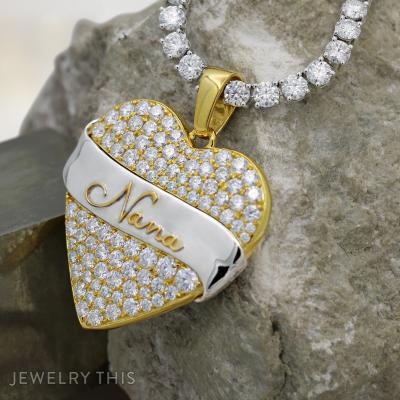
Adorn your neckline with our 1.5-inch heart pendant, crafted in radiant 14kt yellow gold-plated silver. ...

This pendant reimagines the sand dollar as a wearable keepsake, cast in sterling silver with ...

This unique 14K gold pendant features a striking image inspired by a gun scope, intricately ...



