


White Eagle & Celtic Knot Pendant — Two Heritages, One Piece
$$$
14k white gold
J. wanted to honor both sides of his marriage in one piece: his wife's Polish heritage, represented by the crowned white eagle, and his own Irish and Scottish roots, represented by the Celtic knot. He asked for the eagle to be shown clutching the knot, merging both symbols into a single design. When it arrived just before Christmas, he wrote: "Thank you so much. It looks beautiful! She is going to love it."
"Thank you so much. It looks beautiful! She is going to love it." — on delivery
Quick specs
Design type
Primary Metal
Primary Stone
Accent Stones
Design Complexity
Intent: Certainty
Size
Pendant approximately 1in (25.4mm) length. No chain included.
How they made it distinctive
-
01
Combines two distinct national symbols — a crowned Polish eagle and a Celtic triquetra knot — into one unified figure rather than two separate motifs
-
02
Fully cut-out construction lets light pass through the feather and knotwork detail instead of sitting against a solid backing
-
03
Eagle is posed clutching the knot directly, physically linking the two heritages in the composition itself
-
04
Designed without a chain so it could be worn on an existing white gold chain already owned by the recipient
-
05
Switched to white gold after the first render specifically to match the recipient's existing chain metal
How you'd make it yours
Metal: this piece is 14k white gold; the same cut-out design works in yellow gold, rose gold, or sterling silver
Size: this piece is approximately one inch; a new commission can be scaled larger or smaller
Backing: this piece is fully cut-out; a new piece could use a solid backing for a sturdier, lower-relief look
Stones: this piece has no stones; a new commission could add small diamonds or birthstones along the crown or knotwork
One of a kind: this exact pendant was designed for one client's marriage and is not reproduced — a new commission is an original piece inspired by this one, not a copy
Design changes made
The pendant was switched from yellow gold to white gold after the client reviewed the first render — otherwise the approved design and cut-out treatment matched the initial brief.
Who this is for
This piece is for someone who wants to represent two different family backgrounds in a single design rather than choosing one. It's especially right for a couple where each partner carries a distinct heritage, and the goal is a piece that visually merges both rather than treating them as separate halves.
How it's made
Once the design was approved, the team built a 3D CAD model from the sketch and rendered a photorealistic preview so the client could confirm the design before any metal was committed. That model was used to calculate the metal volume needed and to plan the cut-out areas before a wax pattern was produced and invested for casting. Molten 14k white gold was then cast into the resulting mold, producing the raw pendant with its open-worked wings and knotwork already defined by the mold itself.
After casting, the piece was cleaned of investment material and the cut-out sections were cleared and refined by hand to keep the fine lines of the feathers and knot crisp. The eagle's feather detail, crown, and knotwork were then hand-finished and polished to a bright white gold shine, with particular attention paid to the narrow interior edges of the cut-out where casting can leave rough spots. No stones were set on this piece, so the final steps were finishing and polishing only.
Key note
The open cut-out design is planned into the wax and mold itself, not cut afterward, which is why the fine spacing between the eagle's feathers and the knotwork had to be finalized before casting rather than adjusted later.
Pricing guidance
A cut-out pendant combining two detailed symbolic motifs at this scale sits toward the mid-to-upper range for custom pendants of complex design. Most of the cost comes from the labor involved in modeling and hand-finishing an open-worked design with this much fine detail, rather than from the metal itself. Metal choice and pendant size are the next biggest factors affecting the total.
Moves price up ↑
- ↑ Upgrading from 14k to 18k white gold
- ↑ Increasing the pendant size beyond one inch, which adds more metal and more surface to hand-finish
- ↑ Adding gemstone accents, such as small diamonds along the crown or knotwork
- ↑ Choosing a solid backing instead of a cut-out design would reduce hand-finishing but adding one now as a design change would add cost
- ↑ Adding a matching chain in the same metal
Moves price down ↓
- ↓ Reducing the pendant size to under one inch
- ↓ Simplifying the feather detail on the eagle to a more stylized, less literal treatment
- ↓ Choosing yellow gold or sterling silver instead of white gold
- ↓ Omitting the crown or reducing the knotwork to a simpler two-loop design
- ↓ Choosing a solid rather than fully cut-out design, which reduces hand-finishing time
Questions people ask
Yes, combining two symbols into a single unified design is a common request, especially for couples with different heritages. The key is deciding how the elements physically relate to each other — in this case, an eagle standing on and clutching a knot, rather than two separate motifs side by side. A designer will typically sketch a few compositional options before moving to a 3D model so you can see how the two symbols read together. The final cut-out or solid treatment also affects how clearly each symbol is legible.
A cut-out or open-worked pendant has sections of metal completely removed rather than left as a solid backing, so light passes through the open areas. This creates more visual detail and a lighter-weight piece, but it requires more careful mold planning and hand-finishing than a solid pendant. The narrow metal edges around cut-out sections need extra attention during polishing to avoid rough spots. It's a common technique for detailed emblem or crest-style pendants.
A pendant with this level of cut-out detail and two combined symbolic elements sits in the mid-to-upper range for custom pendant work. Most of the cost is driven by labor — modeling and finishing fine open-worked detail takes significantly longer than a simple solid pendant. Metal type and size are the next largest factors; gold costs more than silver, and a larger pendant requires more metal and more finishing time. Getting a firm price usually requires a 3D model, since exact metal volume and labor time aren't known until the design is finalized.
Yes, 14k white gold is a durable choice for a pendant with fine cut-out detail — it holds crisp edges well and resists everyday wear. White gold is rhodium-plated to achieve its bright white finish, and that plating will gradually wear over years of wear, especially at points of contact; re-plating is a simple service most jewelers can perform. Compared to yellow gold, white gold has a cooler, brighter tone that many clients prefer for detailed emblem-style designs. The 14k karat strikes a practical balance between durability and gold content for a piece with this much fine detail.
A pendant of this complexity typically takes four to five weeks from approved design to completion under a standard timeline, covering 3D modeling, casting, and hand-finishing of the cut-out detail. Design approval itself — sketch, 3D model, and render review — usually takes about a week before production even begins. Rush requests are sometimes possible but are not guaranteed, especially around a holiday deadline, since detailed cut-out work requires careful hand-finishing that can't be shortened without affecting quality. Building in extra time for the design phase gives the best chance of meeting a specific date.
Yes, a pendant can absolutely be made and sold on its own without a chain, as long as the bail — the loop the chain passes through — is sized to fit whatever chain will be used. This is common when a client already owns a chain they want to reuse, whether it's a family piece or simply a preferred existing chain. It's worth confirming the width of the existing chain before the pendant is finalized, since a very thick chain needs a wider bail opening. If no chain is specified, the bail is typically sized for standard chain widths.
Yes, a design like this can be adjusted in several ways on a new commission — the size can be scaled up or down, small stones could be added along the crown or knotwork, and the metal can be changed to yellow gold, rose gold, or sterling silver. The proportion between the eagle and the knot is the main structural relationship to preserve, since that's what makes the two symbols read as one combined design rather than two separate pieces. Feather detail and knot complexity can also be simplified or made more elaborate depending on preference. Each of these changes would be planned into a new 3D model before casting.
Explore Similar Creations
Every masterpiece starts with a spark. Explore how our clients raw ideas - sketches, heirlooms, inspirations - were transformed into bespoke works of arts.
This gorgeous rose gold tear drop pendant is the perfect combination of luxury and edginess. ...

This custom pendant features a striking two-sided poker chip design, meticulously crafted in 10k yellow ...

Radiating elegance, this 1-inch pendant features a gleaming heart motif plated in 14kt yellow gold ...

This 14k yellow gold trinity knot pendant is a beautiful symbol of everlasting love and ...

Celebrate artistic expression with our 0.75-inch round pendant. Crafted in 14kt yellow gold, it features ...

Introducing this striking 1-inch unicursal hexagram cut out pendant, crafted with precision in silver and ...
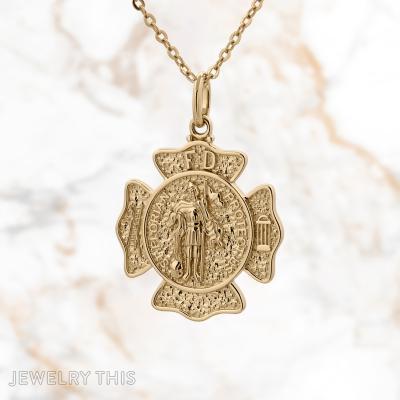
This exquisite custom gold religious fire fighter pendant honors the bravery and dedication of firefighters ...

This Yellow gold zodiac necklace is a radiant tribute to family bonds and celestial connections. ...

This custom key pendant is a heartfelt symbol of commitment and strength, created to celebrate ...

Embrace the enchanting beauty of this custom cloud-shaped pendant created for a special July birthday. ...

Immerse yourself in the ocean’s beauty with this custom pendant inspired by the coral emoji. ...

This pendant was thoughtfully designed as a gift for the client’s daughter, bearing her initials ...



