


Signet Ring with Star and Bar Enamel Detail
$
Gold-plated sterling silver, red-orange enamel
T. designed this ring himself as a personal emblem to go alongside his other creative outlets. He worked with the team to translate his own concept — a star flanked by two bars — into a finished signet-style ring. When it arrived, he wrote simply: 'The ring is splendid. I love it.'
'Thank you so much, it looks really good.' — on seeing the first render
'The ring is splendid. I love it.' — on delivery
Quick specs
Primary Metal
Primary Stone
Accent Stones
Design Complexity
Intent: Certainty
Size
Ring size 7.5 US (17.32mm).
How they made it distinctive
-
01
Entirely self-designed by the client as a personal emblem rather than a studio template
-
02
Flat-top signet table used as a canvas for enamel rather than a traditional engraved crest
-
03
Symmetrical star-and-bars layout creates a graphic, almost badge-like emblem
-
04
Red-orange enamel chosen for strong contrast against the polished gold surface
-
05
Compact, low-profile proportions keep the piece wearable despite its bold graphic front
How you'd make it yours
Stone/enamel: this piece uses red-orange enamel; a new commission could use a different enamel color or a gemstone inset instead
Metal: this piece is gold-plated sterling silver; the same design works in solid 10k or 14k yellow gold
Symbol: this piece uses a star-and-bars emblem; a new commission could use a different personal symbol or initial
Engraving: the inside of the band or the sides of the table can carry a new inscription on a fresh commission
One of a kind: this exact ring was designed for one client and is not reproduced — a new commission is an original piece inspired by this one, not a copy
Design changes made
The ring size was adjusted from 7 to 7.5 during production at the client's request after the design had already been approved. Design matched the initial brief without major changes.
Who this is for
This piece is for someone who wants a ring that functions as a personal emblem — a mark of identity rather than a decorative accent. It's especially right for someone who already thinks visually or works in a creative field and wants jewelry that reads as a considered design choice, not an off-the-shelf symbol.
How it's made
Once the enamel-and-star design was approved, the piece was 3D printed in wax and attached to a wax tree inside a flask. The flask was placed in a kiln to burn out the wax, leaving a hollow mold, and molten gold-plated sterling silver was cast into that mold under pressure. After cooling, the raw ring was removed from the mold and prepared for finishing and cleanup before any color work began.
The flat-top table was polished to a mirror finish first, since the enamel is applied after all mechanical shaping is complete. The star and the two flanking bars were then recessed and filled with red-orange enamel, fired to set the color permanently into the recesses. The shoulders and shank were given a final polish pass last, once the enamel had cured, to avoid disturbing the fill.
Key note
The enamel is fired into recessed channels only after all polishing is finished, since later buffing would risk chipping or discoloring the cured color fill.
Pricing guidance
A simple geometric signet ring in gold-plated silver with enamel detailing sits toward the lower end of the price range for custom rings. Most of the cost comes from the enamel application process and the flat-top casting rather than from the metal itself. Upgrading the base metal or adding stones are the main levers that would move this piece into a higher tier.
Moves price up ↑
- ↑ Upgrading from gold-plated silver to solid 10k or 14k yellow gold
- ↑ Adding a gemstone to the center of the table instead of enamel
- ↑ Enlarging the flat-top table to accommodate a more detailed design
- ↑ Using multiple enamel colors instead of a single color fill
- ↑ Adding engraving to the inside or sides of the band
Moves price down ↓
- ↓ Reducing the number of enamel elements from three to one
- ↓ Simplifying the star to a plain geometric shape
- ↓ Narrowing the flat-top table width
- ↓ Choosing a thinner band profile to reduce metal usage
Questions people ask
Enamel is colored glass powder that is packed into a recessed channel and fired in a kiln until it melts and fuses permanently into place. Once cured, it is hard and resistant to everyday scratching, though like any glass-based finish it can chip if struck sharply against a hard surface. It will not fade or discolor from normal wear the way some plated metals can. Most enamel work on rings like this lasts for years with normal care.
Gold-plated silver means a sterling silver base has a layer of gold — commonly 14k or 18k — applied over the surface. The plating is a thin surface coat, so it will gradually wear thinner with daily wear, especially at high-contact points like the underside of the band. Higher-karat plating tends to hold its color longer than lower-karat plating. Replating is a standard jewelry service when the gold layer eventually thins out.
Yes. This design can be cast in solid 10k or 14k yellow gold instead of gold-plated silver, which removes the plating-wear concern entirely since the color runs through the entire piece. Solid gold is heavier and more durable over decades of wear than a plated piece. The design itself — the flat table, the enamel channels, the squared shoulders — translates directly into solid metal without any changes.
The full process from approved design to finished piece typically runs about four to five weeks on a standard timeline, not counting the initial design phase. The design phase itself — sketch, 3D render, and client approval — usually takes about a week. Once the design is approved and production begins, the ring moves through wax printing, casting, enamel application, and finishing before it ships. Rush timelines are available in some cases but add to the standard schedule.
Yes, this exact ring started as the client's own personal design concept rather than a pre-made template. A custom signet ring can be built around almost any simple geometric or symbolic concept — a star, an initial, a personal mark — translated into a 3D render for approval before anything is cast. The flat-top signet format works especially well for bold, graphic shapes with clean edges, like the star and bars used here.
A simple band like this one can typically be resized within a small range after casting, since the enamel sits on the flat top table and is not affected by adjustments made to the shank. Larger size changes are more involved and should be discussed with a jeweler beforehand. This particular ring was adjusted by half a size during production before any enamel work was finalized.
Enamel is a fired glass fill set into a recessed metal channel, producing a flat, solid block of color rather than the transparency and sparkle of a faceted gemstone. It's typically more affordable than a comparable gemstone and allows for precise, graphic shapes like a star that would be difficult to achieve with a cut stone. Gemstones catch and reflect light; enamel provides a consistent, opaque color field. Both are durable choices for daily wear when properly set or fired.
Explore Similar Creations
Every masterpiece starts with a spark. Explore how our clients raw ideas - sketches, heirlooms, inspirations - were transformed into bespoke works of arts.
This signet ring is filled with sentiment and symbolism. The top surface features a flying ...

This classic14k yellow gold ring is a recreateion of a beloved family heirloom. The ring ...


A heartfelt gesture of sisterly love, this petite ring symbolizes their unbreakable bond. Crafted in ...

This signet-style ring trades the traditional flat engraving table for a fully dimensional skull face, ...

This sterling silver ring carries a raised geometric emblem — a stylized cross-like symbol with ...

White and Yellow gold boxing signet ring with incredible detail. It also includes 4 diamond ...
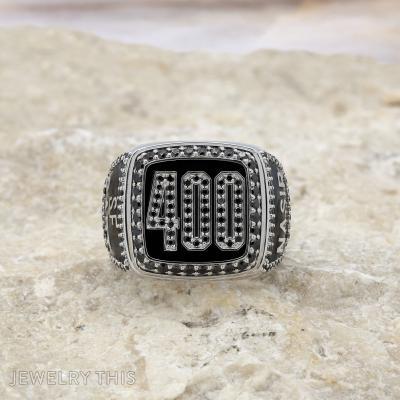
This signet-style ring centers on the number 400 set against a black enamel background and ...

This oval-faced ring was rebuilt in sterling silver with white rhodium plating, recreating a vintage ...

Meticulously crafted in 14K gold, this men’s ring is a stunning combination of classic style ...

This sterling silver ring is a proud symbol of achievement for anglers who have conquered ...

Sterling silver horseshoe ring featuring horse in center of horseshoe. Accented by small colorless and ...



