


Yellow Sapphire Halo Ring Set with Curved Diamond Band
$$$
14k white gold, yellow sapphire, lab-created diamonds
K. came to us with her own oval yellow sapphire and a 15th-anniversary recommitment ceremony to design for. She sent the stone in so the setting could be built around its exact shape, then worked through several rounds of render options — baguettes or no baguettes, a plain band or one with stones — before landing on a curved diamond shadow band that nests against the halo setting. When it arrived, she wrote: 'The ring is stunning. It was more delicate than I had imagined and perfect for me.'
'Yes I love it' — on design approval of the first render
'The ring is stunning. It was more delicate than I had imagined and perfect for me. I really love it.' — on delivery
Quick specs
Design type
Primary Metal
Shape / Cut
Primary Stone
Accent Stones
Style
Design Complexity
Intent: Certainty
Size
Ring size 5¾ US (16.31mm). Two-ring set, approximately 2.5–3 grams 14k white gold each; combined approximately 0.90 ctw lab-created diamonds.
How they made it distinctive
-
01
Setting built entirely around the client's own oval yellow sapphire rather than a stone chosen from inventory
-
02
Curved shadow-band wedding ring custom-shaped to nest flush against the halo's contour
-
03
Tapered baguette diamonds chosen specifically to flank the oval stone's elongated shape
-
04
Client compared multiple render variations — with and without side stones, plain versus stone-set band — before confirming the final design
-
05
VS1 lab-created diamonds used throughout both rings for consistent clarity and cost control
How you'd make it yours
Stone: this piece is built around a client-provided yellow sapphire; a new commission could use a sapphire of a different color or a lab sapphire
Accent stones: this piece uses lab-created diamonds; a new commission could use moissanite for a similar look at lower cost, or natural diamonds
Metal: this piece is 14k white gold; the same halo-and-shadow-band design works in platinum or yellow gold
Side stones: this piece uses tapered baguettes; a new commission could use round accents instead for a softer look
Band design: this piece's wedding band curves to match the halo; a new piece could use a straight pave band if a client-provided stone has a different outline
One of a kind: this exact ring set was designed around one client's own sapphire and is not reproduced — a new commission is an original piece inspired by this one, not a copy
Design changes made
The client requested several comparison renders during the design phase — a version without the side diamonds, a plain band, and a stone-set band — before confirming the original baguette-and-halo design with a curved, diamond-set shadow band to match. The final direction kept the initial setting design and added the custom-fitted band shaped specifically to curve against it.
Who this is for
This set is for someone who already has a stone that means something to them and wants a setting built specifically around it, rather than picking from what's already in a case. It's especially right for a milestone celebration where the center stone itself carries the sentiment, and the design work is about honoring that stone's exact shape and color.
How it's made
Once the design was approved, the ring and matching band were 3D printed in wax and attached to a wax tree inside a flask. The flask was invested in plaster and fired in a kiln to burn out the wax, leaving a hollow mold. Molten 14k white gold was then cast into each mold under pressure, producing the raw rings, which were removed, cleaned, and prepared for finishing.
After casting, each band was polished to a bright white gold finish. The client's oval yellow sapphire was set into the prong halo at the center of the engagement ring, with tapered baguette lab-created diamonds set on either side and round lab-created diamonds pave-set down both shoulders. The wedding band was shaped with a gentle curve along one edge so its own row of pave diamonds sits flush against the engagement ring's contour when the two are worn together.
Key note
The wedding band's curve had to be designed to match the engagement ring's halo contour exactly, since a straight band would leave a visible gap where the two rings meet.
Pricing guidance
A sapphire halo engagement ring with a curved diamond shadow band sits in the mid range for custom bridal sets of this complexity. Building a setting around a client-provided center stone, rather than a stone sourced from inventory, adds design time since the mounting has to be scanned and modeled to the stone's exact dimensions. The band's custom-fitted curve and the number of lab diamonds used are the next biggest cost factors.
Moves price up ↑
- ↑ Upgrading the accent diamonds from lab-created to natural stones of the same clarity grade
- ↑ Adding diamonds around the full halo as a double row rather than a single row
- ↑ Choosing platinum instead of 14k white gold for both rings
- ↑ Extending pave diamonds all the way around the band shank rather than partway
- ↑ Increasing the number or size of the baguette side stones
Moves price down ↓
- ↓ Using moissanite instead of lab-created diamonds for the accent stones, as was offered as an alternative option
- ↓ Choosing a plain wedding band with no diamonds instead of the matching pave shadow band
- ↓ Reducing the halo to a single row of smaller round accents
- ↓ Selecting a lower clarity grade for the lab-created diamonds
- ↓ Sourcing a rounder, simpler-to-set center stone shape instead of a custom oval
Questions people ask
Yes. When a client ships in their own center stone, the jeweler scans and measures the actual stone rather than working from estimated dimensions, since factors like the stone's depth, girdle angle, and corner shape can't be fully determined from photos alone. The setting is then modeled specifically around those measurements so the prongs and halo fit the stone precisely. This process typically adds about a week to the design phase compared to using a stone sourced from inventory. The stone must be received and measured before the 3D design work can begin.
Lab-created diamonds are chemically identical to natural diamonds — same hardness, same brilliance — just grown in a controlled setting rather than mined. Moissanite is a different mineral entirely, with a higher refractive index that gives it more fire and rainbow flash under light compared to a diamond's whiter sparkle. Both are significantly less costly than natural diamonds at the same visual size. For baguette and round accent stones in a halo setting, either option holds up well to daily wear, and the choice usually comes down to whether a buyer prefers diamond's classic sparkle or moissanite's extra flash.
Sapphire ranks a 9 on the Mohs hardness scale, second only to diamond, which makes it one of the most durable gemstones available for a ring worn daily. It resists scratching from normal activities far better than softer stones like opal or moonstone. A halo setting with prongs, like this one, also helps protect the stone's edges from everyday knocks. Sapphires do not require any special care beyond standard jewelry cleaning — warm water, mild soap, and a soft brush.
A sapphire halo engagement ring paired with a curved, diamond-set wedding band falls in the mid range for custom bridal sets. The primary cost drivers are the number and size of accent diamonds, whether the stones are lab-created or natural, and the metal choice. Building the setting around a client-provided stone rather than a catalog stone adds some design time but not significant additional cost. Choosing simpler banding or moissanite accents instead of lab diamonds brings the price down from there.
For a two-ring set like this, the engagement ring design typically goes through its render and approval process first, usually about a week, followed by band design once the ring setting is finalized and the ring size is confirmed. Production for both rings together typically runs around three to four weeks once both designs are approved and the balance is paid. Shipping to a firm deadline, like an anniversary trip, is possible but should be flagged early so production can be prioritized. Overall, allow six to eight weeks from first design to delivery for a two-ring custom set.
Yes, this is typically done by designing the wedding band with a curve or notch along one edge that follows the contour of the engagement ring's halo. The band has to be modeled specifically to the engagement ring's exact shape, since a straight band would leave a visible gap at the point where the halo setting is widest. This is usually finalized after the engagement ring's design is approved, so the band can be shaped to the confirmed halo profile rather than an estimate. The two rings are typically shown together in a render before final approval so the fit can be confirmed visually.
Yes, side stone shape is a flexible design choice in most halo settings. Baguettes give a more linear, architectural look along the shoulders, while round accent stones create a softer, continuous sparkle. The choice affects how the setting reads visually but generally doesn't significantly change the cost unless the stone count or size also changes. This kind of substitution is usually shown as a comparison render during the design phase so the client can see both options before committing.
Renders are built to be a close representation of the finished piece, but there is natural variation between a digital render and the final metal and gemstone under real lighting conditions. White gold in particular can read slightly differently depending on the light source and the rhodium plating. Gemstone color, especially in fancy-color stones like a yellow sapphire, can also shift subtly depending on the exact stone and photography versus real-world lighting. This is a normal and expected difference, not a sign of a design error.
Explore Similar Creations
Every masterpiece starts with a spark. Explore how our clients raw ideas - sketches, heirlooms, inspirations - were transformed into bespoke works of arts.
This sterling silver ring blends delicate beauty with symbolic meaning. The ring features a heart-shaped ...

This beautiful White gold ring is brimming with symbolism to celebrate a marriage of 20 ...
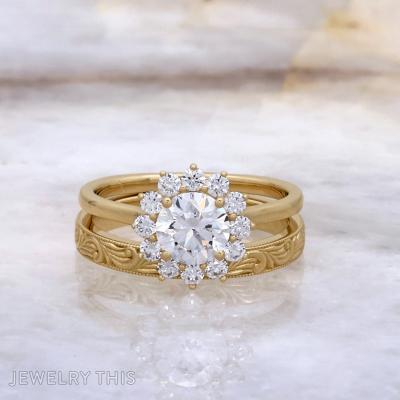
This exquisite 14K yellow gold wedding set seamlessly blends timeless romanticism with modern ethical luxury. ...

This captivating custom engagement ring emanates timeless beauty and exquisite craftsmanship. At its heart lies ...

This elegant white gold ring features a timeless three-stone design centered around a brilliant 2.75 ...

Crafted in white gold, this enchanting engagement ring features an oval diamond at its center, ...

A 2.3carat oval diamond is set into a classic four prong solitaire mount. Adding to ...

This enchanting platinum engagement ring showcases a striking hexagonal-shaped teal sapphire at its center, chosen ...

This custom engagement ring showcases exquisite craftsmanship with a delicately carved poppy design that gracefully ...

This captivating 14K white gold engagement ring features a center 0.75 carat round moissanite.The center ...

This enchanting vine-inspired engagement ring showcases a nature-inspired design, with a 1ct pear-shaped moss agate ...

This engagement ring is built around a twisting infinity-wave band in 14k yellow gold, with ...



